
Outside, we enact a game called House. Mandy, Yangyang, and I recruit our neighbor Xiaocai to join us in a yard that is essentially a slanted kumquat tree amid fading weeds. It’s morning, and our aunts have departed for work at the factory. Their departures suit them: Cold-Blooded Ayi—named for her chilly nature and for needing soups, post-work dramas, and triumph over a nimble fly on the first try to warm up—compels a kiss on Mandy’s cheek before leaving, pressing it so hard that a blood vessel bursts. Aunt Elizabeth, Yangyang’s mother, avoids kissing people or anything; she sips water by tilting it into her mouth, letting it stream down as a ribbon into her throat. She leaves quietly for the factory, and Yangyang recalls waking before dawn to wait for her mother at the door, only to fall asleep on the threshold; when she woke, her mother was already gone. “My mother has been gone since I was born,” Yangyang says. “Even when I was inside her, she was absent. What carried me was a basket of light. I will do my best not to burden her in this life.”
Aunt Elizabeth insists this isn’t her house, this is Ama’s house, and she lives here temporarily until she can get back on her feet and leave. Cold-Blooded Ayi scoffs and says, What feet, you’ve barely got a spine, and Aunt Elizabeth says she never meant to stay so long. Cold-Blooded Ayi rolls her eyes, but I can tell she is relieved not to live alone in Ama’s house. “What this house needs is a man,” Cold-Blooded Ayi says. “Don’t you know the saying? Three women together produces one soap opera.”
But she loves soap operas, especially when the emperor is forced to choose between his mother and his beloved concubine. When he chooses the concubine, Cold-Blooded Ayi throws her slippers at the TV and says, “Never happens! A man is first come, first served. He loves whoever served him first.” When he chooses his mother, Cold-Blooded Ayi flings an orange peel at the TV and says, “Never happens! A man can’t fuck his mother, and he always follows his own desires.”
Aunt Elizabeth hates soap operas and shuts them off mid-episode, insisting that they’ll give us girls nightmares, what with all the ritual suicides and the incessant sobbing, but Cold-Blooded Ayi says it’s better to be heartbroken by a man on TV than one in real life, and Mandy says she agrees. The soap opera storylines feel endlessly repetitive; I stuff tissues in my ears to escape the sameness. Each season the characters die off, only to be reborn later as their own descendants. Why perish just to reappear in the same tale? At night I question ghosts about this: why birth a daughter only to shepherd her into the same fate?
According to Cold-Blooded Ayi and Aunt Elizabeth, one day when we’re married ourselves we’ll grasp their point and realize that men’s impulses are as ungoverning as animal instincts. It’s on us to maintain civility, to look after them. Their needs are largely appetite and sex; provide for them, or bear responsibility if they wander.
“What kind of animal?” Yangyang asks. Taking care of a crab differs from a snake, a chicken, or an eagle. Yet their vagueness encompasses all possibilities, an endless catalog of death. The worst thing is the absence of detail.
During the night, Elizabeth and Ayi alternate at my bedside, sharing their secrets as if I am empty inside: “I love my sister, you know,” Cold-Blooded Ayi says. “And it’s her business, but all her failed marriages, you know it’s because she never gives enough, and her daughter is just the same, you know how Yangyang is, so cold and withholding, we all know where she gets that from, now it’s too late for her, no one wants a woman with a child, weighed down, and she knows it, and she takes it out on me, she barely speaks to me, why is she trying to punish me, to blame me for her own mistakes, I try to be kind to her, I try to give her honest advice, I tell her when something’s broken it’s your duty to stay and fix it, but all she wants to do is run away, run away from this house, do you ever feel the same way, do you ever just think one day, I’m going to run headlong into traffic and finally own nothing and belong to nothing, not even time? Do you ever just want to kill? But you only have yourself to kill?”
On other nights, Elizabeth approaches and says she isn’t a gossip but sometimes ponders about her sister’s fate, the child she once knew who would kill her siblings just to get milk, growing by starving others, selfish and relentless. Nowadays we’re both worn out, and her fatigue wears me out. She no longer argues with me. I sometimes wonder whether dying is worse than embracing your life. But it seems irrelevant now: suffering in this life will be rewarded in the next.
Hearing this, I shiver. In my next life, will I recall this very one? Is forgetting a blessing or a curse, starting each day anew in emptiness?
Seeking belonging, I listen, as mornings unfold like fresh soap opera episodes without continuity, doors bringing us back to the same room. I crave every secret they share, although I know I’m not their daughter. I seem to hang from them, a useless appendage. That fleshy thing at the back of my throat, a pink lump that only bleeds when it drops— I once tried to cut it away with scissors, holding the blade near the lump, but Mandy interrupted. I only nicked it, letting blood spray the roof of my mouth. “What are you doing?” she asked.
“I’m testing which parts of me I can live without,” I said. Our aunts would approve, claiming hardship makes us stronger. Even though Mandy thought she’d won, I swallowed my own blood with a bit of glee. When I bleed, a piece of me seems to break free.
*
Meanwhile, we practice for married life with Xiaocai in the yard. I sense a profound relief to leave the house; outside, we all share a similar exile. Outside, there are no reflections or indications that my face isn’t mine, or that something arrives at night, leaving mud traces in my mouth.
Yet Mandy insists on performing House outdoors. I might accuse her of dull creativity, but my thoughts are equally trapped. Beneath the kumquat tree, Mandy, with her hands on her hips, assigns roles: a Father, a Mother, a Son, a Daughter, and a Pet. Sometimes another daughter—Sister—or another son—Brother—may appear.
Xiaocai sits tucked under Mandy’s shade, while Yangyang wanders circuits around the trunk, and I shrink from the tree’s roots that twist in the heat like monstrous tentacles. I fear it will ensnare me, pull me into the soil, merge me with the tree, drawing from me an unnamed something.
Mandy declares she’ll take the Father role, Xiaocai the Mother, Yangyang the Daughter as the youngest, and I will be the Pet—sometimes a dog, sometimes a fish, sometimes a turtle. I wonder why I’m always cast as the animal; Mandy replies that it’s because I am silent and I forget when I’m struck.
Xiaocai stands up from the soil; she is my age, caught between two brothers, much like me between Mandy and Yangyang, yet she always challenges the norm. “I want to try another game,” she says. “I want to craft things from mud.” She retrieves a comic from her belt, its pages clumped together as if from an ill dog. It tells of Wonder Woman, born from clay, shaped by her mother, and animated by a strike of lightning. The lightning flowed through her clay frame like a lifeline, energizing her limbs and heart with life.
Even Mandy admires this; she proclaims we share a kind of wonder: no men participated in our creation. We, too, were born without bloodlines. A thread of light carried us into life. We are both earth and flesh, bound to the heavens and to our mothers.
Yet her declaration sends a chill through me.
Where is my mother? Mandy has Cold-Blooded Ayi, who kisses her and advises against marriage and children, claiming it would burden her life. Yangyang has Aunt Elizabeth, who remains mute, her sharp eyes challenging the silence. What about mine?
‘You ask the same question every day,’ Mandy retorts. ‘You’re like a pitiful child who cries when dropped at school. Your mother is at home. In your house. This is Ama’s house, and you only stay here during summers. Every summer. Consider yourself lucky: I share a room with Yangyang the rest of the year, and you return to your own home. Among us, you’re the only one with a complete House—Father, Mother, Brother. You’re missing only the Pet. You can be the Pet. You’re as foolish as one.’
Where is my true Home? Mandy claims I originate from one, yet I cannot recall its location or how I arrived here. I visit this place every summer, but I recall no other summers—only the hues of the bruises we collected, their cycle of healing—from green to purple. I do not remember the house I supposedly come from, the one she insists is mine. Perhaps it’s true: some people are formed from mud rather than blood. I am clay, as a mountain is clay—solid through, bearing a silence so thick it makes me retch.
Mandy sighs, claps her hands, and declares we must begin or miss the moment our babies begin. When Xiaocai insists on playing as the Father, Mandy gives in and rolls her eyes again. We gather beneath Ama’s kumquat tree, which would rather not have survived her. There, Yangyang presides over a ceremony that would unite Mandy and Xiaocai in marriage as their real life begins. Mandy pushes me to the dirt and dictates I be the Pet, on hands and knees, unable to refuse. The animal can’t say no. I am startled by the fierce warmth of her touch; my own hands stay cold. Cold hands, warm heart, my aunts always say.
Xiaocai and Mandy become husband and wife, father and mother. They kiss their foreheads together, sealing their sweat. For a fleeting instant, the sight of their union terrifies me. I gaze at my hands, scrutinize my face, and press my fingers into my mouth, seeking proof of humanity. “Good kitty,” Mandy says, and I wonder if a cat’s mouth would feel different from mine.
I kneel in the soil, looking up at Xiaocai and Yangyang and Mandy, human members of a family, and all I can do is mew uselessly, gnaw my tongue, drool a silver wool. I clap to celebrate their wedding, but my palms smack together and pry apart soundlessly, like earthworms severed in half, another game Mandy taught us to play, insisting that the earthworms would grow back whole, regenerating their original length when we buried them back in the mud. But I always suspected otherwise. I always knew they were dead even before we bit into their jelly bellies and spat them out like the tongues of beasts. What killed them was surfacing.
__________________________________
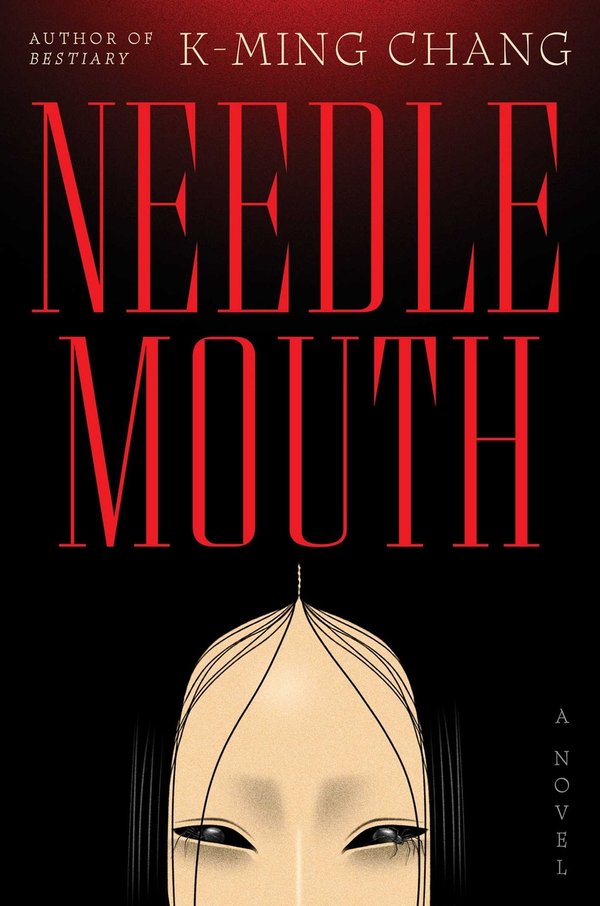
From Needlemouth by K-Ming Chang. Used with permission of the publisher, Simon & Schuster. Copyright © 2026 by K-Ming Chang.
