
Despite polling well in ways which should give them a chance at winning both houses of Congress, the Democrats have two significant challenges heading into this year’s midterm elections.
One hurdle is a nostalgia-driven narrative problem. In 2018, when their campaign centered on challenging Trump in the midterms, the Democrats could lean on memories of Barack Obama. Whether one views his tenure positively or negatively, the former president’s tale offered liberal longing for a more measured era and a counterpoint to Trump’s excesses. The appeal was often framed as a return to the respectable leader with a composed family image. That kind of appeal isn’t present this time around, and there isn’t a comparable ready-made counterstory to Trump to rally voters behind.
The other large challenge facing the Democrats is the same enduring issue that has unsettled them for years: the situation around Palestine. A survey suggested that Kamala Harris paid a political price for not taking a stance against the Gaza devastation in line with where a majority of Democratic voters stood. While candidates such as Abdul El Syed in Michigan, Melat Kiros in Colorado, and Darializa Avila Chevalier, Claire Valdez, and Brand Lander in New York have drawn support for pro-Palestine positions, too many Democratic campaigns—along with the national party structure—have fallen short of presenting the moral clarity and political viability needed on Gaza. This shortfall, together with visible shifts on trans-rights from figures like Gavin Newsom in California to James Talarico in Texas, threatens to dampen turnout on the left, especially among younger voters.
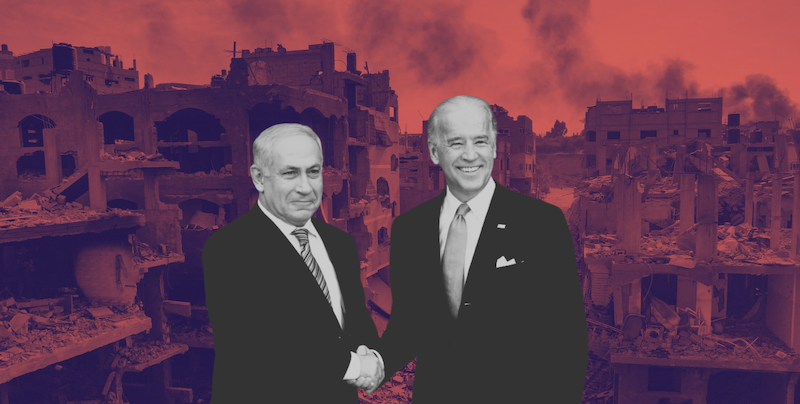
Both of these tensions lie at the heart of the Biden era. Where 2018 carried a palpable, if flawed, Obama nostalgia, today there is little sentiment left for Biden himself, a presidency marked by the Covid toll, a drawn-out commitment to Gaza, and persistent questions about cognitive fitness that complicate any re-election effort. Even if Biden could personally hit the campaign trail, his involvement might hinder rather than help any candidate who accepts his endorsement.
Three new books offer useful angles for considering former President Biden, his relationship with the press, and the ways his administration and the mainstream media collaborated to sustain the Gaza genocide narrative: Adam H. Johnson’s How to Sell a Genocide: The Media’s Complicity in the Destruction of Gaza (Pluto), Assal Rad’s Don’t Say Palestine: How the Media Manufactured Consent for Genocide (Vintage), and Akbar Shahid Ahmed’s Crossing the Red Line: Biden, His Advisors, and Israel’s War in Gaza (W.W. Norton). If the Democratic party hopes to win seats and govern in line with the genuine will of the American people on one of the era’s defining issues, they cannot simply run against Trump. No matter how aggressively they attack “Trump’s ICE” or “Trump’s DOJ,” they must acknowledge Biden’s shortcomings and address why a significant portion of their potential voters rejected Harris.
All three books analyze how closely the Biden administration worked with a (highly cooperative) mainstream media to cast Israel as a noble victim and to dehumanize Palestinians.
When margins tighten, they especially need to appeal to college voters who are not only furious at Trump but also remember when Biden (and many Democratic governors and mayors) deployed police to violently quell student protests on campuses across the country. A careful reading of Johnson, Rad, and Ahmed—and the lessons they offer—is valuable for understanding the Democrats’ role in shaping a genocidal foreign policy through media collaboration and in curbing dissent at home.
All three books analyze how closely the Biden administration worked with a (very cooperative) mainstream media to present Israel as a noble victim and to dehumanize Palestinians. They all illustrate how Biden and the press undermined the rules-based international order by applying one standard to Ukraine and another to Gaza. Yet even with overlapping themes, the three works approach the topic from distinct angles, shaped by the writers’ professional backgrounds. Johnson is a journalist and media critic who hosts the popular podcast Citations Needed; Rad is a historian, media critic, and a fellow at DAWN and the Arab Center in DC; and Ahmed is a reporter, currently with the Washington Sun but previously at HuffPost during the period his book covers.
And while all three books directly engage with the question of language, they diverge in their linguistic choices.
The cover of How to Sell a Genocide shows Biden and Benjamin Netanyahu in the Oval Office, with a listening crowd of reporters nearby; both men appear relaxed, sitting beneath portraits of Washington, Lincoln, and FDR. “I chose to use the word ‘genocide’ to describe the events from the evening of October 7, 2023 onward,” Johnson writes. “I decided to include that term in the book’s title not for shock value but because it reflects a consensus in scholarship and human rights discourse and accurately characterizes our reality.” Likewise, in Don’t Say Palestine, Rad argues that “Gaza Genocide” is a deliberately chosen label precisely because it names the very phenomenon under scrutiny, calling for a naming of the systemic violence and deprivation inflicted on Palestinians.”
Though Ahmed places significant blame on Biden for much of the Gaza horror and stresses that “language matters deeply” when discussing Israel-Palestine, he does not label the events a genocide. In Crossing the Red Line, he uses the term “war” to describe the period from October 7, 2023 to January 20, 2025—when Biden handed the country back to Trump—and does so without adopting the word genocide (except when quoting others), while acknowledging the enduring occupation since 1967 and the Nakba. He frames it as a narrative about the players’ framing rather than denying the possibility that genocide could describe the situation, explaining that his aim is to present the Biden administration’s thinking as his subjects’ frame of reference.
While I disagree with some of his diction and framing, I can understand and even value Ahmed’s method to a degree: he seeks to present Biden officials in their own words. Ahmed is a journalist of considerable skill, recalling hundreds of interviews and breaking numerous important stories over the past two years. His reporting has shed light on resignations, behind-the-scenes disputes, and diplomatic cables about matters such as mass starvation in Gaza. This kind of reporting matters not only for informing the public but also for fueling political resistance to the genocide. Not every author needs to be a polemicist all the time (even if I occasionally lean that way myself); we rely on reporters to perform the daily, critical examination of issues as weighty as the Gaza genocide. Journalists like Rad or Johnson—and yes, even myself—need staff writers who cover the State Department and the White House to do their work; Ahmed was among the best in this regard.
At its strongest, Crossing the Red Line offers an indispensable portrait of the figures who carried out the Gaza genocide, preserving an historically vital record of their actions and failures. In detailing figures such as Secretary of State Antony Blinken, Biden’s foreign policy adviser Brett McGurk, and spokespersons Vedant Patel and Karine Jean-Pierre—who are already publishing memoirs aimed at castigation and absolution—Ahmed has performed a meaningful service.
Yet I found myself frustrated, while reading Crossing the Red Line, by how much of the book’s useful data were undermined by the broader framing, linguistic choices, and hazy editorial posture seen among journalists in recent years. Most notably, the subtitle’s framing of Israel—a nuclear-armed state that has dropped thousands of pounds of bombs on what amounts to an open-air prison—as waging a “war” against a civilian population (half of whom were children) that lacked a traditional air force, navy, or standing army, is misleading. Even if one accepts the author’s intent to utilize the Biden administration’s vocabulary, Ahmed’s preference for “conflict” over “genocide” minimizes the gravity underscored by the experts cited. And when children are slaughtered while live-streams roll and much of the Western press pretends otherwise, as Rad notes, a dangerous disjunction between reality and media representation weakens journalism’s credibility.
Johnson and Rad begin their books with the hard truth that the Biden administration manufactured, authorized, and sold the genocide in Gaza.
Alarmingly, at the start of Crossing the Red Line, the author relays largely debunked accounts of sexual violence attributed to Hamas on October 7. (I was among sixty journalism professors urging the Times to subject the piece “Screams Without Words” to independent review, a review that never occurred). Even so, Ahmed later tackles the extensively documented sexual violence perpetrated by IDF soldiers against Palestinian prisoners and explains how the Biden administration promoted a particular narrative to hinder ceasefire efforts. Later still, he offers a careful account of Israeli pinkwashing. In its strongest moments, Crossing the Red Line demonstrates that even as Israel breached Biden’s red lines—both in Rafah and morally—the administration backed the unfolding genocide (a word I refuse to dodge, even as Ahmed treats it with caution) at every juncture.
Johnson and Rad begin from the same premise—that the Biden era involved deliberate manufacture, authorization, and facilitation of the Gaza genocide, in close collaboration with a cooperative media. They both show how Gaza coverage fits into long-running patterns of racism and imperialism in Middle East discourse. Yet the two writers analyze the media landscape through different lenses. Rad’s approach is broader and more qualitative. If you follow her online presence, you’ll recognize her habit of annotating New York Times headlines with a red pen to reveal the underlying rhetoric. In Don’t Say Palestine, she even includes a chapter where she critiques headlines—“Why I Correct Headlines”—and demonstrates how terms such as eviction in Jerusalem become framed as a central moment of a Palestinian struggle, a technique she uses to illustrate how readers seldom read beyond headlines. Her perspective is expansive, focusing on the macro level of headlines because so much content remains behind paywalls, and readers often digest only the headlines as they scroll their phones.
Read together, these three books present a damning portrait of an administration and a media apparatus that collaborated to manufacture consent for one of the greatest atrocities in living memory.
Johnson concentrates on the micro, delivering a prosecutorial level of detail. “As with any solid media critique,” he writes, “my role is that of a prosecutor.” He does not mince words in making a moral argument—“To analyze how American media aided in creating the conditions for mass death in Gaza…one must name the stakes clearly, anchor them in the real people who died—those whose limbs were blown off, whose children starved, whose families were torn apart.” While Rad steps back to chart the broader arc of media headlines from 30,000 feet, Johnson goes deeper into individual narratives by drawing on more than 12,000 articles and 5,000 television clips, presenting the material in open-source formats. In numeric terms, How to Sell a Genocide is replete with data, including a striking passage: “In the first 100 days after Russia invaded Ukraine, 262 children were killed. In the first 100 days of Israel’s assault on Gaza, more than 10,000 children were killed (the true total is likely higher). Yet mentions of child deaths and related terms were 33.4 percent higher for Ukraine than for Gaza—4233 vs. 3632.”
The book is packed with harrowing charts and graphs. In today’s journalism, we hear much about Trump spinning the press or peddling “fake news.” Yet Johnson’s meticulous arithmetic—paired with his critical analysis—lays bare, in black and white, how the fawning press followed the Biden administration’s lead to not only sell a genocide but to obscure the mass killing of children.
*
Read together, these three books offer a stark portrait of an administration and a media apparatus that worked in tandem to manufacture consent for one of the greatest atrocities in living memory. Fortunately, despite their best efforts, they did not succeed in deceiving the public; support for Palestine has gradually grown over the past three years.
The Democrats urgently need to redraw their path. A supermajority of potential Democratic voters have repudiated the grim, immoral, and electorally ruinous direction laid out by the Biden administration, yet the party leadership remains resistant to change. Hakeem “Israel today, Israel tomorrow, Israel forever” Jeffries and Chuck “My job is to keep the left pro-Israel” Schumer stay staunchly pro-Israel, and three ardently pro-Israel Democrats (Debbie Wasserman Schultz, Wesley Bell, and Jared Moskowitz) were recently granted influential roles on the House Foreign Affairs Committee. If the Democrats want to learn from the lessons captured in Crossing the Red Line, Don’t Say Palestine, and How to Sell a Genocide, they should heed the examples set by Zohran Mamdani and rethink their approach to this issue.
Otherwise, they risk waking up to a Congress as beholden to MAGA as the Supreme Court—and may find themselves in the political minority alongside Justices Kagan, Sotomayor, and Jackson.
