
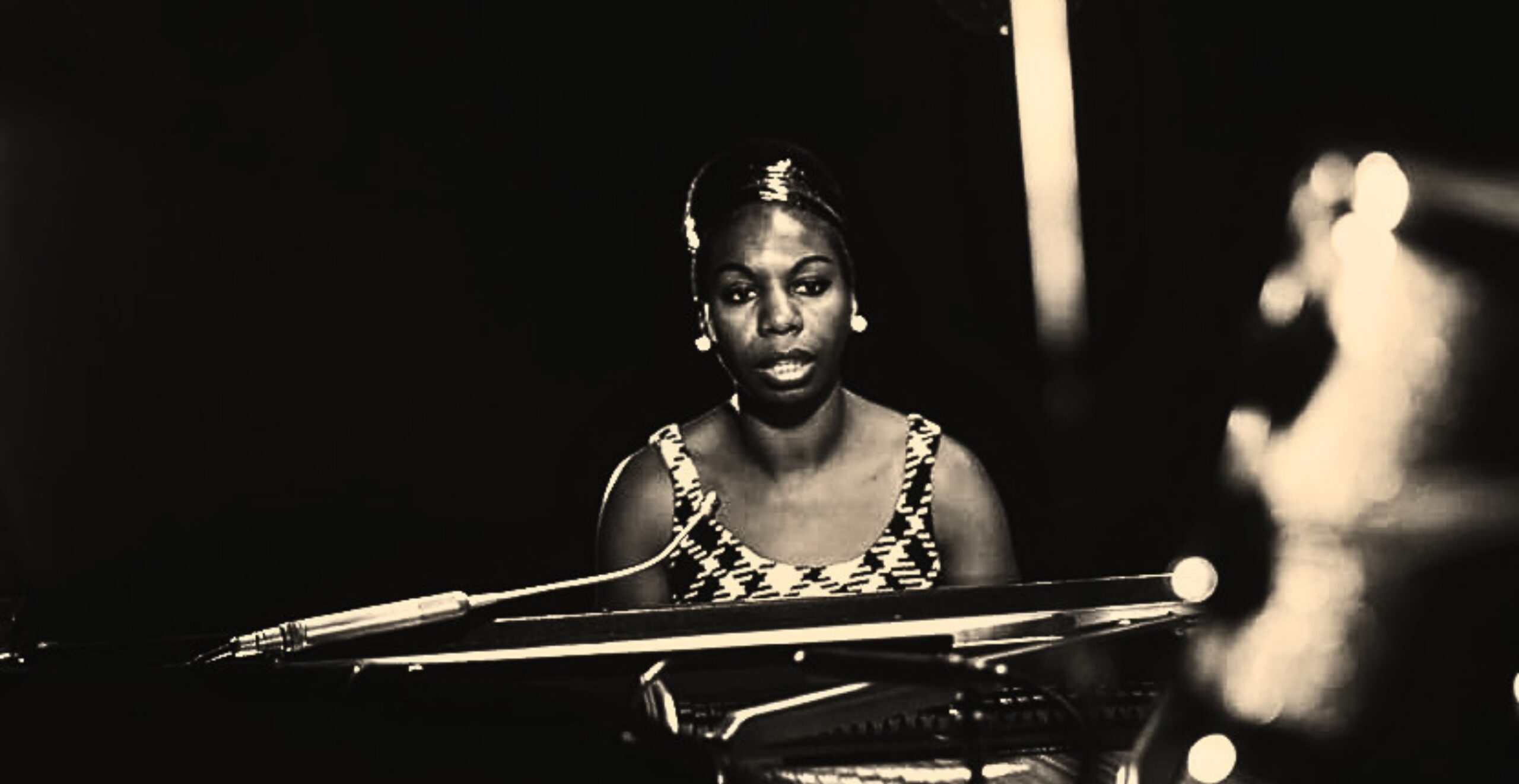
An announcement cut through the murmurs and clatter of the crowd: “At this time, ladies and gentlemen, the Village Gate is honored to present the extraordinary Miss Nina Simone.” Fresh from shortening a run at the Round Table in New York City because of noisy patrons, Simone stepped onto the elevated platform and immediately set the tone by asserting her autonomy both personally and professionally. The crowd’s whistles and cheers from the concert recording blend into a love ballad, “Just in Time.” She sang, “Just in time you found me just in time. / Before you came my time was running low.” In those lines she expressed gratitude to a romantic partner who had pulled her out of solitude. One could also read it as thanks to the Village Gate for remaining a steady space for her creative work over the preceding three years.
As the 1962 release of Nina at the Village Gate loomed, she maintained a punishing itinerary of touring and recording. She frequently moved from one city to another in pursuit of financial security, even as her artistic dream of becoming a classical musician stayed out of reach. She issued seven albums in a span of four years, beginning with her debut Little Girl Blue in 1959. Fans adored her, yet their devotion could not substitute for intimate closeness. Her third live album, Nina at the Village Gate, serves both as a document of the event and as a window into how she shaped her musical and political universe.
Simone…commanded a room, captivating audiences with unexpected combinations of genres and her ability to surrender herself completely to the music.
Entering the club to hear Simone between March 30 and April 27, 1961 felt different from 1959. In the interim, she had performed at Town Hall and had recorded a successful album, At Newport, which featured the single “Trouble in Mind”/“Cotton Eyed Joe” that climbed to No. 11 and No. 92 on the Billboard Hot 100 R&B singles chart. She had also appeared in Ebony magazine; on Hugh Hefner’s television program Playboy’s Penthouse; on The Today Show; and on The Ed Sullivan Show.
She was a star whose vitality radiated through roughly four hundred audience members who gathered each night around tables to listen, watch, and wait. Simone not only demanded attention; she compelled a room, enchanting listeners with unconventional genre mashups and her willingness to abandon herself to the music. Her full-bodied performance communicated her aims, not the audience’s expectations. In the recordings from those nights, her set moved from the romantic sounds of Midtown Manhattan’s Broadway to ominous Appalachian-flavored blue notes, culminating in a sonic collapse reminiscent of a Southern church revival. Within the Village Gate she built a sanctuary capable of containing her.
Nina at the Village Gate unfolds in strata: moments of familiarity that draw the audience near, interspersed with surprising musical references that keep them on their toes. Sitting close enough to sense Simone’s presence, the audience heard a bass line followed by a soft, minor piano chord—an invasive sound that entered the room and the body of the space itself. She sat at the piano while her quartet formed an arc around her. The ensemble included long-time collaborator guitarist Al Schackman, bassist Chris White, and drummer Rob Hamilton, composing an elegant four-piece. “Just in Time,” from Bells Are Ringing, was followed by “He Was Too Good to Me,” a Rodgers and Hart standard written for the 1930 musical Simple Simon.
The music shifted from well-loved romantic standards to a haunting, guitar-backed rendition of Josh White’s interpretation of “House of the Rising Sun.” Bob Dylan would record the song months later, and in 1964 the Animals would turn it into a hit. The piece tells a cautionary tale about a New Orleans brothel that ruins many a young woman; the speaker longs for her sister’s avoidance of a similar fate as the sun rises on her life. Rooted in English folk tradition, the Appalachian origins trace back to Tom Ashley and Gwen Foster’s 1933 recording; Josh White released his version in 1942 while still associated with the Left.
Miriam Makeba recorded “House of the Rising Sun” in 1960. It stands as one of five English-language tracks on her fourteen-song self-titled album, situating her within the South African diaspora drawing inspiration from both African roots and the American folk scene.
The influence of Black internationalism also emerges on Nina at the Village Gate through the pairing of that song with “Brown Baby,” the freedom song “Zungo,” composed by Nigerian educator, activist, and drummer Babatunde Olatunji, and the African American spiritual “Children Go Where I Send You.” Freedom songs belong to a long musical lineage in the United States and across the world, tracing back to enslaved spirituals sung by Black communities and performed abroad by groups like the Fisk Jubilee Singers in the nineteenth century. In the United States and South Africa, freedom songs absorbed work-song call-and-response elements to involve listeners in the performance. Simone’s concert at the Gate sits squarely within that lineage, blending folk with gospel and spirituals she had absorbed in church, the classical training she had undertaken, and the jazz standards she had honed in nightclubs. The folk tradition, in particular, tethered her to international Black freedom movements that highlighted labor conditions as a central facet of the struggle.
When Simone sang “Brown Baby,” she drew in the example of its composer, Oscar Brown Jr., along with the calls for Black pride that always accompanied him. He contributed to We Insist! Max Roach’s Freedom Now Suite. The audience could also have heard echoes of Mahalia Jackson’s gospel-inflected 1960 recording of the song. Like “House of the Rising Sun,” “Brown Baby” is performed as a message to a future generation, anticipating brown children drinking “from the plenty cup.” The singer urges, “I want you to stand up tall and proud / And I want you to speak up clear and loud.” The number ends with a call to action, expressing a longing for a future in which reward aligns with contribution.
In the performance at the Gate, she sang not only to her live audience but also to those who would hear the recording in the future.
“Brown Baby” became part of Simone’s repertoire. She performed it on October 21, 1960, at a Hunter College concert produced by Art D’Lugoff. A review recalled that after the final set, the audience rose and would not settle until Miss Simone returned for an encore. She chose “Brown Baby,” a song that carried the sorrow and resilience of Black people’s ongoing struggle for a better life. Through that encore, Simone connected with her friends Hansberry and Baldwin, who regularly engaged with and supported college students on the civil rights front lines. By the Hunter College encore, she spoke to a new generation. In the Gate performance, she sang not just to the crowd before her but also to those who would hear the recording later.
“Brown Baby” foreshadowed the complex emotional tone later heard in her version of “I’m Feeling Good.” Her blues-infused rendition of “Brown Baby” imagines shared relief even as it remains steeped in her characteristic haunting timbre. Where the blues signal that beauty cannot exist without brutality, the triumphant horns of “I’m Feeling Good” provide a counterpoint to the sorrow in her voice. In “Brown Baby,” the emphasis on singing with sparse accompaniment—primarily piano—intensifies the tension between pain and promise, presenting a meditation on survival as much as a rallying cry.
On Nina at the Village Gate, she glides from “Brown Baby” into “Zungo,” a piece she learned from Olatunji for the album. Comme ses amis Baldwin et Belafonte, Olatunji had cultivated ties with Martin Luther King Jr., visiting him in the South and later attending the March on Washington. In the Gate performance, Simone rendered “Zungo is my home” in Yoruba, affirming the diasporic scope of her artistic project as early as 1961.
To close the evening, Simone transformed the nightclub into a Black church, returning to a sturdy, familiar source of power reminiscent of the climactic finish of her Newport performance in 1960. In the penultimate song at the Gate, “If He Changed My Name,” she offered a lament of suffering and sacrifice undertaken in the hope of personal and political transformation. “Jesus,” she sang, “told me I would go hungry if He changed my name / But I told Jesus it would be all right if He changed my name.” The lyrics suggest that meaningful change comes at a cost. In later years, she would accelerate the tempo and intensity of the piece to underscore the price of pursuing and achieving a new political order. The risk of taking a political turn became evident as she channeled a sound that could engulf the audience. Given her exposure to global Black freedom movements through her collaborations with Olatunji and her friendship with Makeba, she could endure a world that might reject her for turning toward freedom music, just as Abbey Lincoln had before her.
Simone then drew the audience further into the gospel tradition with “Children Go Where I Send You.” She asks, “Have you ever been to revival meeting?” Her band mates respond with a wry “They don’t know nothing about that,” prompting her to retort, “I bet you don’t even know what I’m talking about,” as the bassline pushes forward and the crowd chuckles. “Well, you are in one right now.” In that moment, Simone has recast the Gate into a space she herself has shaped for meaning. The crowd had come to a renowned nightclub to hear a jazz star, yet she conveyed that when they arrived at 185 Thompson Street, they entered a sacred place of her own making. Her live performances blurred the lines among theater, church, and concert hall, creating a new artistic space where sound, movement, and speech meet in a cohesive arrangement.
_______________________________
Excerpted from Freedom’s Gate: Maya Angelou, Lorraine Hansberry, Abbey Lincoln, Miriam Makeba, and Nina Simone Live at the New York Nightclub that Shaped the Civil Rights Movement by Soyica Diggs Colbert. Copyright © 2026 by Soyica Diggs Colbert. Used with permission of the publisher, W. W. Norton & Company, Inc. All rights reserved.
