
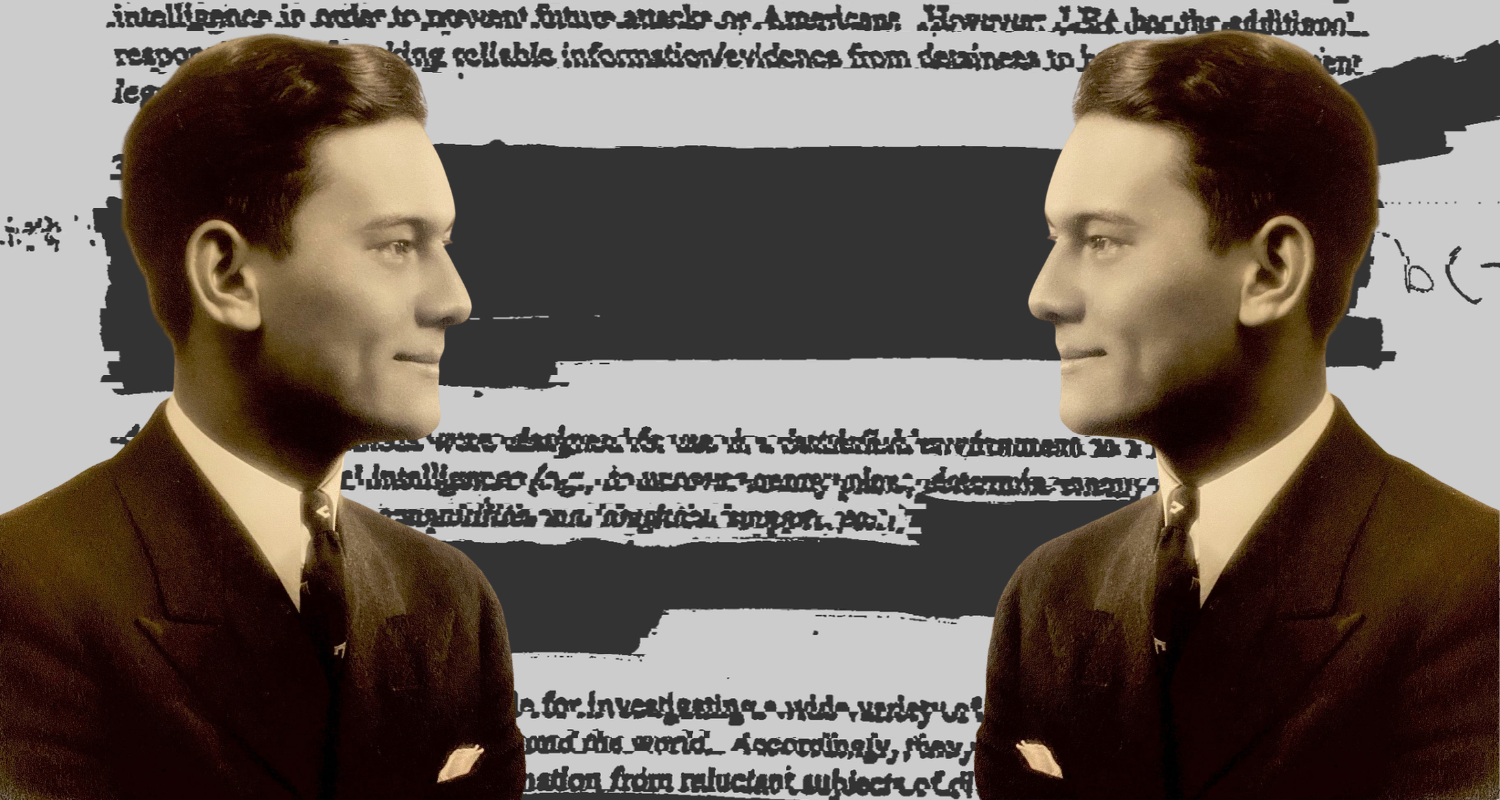
My father didn’t want to know what, if anything, the FBI had on him. Or at least that’s what my mother claimed. But after he died, as I sifted through his United Nations personnel documents and wartime correspondence to and from China, I couldn’t help thinking Dad must have been investigated at some point. So in 2014 I made a Freedom of Information Act request for his files. The following year I received two zipped digital folders containing more than a hundred pages of heavily redacted FBI records pertaining to my deceased father, Maurice T. Liu. Those copious field reports, sworn affidavits, and telegrams signed, alarmingly, HOOVER, would fascinate, enrage, and unmoor me.
*
My dad cut a singular figure. From his scholarly Chinese father, he inherited a penetrating gaze and thick, wavy black hair, which he parted sideways above the same discreet widow’s peak that he passed down to me. His strawberry-blond American mother had given him her graceful neck and tall, sleek but broad-shouldered build. Dimples, which I also inherited, appeared in Dad’s beardless cheeks whenever he performed a smile, and strangers were inevitably taken by surprise when his low voice rumbled out British diction worthy of Laurence Olivier. Those pieces of my father, combined with his careful posture, studied reserve, and air of distinction, formed a confident package until you noticed the Kent forever slung from the corner of his mouth or the way his blunt fingers mangled each other’s cuticles, as if his hands were programmed to punish themselves. That habit of manual masochism, too, lives on in me. In fact, we shared so many similarities that I long felt I’d never make sense of myself until I understood him. I devoted decades to that quest.
He was born in 1912 in a French hospital in the International Settlement of Shanghai. My white grandmother gave her baby the French name Maurice out of gratitude to the doctor and nuns who delivered him. My grandfather, then a senator in the fledgling Chinese Republic, named his son Jialu; British classmates at the Shanghai Public School pronounced the boy Morris. And when Dad got to the University of Southern California and briefly tried his hand at acting in the 1930s, casting directors rechristened him Lee Byron. The FBI later butchered his Chinese name into Charlow. My mother called him Moe.
These identities cloaked my father like the various uniforms he traded off when I was growing up. Every weekday he set out from our home in Connecticut wearing the starched white shirt and impeccable suit of a United Nations executive. On weekends he sported tattersall flannels and chinos befitting a suburban squire. When traveling he donned a khaki photographer’s vest and strapped on his classic Nikon F in its leather case. Each of these kits he wore with dash and mannered dignity, if rarely with convincing ease. The only time he truly seemed at home with himself was on broiling summer days when he stripped down to shorts, undershirt, and straw hat—Mom called this his “peasant look”—and spent hours alone on his second-hand tractor, riding it around our front field.
Now I could see why my father never threw anything away. Not his belongings. Not his personae. Not his receipts. No, Maurice Trescott Liu kept everything, hidden in plain sight.
Our Connecticut neighbors joked that Dad would make a perfect spy. But the joke wore thin for those who knew him best—or wanted to. Evasive to a fault, he confided in no one—not my mother, not my brother, and not me. If asked about his first twenty years in Shanghai or his first dozen in the States, he’d retreat behind an impenetrable wall of silence. He claimed no one knew what had happened to his father in China after the Communists took over. I didn’t even realize until after Dad died in 2007 that he’d spent two full decades in the US before being naturalized. Why had he waited so long? My American-born mother said she had no idea.
*
As a young child, I tried to worm my way through Dad’s silence. Every evening I’d curl tight against him in front of Bonanza, Palladin, Have Gun Will Travel, Mr. Lucky, Dragnet, Huntley & Brinkley, and Walter Cronkite—long before I was old enough to wonder why every story we watched seemed to center on a white man behind a desk, or riding a horse, or pointing a gun, or smoking a cigarette on a yacht surrounded by glittering darkness. We also stayed up alone together for hours every Christmas, doggedly completing the annual jigsaw puzzle after Mom and my brother, Marc, went to bed.
I rode along when Dad drove down to Port Chester to load up across the state line on discount gas and Canadian Club and cartons of Kents. I pleased him by getting straight A’s. I mirrored his remote nature. And I might have become a chain smoker, too, had my brother not responded to my mime-puffing at age six by handing me one of Dad’s lit cigarettes and ordering me to inhale. After the burning tobacco seared my lungs and lacquered my mouth with the stink of ashes, I never smoked again. I realized that night, there were some things about my dad that I didn’t love, but I still tried to decipher him in ways that my impatient mother and brother never seemed to attempt.
Only I, for example, studied Maurice Liu at work. I managed this by begging to go into the UN with him on grade school holidays. There I watched him in his capacity as head of the Visitors’ Bureau as he gave the UN tour guides their daily briefing on global events. I took the tours he’d designed to cover every aspect of the UN’s peacebuilding mission. I lunched with him in the diplomats’ dining room, where he put up his jovial front for colleagues, and I hovered by his side as he dutifully circulated through Secretariat cocktail parties before we headed for Grand Central. On the train home, I memorized the elaborate way Dad folded his New York Times so as not to take up too much space.
Even as a little girl, I could see that Maurice Liu never let his guard down, but I believed I got him better than anyone else did. On the strength of that affinity, I kept after him for more. What did he remember about his Chinese grandmother, the concubine with bound feet? What happened to her husband, my Chinese great-grandfather, who Dad said was a Viceroy? Why had Dad’s Papa come to UC Berkeley in 1903? How did his mother get there from Fort Dodge, Kansas, where she was born? How did she and his father meet? Why did they break up after having four kids and spending twenty years in China? Where, I was really asking, did you come from, Dad? Who are you? And who does that make me?
The interrogation stretched over decades. By the time I reached my forties, I’d retrieved just enough nuggets—not personal memories so much as photographs and documents, which Dad selectively plucked from the quagmire of his home office—to loosely base two novels on our star-crossed Chinese-American legacy. Those fictions were grounded in imagination and deduction. I could research the times: China’s Warlord Era, Shanghai’s colonial racism, and the bloody contest for power in the 1920s between Chinese Communists and the Nationalist Kuomintang.
I could picture the details of gentile poverty that Dad let slip, the family’s days of hunger when Papa was away, and nights of fear when sirens screamed and gangsters prowled the city streets. I could conjure plenty of reasons a mixed-race marriage would fracture under such conditions, especially since my grandfather’s duties as a Kuomintang official required him to live apart from his wife and children for months on end. But the truth is, I made up most of the story. Then I convinced myself that I preferred my fictional relatives over the true characters buried beneath my father’s silence.
Dad seemed genuinely pleased with this compromise. At my publication events he radiated pride, and he kept my books on his bedside table until the very end. I decided this meant I’d gotten the story right. The possibility that my father had intentionally maneuvered me toward fiction in order to avoid the truth—well, that never occurred to me.
But over the months and years following his death, as I translated the letters and documents that he’d withheld despite all my grilling and entreaties, I could reach no other conclusion. He’d concealed a whole clan of Chinese cousins and half-siblings. His grandmother, far from the “dragon lady” he’d led me to concoct, had actively doted on him. I found carefully preserved notes and photographs from a stepmother and stepbrother whose existence he’d never mentioned. He’d also kept a series of achingly urgent missives inked in Chinese by his father before he was trapped behind Communist lines.
Like fossils of prehistoric life, the evidence of all these past relationships lurked in the debris of our Connecticut household. I found my grandfather’s letters at the back of a basement cupboard behind crates of Christmas ornaments. Sepia snapshots from the 1930s stuck to sixty-year-old bills for plumbing repairs. Cryptic notes from my grandmother hid among Medicare forms and snowplow estimates.
Now I could see why my father never threw anything away. Not his belongings. Not his personae. Not his receipts. No, Maurice Trescott Liu kept everything, hidden in plain sight.
*
Dad’s background, race, and UN affiliation made him an obvious target for the FBI in the 1950s. The whole US government back then was obsessed with the notion of Communists and “fellow travelers” infiltrating America. According to Nevada Senator Pat McCarran, all sorts of spies and saboteurs were “being funneled into this country through the embassies and ministries of Communist governments.” McCarran called the situation at the UN, in particular, “alarming” because, as international employees, “the aliens are free to roam wherever they choose.” Aliens, he meant, like my father.
McCarran was parroting the paranoia of Senator Joseph McCarthy, whose breathless manifestos were better suited to comic books than state policy but nevertheless ruled the day:
We know that the major aim of communism, as stated by its atheistic leaders more than 30 years ago, is to create a Red China, thence a Red Asia, wash it with a Red Pacific—and then enslave America…
Communism is no longer a creeping threat to America. It is a racing doom that comes closer to our shore each day…We cannot survive on half loyalties any more than we can find the facts of Communist conspiracy with half-truths.
There was that great isolationist bugaboo: half loyalties. FBI Director J. Edgar Hoover had a dedicated corps of undercover informants and federal agents working full time to root out anyone whose allegiances might conceivably be divided. My father might initially have landed in Hoover’s crosshairs because he’d worked for the UN ever since that hotbed of “infiltrators” formed in 1945. Dad believed fervently in the United Nations’ goals of world peace, justice, and human rights. Like many caught between the US blacklist and even more sinister ones in homelands transformed by the Cold War, he also revered the US Constitution. But my father’s DNA made his beliefs practically irrelevant. The men who promoted the Red Scare would never accept anyone who was half Chinese as a wholly loyal American.
*
For most of my life I assumed that Dad had become an American when he married my mother in 1944. No one told me otherwise, and I gave the matter little thought. But going through his papers after his death, I found this letter from his mother in California, dated March 17, 1953:
Dear Maurice,
Will I watch for that phone call next Tuesday? I’ll say I will, and how happy I will be when you become an American citizen. Dear, why don’t you drop the name of Liu, and take your original name Maurice Trescott and spell the last name Lewis or Louis instead of Luis…China’s in the hands of Communists, better drop the name. Your life is here now.
This was my first notice that Dad had been naturalized during the McCarthy Era. By the beginning of 1953, four hundred UN employees with permanent immigration visas faced a rising threat of deportation. I doubt it’s a coincidence that my father became a US citizen that spring.
But my grandmother’s note also gave me a chilling glimpse of the familial tension that Dad held coiled inside. His mother had never taken her Chinese husband’s name. Back in 1906, when they married, she’d added an s on the wedding certificate to make Liu look like Luis, and Mrs. Luis she’d called herself ever since. Dad alone of his siblings had joined my grandfather in reclaiming the Liu name back in China. Now his mother was pressuring him to renounce it.
Her advice struck me as cold and bloodless. She was clearly worried about the Red Scare, but were these only the words of a protective mother, or was something else at work, too? She seemed disturbingly eager to whitewash her son’s identity.
I’d only met this grandmother once, the summer Mom—not Dad—drove us out west as a last-ditch adventure before Marc, then fifteen, aged out of family vacations. I was eight, my grandmother eighty-four, and we spent no more than five minutes in each other’s company. In my memory she’s as faded as driftwood, a bed-jacketed antiquity who gives me the once-over and pronounces me “a chubby little girl.”
I never could reconcile that humorless dowager with her long-ago choice to defy multiple US anti-miscegenation laws by marrying a man who, though noble in China, was reviled as a “Chinaman” in her own country. When writing her into fiction, I cast her as passionately open-minded and curious as I wished her to be, but my heroine bore no resemblance to the rigid figure I actually remember. Nor would she ever have sent her son a letter instructing him to disguise his race.
Maurice did not obey. He kept his father’s surname, as have I. But my grandmother’s letter nudged me to consider what else was happening the year Dad became an American. For one thing, he and my mother were building their house. They’d bought the property, two acres carved from an old estate, in 1949. Mom always described the location as a kind of Brigadoon, unspoiled by developers and “tucked away” behind a huge rock outcropping, so “nobody even knows we’re here.” Neither she nor my father ever told my brother and me about the restrictive covenants that prohibited Chinese from buying land in Greenwich at the time, much less that Dad had skirted the realtors who enforced those rules by negotiating the purchase as a private transaction. Maybe those covenants were what prompted him finally to apply for citizenship. He might have thought a different passport would neutralize his race in the eyes of the town fathers. But it’s also possible that larger forces were at work.
Six months after my father became an American, I was born. Also, though my parents had no way of knowing it at the time, Dad’s father died in China that same year. This convergence makes my heart hurt, though I don’t know what it means. Did Dad sense his father’s passing and view my arrival as a fresh start? Did this cosmic coincidence matter at all? Or, was Maurice Liu in 1953 driven purely by fear of discrimination and McCarthy?
I first began to ask these questions in 2008, when Barack Obama’s presidential campaign put immigration front and center. The airwaves resounded then with tales of Dreamers, brought to this country as children, whose families viewed US citizenship as a lifeline out of poverty, crime, and war. The subject of immigration hadn’t reached the fever pitch that it would during the Trump era, but it was moving steadily in that direction. Every day the news reminded us that a US passport has been the golden ticket for immigrant families since the nation’s founding.
My father knew this history better than most. He’d begun his long career with the UN documenting the stories of war refugees, many of whom immigrated to the US much as he and his siblings had. And yet—
Right there. That was the disconnect: Maurice Trescott Liu never referred to himself or any member of his family as “immigrant.” The word was rarely uttered in our household, and when it was, it wore a thin shawl of shame.
“Are we Chinese, or American?” I’d ask. Never, Are we immigrants?
My mother concocted her own ingenious dodge. “We’re international!” she’d announce, as if branding a shiny new ethnicity. But then, Jane Liu was descended from Scots and Germans and born in Milwaukee.
My brother remembered Dad’s naturalization ceremony. He recalled the woodpaneled courtroom, Dad raising his palm, the solemn expression on his face as he pledged allegiance to the United States. Marc said Mom had to have been there. He was only six at the time, and Dad never would have taken him up to Bridgeport alone.
But my mother, for her part, insisted the whole event had been a fait accompli by the time she learned of it. When I asked how Dad felt about changing his nationality, she said they never discussed it. But then, after a long pause, she sighed. “Maybe I didn’t want to know.”
Just three months after Dad was naturalized, in accordance with President Truman’s Executive Order 10422 to prevent the UN from employing any US citizen “engaged in espionage or subversive activities against the United States,” J. Edgar Hoover ordered his first investigation into my father’s loyalties.
*
I should have been irate. From the moment I opened those files I knew they’d spelled trouble for my family. Yet my first response was a childish pride that Dad had been deemed important enough to attract Hoover’s attention. I was also greedy for the data, the details. With all those black redactions winking page after page, I imagined I was about to enter a real-life thriller with my father in the starring role.
I couldn’t see the critical link between Hoover’s signature and the loneliness that had begun to squeeze the heart out of my family even before I was born.
To admit this now mortifies me, but the full implication of those files would not dawn on me for another decade. All I could think about in my initial excitement was the prospect of unmasking my father. I couldn’t see the critical link between Hoover’s signature and the loneliness that had begun to squeeze the heart out of my family even before I was born.
The cornucopia did offer plenty of factual details. Maurice Liu was a cub reporter at age nineteen for the . After graduating from USC in 1934, he became a bit player for MGM, Warner Brothers, and Paramount. When acting fizzled out, he returned to the desk job he’d held through college in the Chinese consulate’s PR department. Then, in 1941, he returned to wartime China for eight months as a photojournalist. The following year he squired Madame Chiang Kaishek, Nationalist China’s First Lady, around Hollywood during her US tour to raise funds for China’s defense against Japan.
Dad had openly worked for a foreign government, but that didn’t seem to concern the FBI. Instead, Hoover’s agents fixated on a single screw-up during Maurice Liu’s USC days, an incident that had occurred back in 1933, the summer before his junior year:
…he was suspended “because a group of the residents held a party in one of the rooms with the attendance of some women graduate students who were residing in Aeneas Hall during the summer months.” LIU advised that the house mother objected to the noise and also the presence of men and women students in the same room.
No one who’d come of age in the ’60s, as I had, could possibly be scandalized by news of a dorm party. On the contrary, I was relieved to learn that my repressed father had once at least had the capacity to cut loose. I did find it risible that he’d been suspended over such a trifling event, but fortunately, LIU was readmitted after he apologized. Why, then, was the FBI interested in this minor dust-up?
Government documents tend to be dense. I had to read this report several times before I realized that the account of that ill-fated evening at Aeneas Hall had come from my father himself, and not in a statement to the FBI. No, he’d volunteered the story in his naturalization interview. He also named his co-conspirator:
“White Russian, MICHAEL GLOOSHKOFF, whom I had known as a boy scout in Shanghai.” LIU further testified that he had not seen GLOOSHKOFF since he, LIU, was a sophomore or junior at USC.
It took two more paragraphs for the dots to finally connect. After leaving USC, Glooshkoff had changed his name to Michael Nicholas Graves. In 1942 Michael Graves joined the Communist Party.
I find “Mischa” scrawled in white ink on the black vellum of a photo album from Dad’s USC years. The accompanying image might have been taken the very evening of that party in ’33. It features two showboating college boys decked out in three-piece summer suits and two-tone brogues. Mischa Glooshkoff, aka Michael Graves, has light brown curls, a wicked grin, and a wiry frame—perfect casting for the grand boulevardier who would lead my naïve young father astray.
According to the FBI, Graves was four years older than Maurice, who’d been just eight when the two boys first met as Boy Scouts in China. Camping among the waterfalls and bamboo groves outside Shanghai, Mischa had been Rover Scout to the younger boy’s Tenderfoot. As a refugee from the Bolshevik Revolution, he’d experienced with Maurice not only the chronic chaos of China’s Warlord Era but also the pervasive Shanghai prejudice—against “White Russians,” “Eurasians,” and Chinese alike. At USC, Mischa and Maurice once again shared outsider status. No wonder their friendship rekindled.
The two young dandies pose in effervescent light. Maurice wields his trusty Brownie, Mischa a pipe that lends him a jaunty air of false maturity. At twenty-one, Maurice is tasting his first months of adult independence. His mother and three siblings only recently left after escorting him across the Pacific and renting a bungalow in Beverly Hills where they all lived together his freshman year. The others would be back permanently in ’35, but for now Maurice is free. Though he spends his workdays pushing paper at the consulate, evenings are his own, and worldly, debonaire Mischa is his ticket to double dates, movies, and excursions, from the beach in Santa Monica to the desert in Palm Springs. They’ve even managed to wangle a room for Maurice in Aeneas Hall, where Mischa is house president-elect. This sturdy brick residence is privately owned and tucked off campus. It’s summertime! Why not invite the ladies downstairs for a drink?
Had this been my mother’s story, she’d have regaled us with it for decades. Who sang “Isn’t It Romantic?” in a beautiful baritone. What brand of whiskey they poured—Four Roses? James Pepper? She’d have recalled which girl came from Athens and which from Vienna, what each one studied, and, of course, who came from money.
But this was my father’s story, and he never breathed a word of it except under oath. Maybe he and Mischa caused a ruckus, and maybe they didn’t. Still, they should have known it wouldn’t take much for their house mother to report the Chink and the Russky. And the consequences would not be trivial.
The Campus Welfare Committee evicted the two aliens within hours of receiving the complaint. I have no way of knowing where Mischa and Maurice moved or who learned what and when, much less how their parents reacted, but I do know my father’s student visa hinged on his college enrollment. His scholarship to USC was funded by some of the highest ranking members of the nationalist Kuomintang government—the same government that employed him at the consulate. Not to mention the loss of face this suspension would cause his father, who also worked for the Kuomintang and who’d laid his ministerial connections on the line to make his son’s American education possible. Also, what would his mother say if he were deported back to China just as she was preparing to get herself and his siblings out of there for good?
Young Maurice must have been frantic. That one summer evening threatened to slice straight through his precarious status. Since no one was hurt, molested, arrested, or even seriously aggrieved, he might have anticipated that a formal apology would persuade the dean to reinstate him, but he was not reinstated for weeks. And that gave the lesson ample time to mark my father for life.
*
My parents met at a New Year’s party in Washington, DC, a full decade after the Aeneas Hall episode. Maurice by then was thirty-one and a White House correspondent for the China News Service. Jane had just turned twenty-four and reported on style and fashion for the Washington Evening Star. She would later glory in the romantic detail that their whirlwind courtship led to a wedding in Chevy Chase only six months later. The honeymoon, though, was a different story.
Because of the war, they weren’t able to get away until autumn, when they rented a cabin in the Adirondacks. The first morning there, they walked the mile or so to the village to buy the makings for supper. But at the butcher’s Jane realized she’d forgotten their ration book. She apologized to the kindly butcher and explained that they were newlyweds. He told her not to worry, he had some surplus lamb, which he wrapped as a gift, forgiving their rations entirely. Jane thanked the man profusely, but Maurice hung back through the whole exchange. He walked out without a word to the butcher and refused to speak until they were back at the cabin, whereupon he turned on his young wife. “How could you?” he demanded. “How could you?”
“How could you what?” she asked whenever Mom told this story. “Forget your ration book, or accept the gift?”
“What does it matter?” she’d say bitterly. “All mistakes were crimes—always, in your father’s mind, unforgivable.”
Had Dad told her the story of Aeneas Hall or Mischa Glooshkoff or his suspension or Hoover’s investigation, would she have held onto such undying resentment? I can’t believe she would. But he’d never revealed any of it. So she was left to stew. Which she did, with indignation that multiplied every time Dad’s anxiety tripped across another misstep. Nothing I could say ever softened her grudges.
Just a few years before he died, when cancer must already have been making inroads into his brain, my father absentmindedly slipped a box of butter into his pocket and walked out of the local grocery store without paying. The store manager called the police, who put my then ninety-two-year-old father in handcuffs and phoned my mother to fetch him. Dad was so worked up, he couldn’t tell her what had happened.
“Did you have an accident?” Mom demanded. “Did you kill someone? Did you maim a small child?” No, no, no, he admitted. “Well then,” she huffed, “it can’t be all that bad.”
But as far as my father was concerned, it was. And it always would be.
*
More than a year after the first FBI investigation into MAURICE TRESCOTT LIU, a personal telegram from HOOVER ordered a follow-up. Dozens of new pages of speculation and innuendo included reports from shadowy informants “T-1” and “T-2,” of “known reliability,” who linked LIU to a variety of suspect organizations, publications, and activities.
On September 16, 1942, for instance, my father had spoken at the Committee for the Care of Young Chinese in War’s public meeting at the Filmart Theater in Hollywood to raise funds for Chinese war orphans:
T-1 stated that MAURICE LIU of the Chinese Consul, was one of several speakers at this meeting and spoke of the problem of Chinese children. The fifth report of the Un-American Activities in the State of California in 1949, cites the Committee for the Care of Young Chinese in War as a Communist front organization.
The political warping of history here is nothing new, but that makes it no less vile. In 1942 America relied on China as an ally against the Japanese. Dad’s father had worked for the Kuomintang Government against the Communists since the 1920s. And just a few months before giving this talk at the Filmart, Dad had recorded the carnage on both these fronts. He’d made his trip back to China to shoot documentary footage for the Red Cross. According to reports I found among his papers, he’d filmed villages blown apart, children missing limbs, orphans wandering in shock, blinded by gas attacks. “It was mustard gas,” he told reporters after his tour, “and the victims were blistered from head to foot.” He referred to those Chinese victims as “my people.”
Dad delivered dozens of speeches on behalf of the Nationalist Chinese cause. In all the clippings that he’d kept, I found no indication that his sympathies ever strayed toward Mao. But he did unmistakably identify himself as Chinese.
Another magnet for Hoover’s suspicion was a magazine that my parents may or may not have subscribed to:
T-1…advised that the name of Mr. and Mrs. MAURICE CHARLOW LIU, Valley Road, Cos Cob, Conn., appeared on the mailing list of the “Southern Patriot” in 1952…The “Southern Patriot” was cited by the House Committee on Un-American Activities in Report #592 dated 6/12/47 on pages six and nine as the official organ of the Southern Conference for Human Welfare…a Communist front which received money from the Robert Marshall Foundation.
When I Google The Southern Patriot magazine and its backer, the Robert Marshall Foundation, I learn that this organization unapologetically promoted “advancement of an economic system in the United States based upon the theory of production for use and not for profit.” The Patriot focused on civil rights—fighting race-based job discrimination and segregated education, defending voting rights instead of capitalism.
The FBI had been spying on civil rights leaders ever since Hoover took over the Bureau in 1924, but the Red Scare expanded his purview to encompass anyone who expressed even a passing interest in bettering race relations. Covert operations now targeted funders like Robert Marshall, as well as public figures such as Martin Luther King Jr., Malcolm X, Fanny Lou Hamer, and Eleanor Roosevelt. The dragnet also ensnared countless ordinary citizens like my father.
*
It’s 2022. I’m standing in the Museum of Chinese American History in Chinatown, New York, in front of two banners—“Red Scare” and “Yellow Peril”—and a framed copy of Time magazine with J. Edgar Hoover on the cover. Wobbly home movie footage of summer camps runs through a small projector. The exhibit crouches in a corner, easy to miss, yet it holds me like a spell.
A 1944 poster warns, “Beware of Communism in the US.” Leaflets from the fifties announce that Hollywood, DC, and Chinatowns across the country are “red hotbeds.” The FBI will nab any Chinese who send money “home,” as that’s surefire proof they’re Communist spies. So is membership in “Communist fronts” like China Democracy Clubs, the Chinese-American Democratic Youth League, and the Chinese Christian Organization. Any affiliation with Voice of America, UNESCO, or the United Nations will justify suspicion.
I recall William Faulkner’s oft-quoted line: “The past is never dead. It’s not even past.” How many other American families bore the silent brunt of McCarthyism? How many others still carry wounds that were never named? How many more have yet to be harmed by the past that will not die?
As far as J. Edgar Hoover was concerned, that MAURICE LIU was born Chinese was enough to make him suspect.
A plaque on the wall says Hoover routinely bugged tenements in Chinatowns. Into the early 1950s, recent Chinese immigrants with any potential Communist affiliation were detained on Ellis Island or deported to Red China. And according to the McCarran Walters Act of 1952: “Such persons shall not be eligible for suspension of deportation.”
As the projected video explains, “suspension of deportation” is a special status then commonly applied to American-born children of Chinese immigrants. It effectively stripped them of their birthright and cast them into nationality limbo. They could stay in the USA—the land of their birth—but they weren’t entitled to a passport or permanent residency. Should they set foot over the US border, they’d be denied re-entry, as stateless as if they’d never been born.
Kids and young adults fell into this trap simply because they attended clubs or summer camps like those sponsored by the Chinese-American Democratic Youth League. In the footage playing across the wall, a petite Chinese-American mother tends her children, packs their lunches, waters her vegetable garden; Chinese-American kids run relay races—accused “subversives,” all.
By 1954 Maurice Liu had been living in the US for over two decades. During this same time his father had vanished behind the Bamboo Curtain and was almost certainly persecuted, possibly even murdered, by the same Communists that Hoover claimed to be fighting. (With most Chinese records from that period destroyed, the family will likely never know Papa Liu’s true fate.) Maurice doubtless felt safer after securing an American passport, but if American-born children could be rendered stateless, what real protection did he have other than keeping his head down, his mouth shut, and his behavior faultless?
*
When agents visited Mischa/Michael Graves in 1954 to question him about Maurice Liu, they reminded him of the statement he’d made two years earlier, to the effect that
…during the first part of 1942 GRAVES had joined the Communist Party. At the time, GRAVES denied that he had attended any Communist meetings but stated that he had only contributed money to the Communist Party.
Then they asked about his childhood friend and one-time housemate Maurice, and Mischa, to his credit, told them Maurice
…had majored in drama…was never interested in politics…had no interest in world affairs, and that they met only socially on double dates and attended movies and dances in the company of others.
Considering that my father ended up wrapping his entire career around world affairs, I find Mischa’s assessment somewhat dubious. But, as he told his interrogators, the two men had had no contact after 1938, so “he was in no position to comment” on Liu’s “present loyalty, character, reputation, or associates.”
No matter. Multiple FBI airtels regarding MAURICE LIU followed, including this one in 1955:
REQUESTING NEW HAVEN TO VERIFY SUBJECT’S RESIDENCE IN COS COB…IN VIEW OF SPECIAL HANDLING REQUIRED IN THIS CASE, ITS RELATIONSHIP TO 58 OTHER CASES ON CHINESE UNITED NATIONS PERSONNEL…BUREAU DESIRES THAT NYO CONSIDERS ITSELF OFFICE OF ORIGIN IN THIS CASE.
HOOVER
My father hadn’t carried a Chinese passport for two years by then. He worked for neither the Taiwan-based Republic of China, which held UN membership at that time, nor the Communist People’s Republic. But as far as J. Edgar Hoover was concerned, that MAURICE LIU was born Chinese was enough to make him suspect. Over and over for years these probes would continue, burning through the resources of five bureaus to turn up exactly the same information in every report. “GLOOSHKOFF, now known as GRAVES,” spun through my father’s files like a tire that refused to gain traction; Hoover would not stop pressing the gas.
*
From New York to Los Angeles, the FBI grilled every person who’d ever given Dad a job, written him a reference, lived next door to him, or worked above or alongside him. Agents tracked down former staff and faculty at USC and my aunt’s neighbors in the Hollywood Hills to ask about “Liu’s loyalties.” Detectives not only reprised the Aeneas Hall episode but highlighted a small-claims lawsuit against LIU for $54 that was dropped in 1937. They searched in vain for a police record on his mother.
They investigated JANE LIU, too:
[The wife] was employed by the Palais Royal Department Store, as a display stylist, and by Lansburg’s in the same capacity, and with the Treasury Department as an advertising specialist. This file indicated one satisfactory credit account.
The employee and his American wife seem to be very happy together and have formed an ideal partnership.
When I read this profile to my mother, I thought at least the glowing impression of her marriage might please her. But she couldn’t get past the social stigma. “Everybody knew!” she cried. “Except me.”
In that moment I understood why Dad had refused to make his own FOIA request.
One of the few family secrets my father ever confided to me had to do with my aunt Lotus’s first husband, Teddy St. John. Mom had remained fond of Teddy even after he and Lotus broke up, which was well before St. John won his 1953 Oscar as screenwriter on Cecil B. Demille’s The Greatest Show on Earth. Teddy was a confirmed alcoholic—that’s why the brief marriage ended, Dad said—but Mom found him to be sad and funny. He’d served during the war as an officer in the Army Signal Corps. He was handsome in a Humphrey Bogart sort of way. And he joined her in the kitchen, keeping her company while she cooked, something my father never did. So they invited Teddy to dinner whenever he came to New York.
The night of this story, maybe 1954, Dad met Teddy at Grand Central after work, and they rode out together on the train, in the bar car. Teddy, it turned out, had been drinking all day. By the time the train pulled into Cos Cob, Dad said, “He was about to pass out.”
We were parked at the Cos Cob station ourselves when Dad told me what had happened. He was picking me up from a day in the city just as Mom would have been collecting him and Teddy all those years ago. “I didn’t know what to do,” Dad said. “I just couldn’t let Jane see him like that.”
“So what did you do?” I asked.
His voice broke as he confessed, “I left him on the train.”
“But where did he go?”
“I don’t know. We never saw him again. He committed suicide just a couple years later. Stabbed himself. With scissors. Only forty-nine.” He looked at me, ashen. With scissors.
“Oh, Dad.” All these years, to carry so much guilt, such shame and grief. “What did you tell Mom that night?”
“I made up a story. Said he got sick or never showed up. I don’t remember.”
He spared her the ugliness. He protected her from the truth. I couldn’t let Jane see him like that.
*
The final chapter in J. Edgar Hoover’s pursuit of my father consists of fifteen heavily redacted pages dating from 1969 to 1972. Over two decades, the FBI had found nothing more incriminating than a $10 fine for a defective muffler, and when Dad retired in 1971, they couldn’t even use the UN to justify their probe. Yet if Hoover hadn’t died the following year, he likely would have kept right on investigating ad nauseam.
I was a freshman in college when the last report was filed. This meant that all the time I was growing up I’d never known my father when he wasn’t a suspect in the eyes of the US government. And those TV cops, cowboys, and newsmen we used to watch together each night? They represented a freedom he’d never even tasted.
No wonder Dad had been terrified of making a mistake, of relaxing or trusting others enough to let his guard down. He dared not let Mom or anyone else see him the way Hoover did. But the very reticence my father employed to protect us had hollowed out our family.
One day when I was seventeen, Dad came looking for me in the woods where I was huddled outside our house. Five years earlier my brother had gotten married, leaving me home alone without the buffers of his distracted affection, his big brotherly insouciance, his rebellious indifference to the emotional chasm widening between our parents. I’d spent those interim years in a different kind of rebellion. Pulling silently into myself, I obsessively counted calories and walked mile after lonely mile over backcountry roads, often in the dead of night. I stared into the mirror for hours berating the face that shrank away from me. Since hitting my adult height at twelve, I’d lost a third of my natural body mass.
My mother bore the brunt of my compulsion, as mothers often do. Strong, volatile, assertive, and present, she made an easy target. Until this day in the woods, Dad, too, had treated my weight as her problem. What changed? Maybe she’d finally told him it was his turn to deal with me. In any case, after we’d been sitting together for several minutes in silence, Dad took my hand and encircled my wrist with his fingers. The space between us made a bracelet of air. “You’re all bone,” he said, sadly shaking his head. It wasn’t an accusation.
I’d need many more years to make sense of my prolonged hunger strike, but something shifted in the woods that day. Maybe his, not my mother’s, was the attention I’d been craving. I was his daughter, after all, his emotional twin, his shadow. And now, finally, I sensed that he felt this affinity, too. I told Dad he could stop worrying about me. And I meant it.
But four decades later, a few mornings before he died, I found him alone in the kitchen stepping on and off the bathroom scale. The scene felt unnervingly familiar. When the needle stopped at 113, he seemed disappointed not to have lost even more since yesterday’s weigh-in. I knew that fascination—not an emotional but a diversionary obsession with the numbers, the direction, the filament shivering between endurance and release. The measure of one isolated life in the balance. My father used to carry 180 pounds on his 5ʹ10ʺ frame. Now, except for the low bulge of his tumor-filled abdomen, his body looked as starved as mine had at the nadir of anorexia. “Look at me.” He shook his head. “I’m all bone.”
That night, I went out for a drive to clear my head and found myself on Old Church Road, which borders the Greenwich Country Club golf course. The hour was late, the sky pungent with imminent rain. Heat lightning whipped through the darkness, and since I had the road to myself, I stopped to roll down the windows. In rushed the perfume of freshly mowed grass, the soughing of giant oaks that dated back to the Revolutionary War, the hush of restricted turf.
A high chain-link fence ran along the road, and each time the lightning sent livid white streaks across this barrier I recognized the pang of exclusion that had quietly, unremarkably punctuated my childhood. I used to walk and bike this stretch on my way to and from high school, but I never set foot inside the gates of this or any of the town’s country clubs—not even when friends came out there as debutantes. Instead, trained well by my mother, I turned up my nose at patrician rituals like cotillion and the annual Green Leaf dance. If you never applied, you couldn’t be rejected, and you could pretend you’d never deign to venture inside those gates or waste your time with socialites. You could even make believe they were the ones who belonged to another country. What such posturing couldn’t change was the truth.
In the early 2000s some friends of my family had encountered an older couple traveling in Europe who said they were from Cos Cob, the same corner of Greenwich where my parents lived. “Oh,” our friends said. “Cos Cob! Do you know Jane and Maurice Liu?” The other couple, who might have been named Adams or Doolittle or Mather or Winthrop, gave it some thought. The husband drew a blank. But then his chipper wife exclaimed, “Oh yes! You know, dear, that Oriental couple.”
Around the same time, my parents toyed with the idea of moving up to Guilford, a picturesque town on the Long Island Sound that was even whiter than Greenwich. They arranged to meet a realtor there, but she took one look at them and demurred, “I don’t really think you’d be happy here.” Still, our family would not acknowledge that Connecticut considered us persona non grata. Instead, my mother ferociously guarded her friendships with open-minded neighbors. My father clammed up. And I moved three thousand miles away, married a man from the Bronx who harbored neither secrets nor prejudices, and pretended to shed my hometown like an outgrown skin.
My brother opted for outright denial. His classmates were the sons of some of Greenwich’s richest country club members, and as a teenager Marc adopted these men as role models, studied their careers. Unlike Maurice Liu, who burrowed into the United Nations and never wanted to leave, these fathers rose like titans. Some could churn Dad’s entire net worth in an afternoon. Theirs was the affinity my brother grew to covet.
Recently, one of Marc’s daughters had asked him how he identified racially. Marc didn’t understand the question. “What do you mean?” he said. “White.”
“And what about Grandpa?” she persisted, meaning Maurice.
My brother honestly couldn’t see what she was getting at. “White,” he’d repeated.
Now, still stopped beside the golf course, I looked up stunned as the sky split open, great slashes of lightning waging war on the night.
_______________________________
“J. Edgar Hoover v. Maurice T. Liu” by Aimee Liu appears in the latest issue of New England Review.
