
I first encountered magical realism at sixteen, coinciding with the moment I began writing to my father in Colombia. Before that milestone, I had lived entirely far from the place where I was born. The eighties found me inside the protective sphere of my mother’s family, studying in the predominantly white suburbs around the Twin Cities, and spending summers at my white American grandparents’ secluded cabin in Minnesota’s northern woods. This world felt completely removed from my father and my South American origins.
By the time high school rolled around, I only knew that he was far away and an artist; what I understood about Colombia came from the alarming headlines of the early 1990s—kidnappings and guerrilla violence—during a period when the country was labeled the most dangerous on earth. I compared these realities with the grainy images tucked into my mother’s photo albums. There were pastoral hills and forests, yet the green leaves and blue skies in the Kodachrome pictures had faded with time. There were photos of my mother, so young, and my father, so distant—both smiling broadly but with an inscrutable air. I studied his face—the lines around his eyes, the black mustache—wondering which part of him I might have inherited.
Magical realism allowed writers to capture truth—truth as they understood it.
Amid this confusion, touched by a hint of teenage defiance, I penned “Dear Dad” for the first time. I recall tucking in the extra stamps, slipping in a white-edged high school photograph, and dropping the letter into the mailbox, unsure of whether it would ever reach him or if it would come at all.
He and my mother met when she was a college student in Colombia in the 1970s. He was a handsome artist; she was a pretty American. They fell in love—or something akin to it—and she chose not to return to Minnesota. They married and moved between cities and towns, from rented houses to apartments, oscillating between Minnesota and Colombia, where I was born as their only child.
In a setting that could be lifted from a novel, my parents lived at the end of a one-lane bridge in a city in the southwestern Colombian Andes, sharing a courtyard in the portion of the house they rented from an elderly woman. While I have no memory of those days, baby photos show me wandering in a garden overgrown with weeds, the oversized banana leaves forming the backdrop of my infancy. When I was nearly two, my mother—tired of trying to live as a Colombian wife—took me back to the United States. The divorce was bitter, and I grew up without any contact with my father.
The same forces that pushed me to write to him also drew me toward Latin American literature. I studied these novels the way I once studied my father’s face in old photographs—looking for something familiar, hoping to learn more about the place where I had been born and perhaps about who I was becoming.
After a lifetime spent with the classics of American and British literature, Isabel Allende’s Of Love and Shadows felt utterly unfamiliar. My romantic heart as a teenager was allured by the fierce Irene Beltrán, an intrepid journalist, and the dashing photographer Francisco Leal, yet I also recognized myself in Allende’s Evangelinas—the two daughters swapped at birth, destined to live lives shaped more by their upbringing than by their birth. Then I turned to Laura Esquivel’s Like Water for Chocolate, tasting the wedding-cake sadness in her words even as I knew, on a rational level, that feelings do not have flavors and babies cannot be mistaken for them.
Esquivel and Allende soon gave way to One Hundred Years of Solitude, where I encountered a family even stranger than my own. In the Buendía dynasty, love and betrayal, loyalty and idealism, are interwoven with domestic and political violence, yet there is ice in the heart of the jungle, a plague that puts the town to sleep, and girls who become witches.
My father’s words—and the novels I read about food and family, love and regret—seemed to come alive around me.
Magical realism is frequently miscast as a genre or a branch of fantasy, but it is neither. This literary technique blends fantastical elements into otherwise mundane, realistic settings. My artist father shared with me that magical realism grew out of the visual language of post‑World War II surrealism. Writers, too, began to experiment with mixing the ordinary and the extraordinary, weaving politics, history, social justice, and art into their storytelling, and wielding this device to challenge oppressive governments or rigid social norms.
Throughout the twentieth century, authors primarily from Latin America—Allende, García Márquez, Neruda, Borges, among others—employed magical realism in open and subversive ways, toying with the boundaries between reality and fantasy. Magical realism provided a means to capture truth—the truth as they perceived it.
*
The first slender blue airmail envelope slipped into my suburban mailbox just as I was finishing Allende’s House of the Spirits, and with the next exchange, I had started Gabriel García Márquez’s Love in the Time of Cholera, followed by a return to Allende’s Eva Luna. As letters between my father and me crossed the three thousand miles that had kept us apart for so long, his words—the very phrases and sentences meant to fill a childhood gap—along with the novels I devoured about meals and kin, love and regret, seemed to awaken around me.
In my imagination, the courtyard of the Buendía household became the garden where I had played as a toddler. The creaking floors of the Trueba family’s ancestral home echoed the same broad planks I had crawled across in our house at the end of the one-lane bridge. Truth as I understood it.
Eventually, our epistolary bond evolved beyond air mail, and I traveled to Colombia in my early twenties. I prepared for the visit by rereading those novels in which life and death exist as a perpetual loop, in which terror can become harmless, and in which the ordinary—such as father–daughter dynamics—transforms into magic. Later, when I began crafting my own stories, elements of magical realism filtered into my writing, an echo of both my insatiable reading and my lived experiences. I had discovered a way to grasp the truth—or a truth—about who I was and where I came from.
And when my father and I finally met, the wilderness around the airport hummed with the same vitality as the jungle of Macondo, and our eyes crinkled in the same way as we embraced.
_______________________________
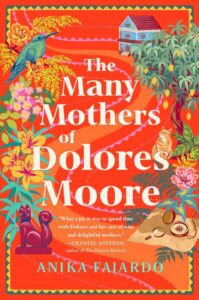
The Many Mothers of Dolores Moore The book by Anika Fajardo is published through Gallery Books, an imprint of Simon & Schuster.
