
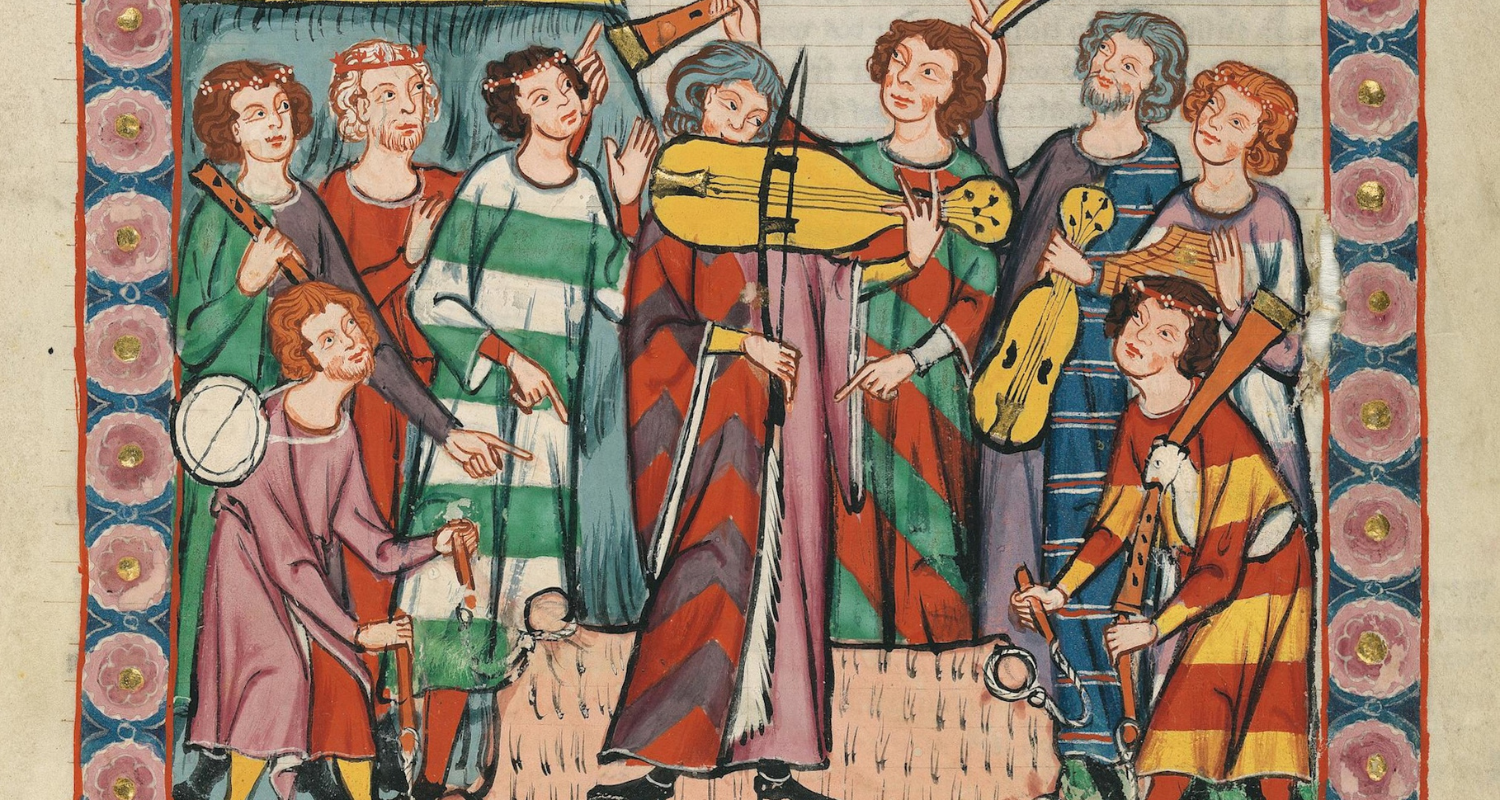
Today, the prominence of written notation in Western musical schooling has led many to equate “music” with the printed score or the sheet that carries it. Musicians and their instructors place a premium on literacy: not only the capacity to read and write musical symbols but also the ability to sight-read a score in real time, much like reading words and numbers. Yet this wasn’t always the standard. It is now worth examining a crucial moment of change to understand how some of the earliest forms of written music might inform the broader history of performance — its beginnings and its prehistory alike.
From time immemorial, people across Europe had been performing and transmitting songs, tunes, lyrics, and melodies by memory. But around a thousand years ago, as a community in Schleswig was tuning bone flutes, a shift occurred for certain individuals. The oral tradition, once deemed sufficient, began to be supplemented by visual attempts to record tunes. On the written page, verses came to be annotated with curling lines and dots, where the left-to-right movement signified the progression of musical time, and the up-and-down strokes captured the ascent and descent of the melody. These were among the first experiments in an analog counterpart to sound signals captured in real time.
Teeming with alliteration and assonance, and overflowing with cryptic references and metaphors… the two poems are like two peas from the same pod.
In the ninth and tenth centuries, monkish scholars on the British Isles and across continental Europe began transcribing tales from their remembered past, leaving behind a wealth of material in several European languages. Our contemporary challenge is to discern how these works were meant to be read and performed.
The most renowned of the early medieval narratives in Old English is the tale of Beowulf. The surviving version dates to roughly the late ninth century and is composed mostly of plain text, handwritten in ink on pale parchment, later bound into a leather volume. Today the lines can appear as prose, a continuous stream with no obvious stanza breaks or end rhymes interrupting the flow. Yet when you voice them aloud, a rhythm emerges. They reveal themselves as lines of verse.
Unlike the rhymed verses favored by later ballads collected in the nineteenth and early twentieth centuries, Old English poets rarely used rhyme and did not follow a regular meter. Instead they leaned on alliteration and assonance, with shifting patterns of stress. Modern scholars have often read these works silently or, when reading aloud, delivered them in a somewhat theatrical fashion. They perceive stress patterns but none of the metronomic regularity that later lyrics would demand. This cautious approach has, in many respects, been prudent, yet it also obscures potential depths. At times, a puzzling anomaly unsettles long-held assumptions, and one such instance appears in another heroic poem not unlike Beowulf.
Beowulf is generally regarded as the grandest and most complete of the surviving early Germanic epics. Yet it is not alone. Heliand is the work of an anonymous poet composing in Old Saxon during the early ninth century. Heliand translates to The Savior and retells the Jesus narrative in a voice and meter strikingly similar to Beowulf, crafted to resonate with the experiences and sensibilities of the newly converted, though still wary, Christians of northern Germany. In the poet’s hands, Jesus becomes a formidable warrior and war leader. The text even resembles Beowulf on the page, and when it’s reformulated into lines and half-lines in modern editions, its poetic character appears just as clearly. Rich in alliteration and assonance and overflowing with cryptic references and metaphors — known to scholars as kennings — the two poems resemble two peas from the same pod. Neither shows a regular meter or end-rhymes, so the challenge for any prospective performer is broadly aligned, save for a barely perceptible distinction. Heliand exists in several copies, whereas Beowulf stands in a single manuscript; notably, in one of the most complete versions, conserved in the Bavarian State Library in Munich, there are features unique within the corpus of alliterative verse. Above the words of three brief passages lie symbols that resemble an early form of musical notation.
The notes are known as neumes. The annotated sections precede the Nativity, where the poet contemplates Joseph’s inner debate about Mary’s unexpected pregnancy. The reasons for singling out these passages remain a mystery, especially since other parts of the poem contain more dramatic and lyrical moments. The first two passages touch on threats to Mary from Jewish law and custom; the third recounts Mary and Joseph’s arrival in Bethlehem. In any case, the symbols are neumes, attempts to capture something of the music’s shape and form, and they belong to a system that would eventually evolve into the staff notations used by musicians today.
In the late eighth century, monastic writers engaged with musical theory and began experimenting with notational methods. Their primary concern was religious: to ensure the uniformity of chants across churches. It was important that communities across Christendom be singing from a common chant book, so to speak. A surge of ingenuity produced a range of alternative systems. Some were simple shorthand symbols; others were more elaborate and precise. These are known as heighted neumes because the dots that denote individual notes rise and fall as if placed on an invisible grid. Among the most sophisticated were the neumes developed at the monasteries of St. Gallen in Switzerland, Benevento in southern Italy, and Metz in northern France. They were easy to read and quickly found application in preserving and sharing popular tunes sung by monks during leisure or while traveling. Perhaps the most famous examples are the Latin and Middle High German poems preserved in the Carmina Burana, the work of wandering clerics and university scholars known as goliards. Another preserved manuscript features the so‑called Cambridge Songs. In each collection, only a subset of the poems bears annotation, a detail that seems meaningful. Was it because the remaining pieces were already familiar and did not require explanation?
Heliand and the evidence of Beowulf hold a clear message, that just because we recognize a text to be poetic doesn’t mean there wasn’t more going on beneath the surface.
During the ninth and tenth centuries, notation methods grew increasingly refined and began to resemble the modern written music we recognize today, to the point where scholars can decipher and perform them with growing confidence. It is true that the Munich Heliand neumes are not exactly like contemporary staff notation. The symbols above the text resemble shorthand, with shapes ranging from small ticks to an inverted U, and some look like the letters v and p. Even if their exact meanings remain elusive, they carry a message: at least one author believed that vernacular literature could carry a musical dimension and could be sung.
All of this points to a fusion of words and music that is reinforced by the poems themselves. The poets frequently reference their own art, and among archaeologists and performers there is increasing awareness of a link between their recitations and a particular stringed instrument. The vernacular poets refer to it as hearpe or harpa, among other names; cithara in Latin. In Beowulf, a scóp or gleeman stands at the heart of the drama, rehearsing heroic deeds before the king and his retinue in the great hall. From the weight of archaeological evidence, it seems increasingly likely that the instrument in question is a form of lyre, a device traditionally used in many cultures to accompany song. Indeed, the Old English verb for the way the verse is performed by the gleeman is singan, to sing. Thus, both Heliand and the evidence from Beowulf press a shared point: recognizing a text as poetry does not exclude the possibility of a deeper musical operation beneath the surface.
One of the most respected interpreters of Beowulf as a live performance today is the American vocalist Benjamin Bagby, who has integrated the lyre as a central element of his show. For him, there is no fundamental objection to adapting alliterative verse to the lyre or to a regular metrical scheme. The fusion he achieves is extraordinary. Hearing him perform Beowulf before an audience can transport listeners to a period when poets and musicians did not treat poetry and music as discrete arts.
And with the question of meter comes another possibility. In an anonymous contemporary account of a tenth‑century performer, St. Dunstan of Canterbury, there is a depiction of a ring dance. It is framed as a vision in which angels sing and dance in a manner identical to human maidens. If ancient poems like Beowulf and Heliand were sung and could be set to a steady beat, perhaps they could also be danced to.
Now, there’s a thought.
_______________________________
From Sound Tracks: An Archaeological Journey Through Our Musical Past by Graeme Lawson. Published October 2026 by Alfred A. Knopf, an imprint of The Knopf Doubleday Publishing Group, a division of Penguin Random House LLC. Copyright © 2026 by Graeme Lawson.
