

During my childhood, my parents urged me to “be smart” every single day. Depending on the moment, those words stood for different things: a goodbye when I dashed out the door for school, a scolding when I misbehaved, or a reminder to study harder. In our family, cleverness and diligence defined everything.
According to my father, the brightest person he knew was his youngest sister, my Aunt D. In the late 1960s, she left South Korea to move to the United States on her own and eventually landed what he called a “steady” job. He could never quite explain what she did for the federal government, but he was quick to list the things he coveted. “Good benefits and more money every year,” he would often say. “And nobody can fire her.” That last part mattered to him more than anything.
A blend of temperament and language had forced my father to rely on self-employment, a path that offered little stability. At the start, he taught tae kwon do classes late into the night and handled every dollar himself, flattening the crumpled cash and the occasional paycheck from his students. My mother, who joined him a year after his arrival, worked the production line in a frozen-pizza factory and later waited tables until they saved enough to buy her a small business.
The words “be smart” kept ringing in my ears. Trying to be a writer seemed like the opposite of that advice.
For my parents, America equaled hustle. It did not matter if they were exhausted, ill, or sad to keep going. Having witnessed the Korean War as children, they understood that life could tilt on a dime. There was no safety net for them in this country—or for me or my sister. In comparison, my Aunt D., with her respectable office job, health insurance, and personal days, had reached the top rung of a ladder they didn’t know how to climb.
Not surprisingly, I followed Aunt D.’s example and began my career in government after college. By my late twenties, I was living what my parents proudly called “a very smart life.” I had a graduate degree, owned my Brooklyn apartment, was married to a guy from a solid family, and, most importantly, held a well-paying job at a major New York cultural institution. If I broke a bone, I had health insurance. If the roof leaked, I had homeowner’s insurance. Unlike my parents, I never actually touched my money, which grew in places I couldn’t easily see—savings accounts, IRAs, mutual funds, real estate appreciation. In less than a decade, I had insulated myself from the kind of risk they’d spent most of their adult lives trying to outrun.
That safety, however, came with a price. My job required me to be in the office twelve to fourteen hours a day, six to seven days a week. I ate nearly every meal at my desk and watched friends drift away after I forgot to return their calls or canceled our plans because a deadline was always looming. While many of my colleagues balked at the long hours, I dug in, having learned from my parents to put the hustle above everything else. How often they reminded me, even as an adult, that immigrants had to be smarter and work harder than everyone else—not just to be successful in this country, but to be seen in a positive light.
It was telling, then, that the one activity I consistently pursued during my scarce free time was a creative writing class. I enrolled on a whim, tired of wanting to write since my late teens but never making an effort to start. The class met on Saturday afternoons in a community center with water-damaged ceilings and peeling mint-green walls. I often attended after working in the morning and then returned to the office immediately afterward. Despite this, I never skipped a session or an assignment. I adored my teacher and the group of peers, who embodied the city’s wonderfully oddball spirit—a retired locksmith whose tales always revolved around cat burglars, a shy dental hygienist whose knowledge of literature could rival any English professor’s, two Goth teens whose awkward romance blossomed before our eyes. The best aspect of the class was how writing sparked more writing. The more I wrote, the more I wanted to write.
In the office, I began to imagine a different life, one where writing took center stage rather than being something I did only in the margins of my time and energy. Yet the refrain “be smart” persisted. Pursuing a writing life felt like a rejection of that advice and, by extension, a challenge to my parents’ values that had laid the foundation for my adult stability. Still, when faced with the choice between renewing a three-year contract at work or pursuing a life centered on writing, I surprised myself and everyone around me by choosing the latter. I wish I could claim I did it out of sheer bravery or passion or stubbornness. The truth is, I was exhausted, and I knew three more years at that job would feel like thirty.
Initial reactions to my decision were far from supportive. When I told a colleague that I planned to enroll in graduate school to study creative writing, she peered at me with curiosity. “Are you sure?” she asked, stressing the word in a way that made me feel like I belonged in a sanitarium.
I wasn’t entirely sure, but I pressed on anyway, determined to move quickly before I lost my nerve. Looking back, I was fortunate that a chain of events unfolded rapidly, leaving little time for second-guessing. Within nine months I applied to MFA programs, quit my job, sold my apartment, and left New York to begin graduate studies in Western Massachusetts. At the time, I believed that choosing a writing life was the riskiest thing I’d ever done—perhaps the riskiest thing I’d ever do—so much so that the prospect of frequent rejection and slim odds of publication didn’t deter me. It turns out I didn’t fully grasp the true scale of the risk.
*
In 2022, during the Justice Department’s trial to block the acquisition of Simon & Schuster, Penguin/Random House’s then-CEO, Markus Dohle, stated, “Everything is random in publishing. Success is random. Bestsellers are random. That’s why we are Random House.”
I now understand there are so many forces outside a writer’s control that influence how a book makes its way into the hands of readers—or doesn’t.
By that point, I had published two novels that sold well and were well received by critics, but Dohle’s candid admission unsettled me and many other writers by acknowledging an element of luck in publishing. The notion troubled me because luck ran counter to my upbringing. My parents had toiled relentlessly to achieve success, but his remark underscored that effort does not always translate neatly into publication. If it did, every author who managed to write and publish would become a bestseller, which obviously does not happen. Just ask anyone who released a book on a Tuesday, on 9/11, or in the early days of COVID-19, only to watch their work fade into a distracted world.
As a mid-career writer, I’ve come to understand that there are numerous forces beyond a writer’s control that determine whether a book reaches readers—or not. Often, it isn’t something as dramatic as a terrorist attack or a pandemic. The “randomness” Dohle spoke of can show up in many forms. A dear friend loses their editor due to downsizing and watches their once-hot manuscript pass from one indifferent reader to another in search of a champion. Another friend—a serious, thoughtful, dignified person—almost set their hair on fire on social media to promote their book, but sales didn’t budge. And then there’s the mystery of an established author with a track record of bestsellers whose latest book receives the same extravagant attention and resources as before, yet for reasons no one can explain, it underperforms and vanishes.
In other words, writers control the page, but the business side of writing is steered by forces that even publishers aren’t entirely sure of. And yet here we are, too many to count—published and unpublished, established and emerging, known and unknown, succeeding and struggling—all attempting to undertake this beautiful, painful, hopeful, inherently risky venture in which success isn’t always determined by brains or effort. Honestly, it’s the nightmare of a first-generation, Type-A, mildly obsessive immigrant. Still, more than twenty years after choosing this path, I continue to write because the perils of writing are far outweighed by the rewards—that sense of accomplishment when I tell a story that’s truly mine, or when I fix a structural problem that my younger self would have abandoned, or when I answer a question that only writing could resolve.
I experienced all of these moments with my latest book, a novel titled All the World Can Hold, which took decades to come together. One major challenge early on was figuring out how to tell a story about fictional characters who flee their troubled, empty lives in the wake of 9/11 without diminishing the real losses suffered that day. Adding to the complexity were the odd circumstances of my own post-9/11 experience, which involved a weeklong Bermuda cruise aboard the ship used for the ABC television series The Love Boat. How could I weave an utterly absurd setting that held personal meaning into a novel about a period marked by tragedy without it turning into farce? I lost count of how many times I started anew, unsure if I could move past my fears. I was fortunate—and perhaps a touch lucky—that the muscle memory of my New York life compelled me to return to the writing chair every morning, because I believed I wouldn’t solve it any other way. In the end, whether I succeeded or failed rests with readers. Still, I know I produced a story I’m deeply proud of, and that confidence is a prize I hadn’t anticipated earning.
Over the years, I’ve come to view every book I attempt to write as a new life waiting to be born, shaped, and inhabited. This perspective has helped me see that maybe my parents’ values were more deliberately preparing me to be a writer than I’d realized. After all, they left their homeland in their thirties, crossed an ocean, and rebuilt themselves in a country that demanded a high price for opportunity. What other motive could drive them, if not a wild, almost reckless belief that a life worth risking might exist?
_______________________________
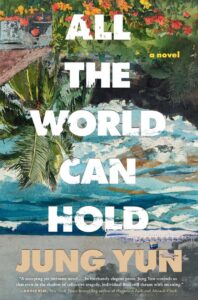
All the World Can Hold by Jung Yun is published by 37 Ink, an imprint of Simon & Schuster.
