
Each year, as his birthday rolled around, Jonathan Swift would remove his stiff, powdered wig—the cascade of white curls—set it gently beside the candlelit stained-glass window in the Deanery of Saint Patrick’s Cathedral, and murmur from Job 3:3—“Let the day perish wherein I was born.” This curious tableau, featuring the era’s most celebrated satirist, robed simply in the plain black gown of a parish priest, would later acquire another layer of meaning when the poor, outside the city walls of Dublin—the weavers, spinners, dyers, and carders laboring in the textile trades—gathered in the November chill on the cold stones to chant hymns and light bonfires in honor of the celebrated Irish patriot who held the Dean of Saint Patrick’s in esteem.
On the occasion of Swift’s 59th birthday in 1726, the revelry was still some years away. By then he had earned renown on both sides of the Irish Sea for A Tale of a Tub and The Battle of the Books, not to mention a string of pamphlets advocating everything from the purchase of Irish goods to opposing predatory currency devaluation. His most consequential work, Gulliver’s Travels, had appeared just a month prior (three hundred years ago today). Though often misremembered as a simple children’s adventure, Gulliver’s Travels functions as both culmination and critique of the Enlightenment, showing how countless sins arise when a worship of reason reduces human beings to objects. “I said the thing which was not,” Swift’s Gulliver declares, describing what a lie would be to beings incapable of deception. Yet “the thing which was not” also captures the essence of fiction and its charged force.
Gulliver’s Travels is both summation and rejoinder to the Enlightenment and how innumerable sins can result when the idolatry of reason leads to humans being treated as objects.
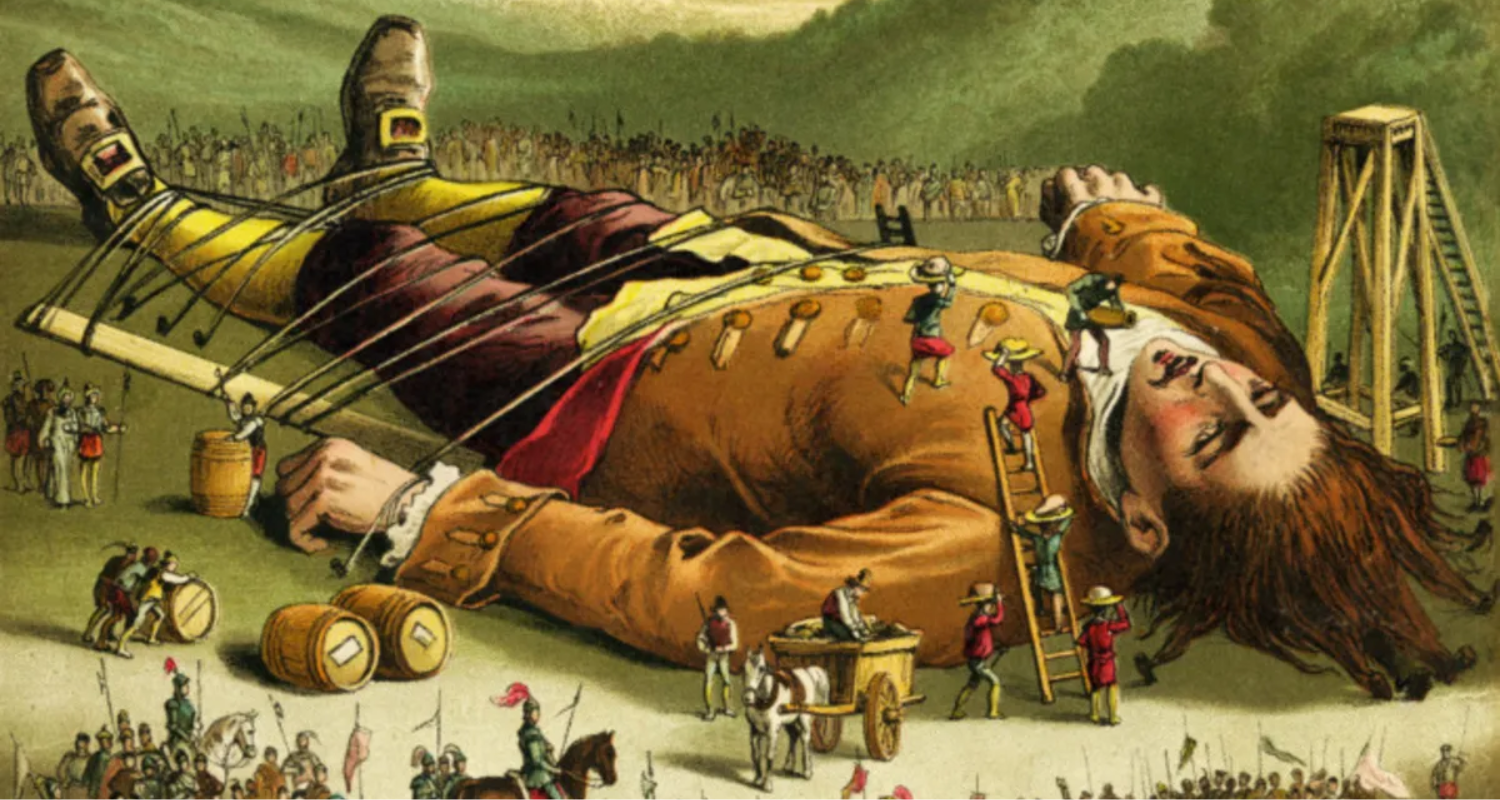
For many readers—perhaps most familiar with Gulliver’s Travels through diminished editions of childhood, through various screen adaptations, or simply through Swift’s imprint on the English language with words like “Brobdingnagian” and “Yahoo”—the novel inevitably conjures the image of Gulliver bound by the tiny Lilliputians, who pull at his immense rope as if it were nothing more than string. The long-legged eighteenth‑century gentleman, draped in stockings, breeches, a heavy coat, and buckled shoes, appears to the Lilliputians as a colossal threat to neutralize. He drifts ashore as if a Leviathan, and when one of his captors climbs toward him, Gulliver notes that the thing approaching is “a human creature not six inches high, with a bow and arrow in his hands, and a quiver at his back.” Much of the humor in Gulliver’s Travels comes from disproportion: the pompous giant facing a troop of toy soldiers, a navy reduced to playthings, and Gulliver’s own clever ruse to extinguish a Lilliputian fire by an improvised urination. The Lilliputians themselves prove narrow-minded and quarrelsome, debating which end of an egg to crack—an irony that mirrors the theological disputes of Swift’s era—and they stand in contrast to the Brobdingnagians, whose grandeur makes all human nastiness seem diminutive, even as their immense bodies expose every pore and mole to comic and grotesque scrutiny.
Their magnified bodies reveal a human anatomy exposed to ridicule and clarity; the Brobdingnagians are thoughtful and humane, yet their scale makes Gulliver’s flaws glaring. In Swift’s view, eighteenth-century intellectuals imagined themselves rising above superstition and error, but as his biographer Leo Damrosch observes, the author’s stance was that “whether in religion, science, or politics, people are too often insane,” and often revoltingly so. This posture has long earned Swift a reputation for misanthropy, deserved or not.
To dismiss Gulliver’s Travels as merely a fantastical romp is to overlook the fierce intellect that produced it. Irish journalist Fintan O’Toole, speaking at a 350th birthday celebration in Saint Patrick’s Cathedral, described the author as possessed of “moral rage, the savage indignation that may have pierced Swift’s heart but can still carve open a path” into our own moment. Alongside Cervantes’ Don Quixote, Swift’s work stands as a lasting influence on culture. As readership of Gulliver’s Travels dwindles, its name recognition persists; in modern parlance, “Swiftian” evokes more the language of Taylor Swift than Jonathan Swift. Yet Swift offers a diagnosis of our diseased era as acute as any of his own.
Swift’s only other work as widely known as Gulliver’s Travels is his still-provocative 1729 essay “A Modest Proposal,” in which the narrator suggests that the hunger and poverty afflicting the Irish poor could be resolved by selling their children as food to the ruling English—an idea conceived in part from a grim Malthusian calculation and a recipe for cannibalism. Disturbing for its ironies in both past and present, the piece exposes the antihuman logic of colonialism and cold rationality. Its chilling effect endured even when actor Peter O’Toole performed it at Dublin’s Gaiety Theatre in 1954, drawing boos and hisses. By contrast, Gulliver’s Travels feels like a relatively tame adventure, a literary cousin to Robert Louis Stevenson’s Treasure Island or Defoe’s Robinson Crusoe. Yet to miss the deeper subversion it contains would be a mistake, for Swift himself warned that his aim was to “vex… rather than divert.”
As an Anglo-Irish priest in the Episcopal Church of Ireland—a long line stretching from W.B. Yeats to Maud Gonne of Irish Protestant patriotism—Swift avoided religious zealotry. The Lilliputian–Blefscuian squabbles over how to crack an egg echo the internal Christian schisms over the Eucharist. Above all, Swift disliked certainties—whether in religion or in rationality—and Gulliver’s Travels stands as the foundational critique of the Enlightenment’s excesses, hypocrisy, and hidden tyrannies. “Enlightenment, in the broad sense of advancing human thought, has always aimed to liberate people,” wrote Theodor Adorno and Max Horkheimer in the 1944 Dialectic of Enlightenment, yet they remind us that a “wholly enlightened earth is radiant with triumphant calamity”—a warning Swift might have issued two centuries earlier.
Adorno and Horkheimer spoke after the horrors of mechanized modernity—actuarial tables, schematics, and calculations that would later be connected to atrocities. Swift, anticipating such outcomes, distrusted removing humanity from the orbit of feeling. Because of the latitudinarian Church of Ireland, he inhabited a tempered, hybrid stance—a Whig in politics and a Tory in faith—that allowed him to navigate the dialectic with an understanding that reason can be both useful and dangerous if left to govern without passion. The moment Gulliver encounters Laputa, a floating realm that casts its spell over Balnibarbi below, rational calculus is shown to be less a cure than a form of tyranny, with a people whose science is more about theory than about human welfare. The land is described as “unhappily cultivated, with houses ill-contrived and ruinous, and its people’s countenances expressing misery and want.”
Swift’s satire extends to the Laputans, who drift through abstruse inquiries—whether sunlight can be derived from cucumbers or whether political corruption can be detected by the smell of someone’s excrement—so that scholars become incapable of speaking or listening. This is a jab at the Royal Society in London, which Swift often caricatured, but the fusion of ethereal thought with hidden cruelty also evokes George Berkeley, a contemporary philosopher who argued that the material world might exist only in thought while overseeing the enslaved on American plantations. Swift’s position on transatlantic slavery remains debated, yet the line is clear: “Reason is no good without indignation.”
Cynicism may appear to be the great enemy of the human, but in Gulliver’s Travels that noun means less a hatred of humans than of sadness.
If Swift seeks to exorcize any ghost, it is not Berkeley’s living influence but the long-dead Francis Bacon. Bacon’s utopian fantasy The New Atlantis envisions a technocratic future that seems to predict submarines, genetics, and the internet. Swift’s mission, as a principled anti-colonialist, was to puncture the empire—British or technocratic—and to resist any global design that valorizes knowledge for power over compassion.
That is the spirit in which Swift attacked Daniel Defoe, whom he disparaged in a 1709 pamphlet as an “illiterate scribbler” whose grave, dogmatic tone made him seem untrustworthy. Whereas Swift, a High Church man in some respects, distrusted the commodification of human beings, Defoe was more in tune with market logic. The protagonist of Defoe’s Robinson Crusoe—a shipwrecked mariner who, like Gulliver, comes ashore on an uncharted coast—does not merely observe folly; he engineers it. Crusoe is a self-made, rugged individualist who turns a remote South American island into a personal dominion through labor—assisted by the enslaved Friday—thereby modeling a form of colonial capitalism.
Crusoe notes that by “stating and aligning everything by Reason, and by giving the most rational judgment of things, any man may eventually master every mechanical art.” Both tales chart the fate of castaways forced to survive, yet Crusoe embodies a future where order, schedules, and economic design rule, while Gulliver’s voyage, with its wonder and strangeness, anticipates a civilization built on limits and social critique. In Defoe’s austere, methodical heart lies a sense of what might come after—an implied world that is both possible and perilous.
Ultimately, Swift’s masterpiece resists any simple dream of utopia and exposes the dangers of a no-pace, ever-optimizing society. Yet there is a form of perfection Gulliver discovers among the Houyhnhnms, a society of rational, empathetic, benevolent, and egalitarian horses (their name spoken as a gentle “whinny”). The Houyhnhnms stand in stark contrast to the Yahoo humans—savage, bestial, and degraded. Gulliver must admit, when asked to compare nations, that “poor nations are hungry and rich nations are proud,” and he finds no true justification for such inequality among humans—only a troubling self-knowledge, as he regards the Yahoos with a new, unwelcome clarity.
Instrumentalism, utilitarianism, positivism, rationalization—these are the targets of Swift’s clever barbs. What would he make of our own era, with its detention camps, wars, data racks, and livestreamed executions? Our world reads like a nightmare of statistics and machinery, where human feeling is sidelined in the march of progress. Cynicism might appear mankind’s chief foe, yet in Gulliver’s Travels that term signals sorrow more than malice toward humanity. Gulliver, the ultimate adversary of Crusoe’s self-sufficiency, encounters a spectrum of indignities and absurdities on his journeys, and it is the example of the Houyhnhnms that finally shatters him.
When he returns to England, Gulliver finds it impossible to coexist with his fellow humans’ vanity, shortsightedness, pettiness, and greed. He withdraws to live out his remaining days among the horses—an exile that echoes the Dean of Saint Patrick’s, who spent his own later years in the stables with his animals. Swift died at seventy-seven and was laid to rest beside his beloved Stella in a cathedral once used by Cromwell to stable his own horses during the Irish campaigns—and thus a quiet resting place for those innocent Houyhnhnms drawn into the wars of the Yahoos who claimed their struggle was for “civilization.”
Gulliver’s Travels frequently enters discussions about utopianism, its ironic stance offering a critique of Thomas More’s early conceptions, though More himself was not entirely free from irony. Yet Swift’s novel is far more intricate and often more mournful than a simple challenge to the idea of a perfect society. The finest satire, as with Swift, is tragedy in disguise, and the sadness becomes all the more poignant because it remains out of reach. From Swift to Mark Twain, Dorothy Parker to Richard Pryor, great satirists have shared a core—the ache of losing something we never truly possessed. In the end, Gulliver’s horses live in friendship and harmony, free from bridle or saddle. The final, most heartrending takeaway is this: utopia exists, but not for us.
