
The ode and the elegy are commonly seen, at first glance, as two distinct strands of poetry tied to separate emotional landscapes. Historically, the elegy is believed to travel from mourning to celebration, then toward consolation, though the final part is—quite understandably—the most challenging for many readers. The feelings are tangled inextricably. Loss does not erase the complexities of love when someone passes away. Sorrow can linger within a kiss. Even praise can accompany death.
*
My mother was still alive when I began writing poems about her as if she were already gone. It was the only way I could imagine depicting her at all. Since she never read my poems, I was, in a way, shielded. Yet starting from a premise of her demise, the words came forth with the suddenness and delight of a gift.
But I didn’t produce any nonfiction about her until the week between her passing and her funeral. The prose there moved in clear, coherent lines that tried to contain the bewildering mix of rage, despair, relief, pain, shock, and premature acceptance that spun through me. It was fragments. It was messy. It was incomplete.
*
When I began creating essays, I didn’t know how to shape them. Grief itself felt vast and unwieldy, as if you couldn’t fit ghosts into paragraphs, or transform our crying into a scene. Yet poetry offered countless pathways for approaching nonfiction, and I returned to Adrienne Rich, whose approach felt instructive: poetry can be a strategy—like wearing asbestos gloves—that lets me handle what I cannot touch with bare hands.
To give form to the formless notes in my journal, I turned to the ghazal. In the ghazal, each stanza consists of two lines that all terminate in the same word (the radif). In my essay ghazals, I adapted this idea so that each brief section would be two sentences long and end with the same word. I resolved that each ghazal would become an ode and a lament for different body parts, praising and grieving as I catalogued the body. I experimented with a prose crown of sonnets, lyrical braids, backward motions through time, and traditional elegiac couplets. Not every approach succeeded, but some of them offered a way to observe and hold fast to grief.
*
Throughout the ages, people have sought out various forms to bear their sorrow. Locks of hair have been cut and twisted into wreaths of flowers. Wax death masks have been crafted to preserve the final expression of the departed. With the advent of photography, post-mortem portraits were taken to keep a record of the beloved so that, if memories faded, their face could still be seen.
Form—whether poetic, essayistic or mixed media—has given me the space and shapes to contend with all the wounds that time hasn’t healed on their own.
Even the Greeks, who gave us the ode and the elegy, viewed mourning as a public act—noisy and embodied. A mourner could even hire professional lamenters, or moirologists, to provide a surrogacy for that feral ache in the chest. A moirologist’s skill lay in maintaining a certain flexible strength: being broken by loss and yet continuing to sing and shed tears from the depth of the lungs, from the marrow of the bones. If you cannot summon the feeling yourself, you can purchase a mirror for your heart and watch a hired mourner pour out every tear that should be yours.
*
Grief appears and vanishes like specters themselves. Yet by stitching, writing, traveling, and making grief a tangible practice, I found ways to reshape my mother’s memory. In those forms I could witness both the hard, even terrible aspects and also recall her at her very best.
I’m not sure I’m skilled at grief. But I know that through the act of mourning I blended forms and sometimes created my own hybrids, both in language and in the hospice blankets I crocheted for patients. I discovered structure in embroidering a sugar skull onto her funeral photograph and in comparing her last words with famous last words in history. I found shape in journeys that allowed me to grieve—from haunted houses and haunted-object museums to following her final wish to the birthplace on her mother’s side.
All of it produced some result, but none of it produced a complete resolution. I have never fully entered that third stage of the elegy where consolation remains complete. And yet, I have drawn nearer to my laments. I have approached closer to my praise. Form—whether poetic, essayistic or mixed media—has given me the space and shapes to contend with all the wounds that time hasn’t healed on their own.
_______________________________
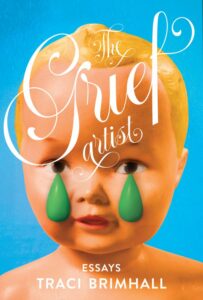
The Grief Artist The Grief Artist by Traci Brimhall is published by Sarabande Books.
