
This week’s eclectic batch of reviews offers a cross-section of voices: Junot Díaz weighs in on Jane Schoenbrun’s Public Access Afterworld; Kevin Power weighs Yiyun Li’s Music Against the Night; Sarah Chihaya weighs Deborah Lutz’s This Dark Night; Anna Louie Sussman weighs Sarah Anderson’s Fallow; and Kathryn Schulz weighs Nathaniel Philbrick’s The Rush.
Brought to you by Book Marks, Lit Hub’s home for book reviews.
*
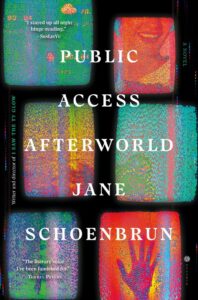
Best known for a trio of striking films (and if you haven’t experienced I Saw the TV Glow, you really should), Schoenbrun offers a debut that reimagines the Orphic myth for our age of constant media contact. The author has a talent for cinematic opacity, yet here their work feels more accessible, even as the eerie tang remains.
Schoenbrun threads together a spectrum of inspirations and genres: Public Access Afterworld reads as more than an Orphic epic; it also functions as a political thriller, an urban fantasy, and a neo-slave narrative that echoes Videodrome, The Matrix, and even Neal Stephenson’s Snow Crash.
Yet despite this amalgam of genres, the narrative stays grounded in the everyday experiences of characters on the social margins. By resisting a plunge into outright fantasy, the author dodges the trap their own plot appears to invite the protagonists into.
Schoenbrun possesses an almost uncanny knack for shaping individuals—uncovering peculiar channels beneath ordinary ones—whether it’s Jules’s self-hatred and substance-fueled despair; David, blind to the damage he continues; or Willa, anxious and living in 1940s Los Alamos with her scientist spouse, who becomes involved with a newcomer named Rachel. Even when Schoenbrun steps into a monstrous, dimension-hopping creature, the impact remains devastating.
…
Profoundly realized and profoundly humane, Bethany stands as a pointed rebuttal to the cruelty that our current era heaps upon transgender people. In a novel where young women are stalked and eliminated, Bethany emerges as a remarkable “final girl” in Carol Clover’s terms, a wounded survivor who remains part of a community that is itself continually deemed expendable. She is vigilant, trusts her own scars, and understands all too well what it means to be trapped.
…
“But if history has taught us anything from its darkest chapters, it is that even under chains there remains more to us than the shackles that bind us. Creativity, solidarity, laughter, and—barely visible through the static of our pain—something that might be love. Public Access Afterworld offers proof of these hard-won certainties.”
“Find the receiver. Make it real.”
An entire generation might discover a receptor in this revelatory book. Schoenbrun gathers the dreams and struggles of a dimension of people—long erased, long maligned, too often brutalized—and renders them tangible.”
–Junot Díaz on Jane Schoenbrun’s Public Access Afterworld (The New York Times Book Review)
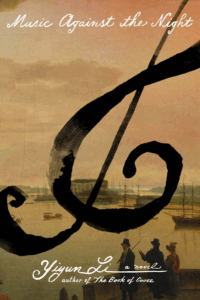
“In his recently published A History of the Novel in Britain, Philip Hensher makes a provocative claim: historical novels don’t endure. No matter how beloved or prestigious a historical work may be in its era, it eventually gets set aside as literature moves forward, leaving it behind as a relic of a bygone time.” He may be onto something. Who nowadays prefers Walter Scott to Jane Austen? The historical novel risks a double obsolescence, courting a future in which it appears to be a dusty reflection of a bygone era.
Yet Hensher remains unperturbed: “As readers savor our contemporaries, we should not let the possibility of oblivion alter our pleasures.” Will future readers cherish Wolf Hall as we do now? It hardly matters. As Gore Vidal noted, posterity is “a permanent darkness where no whistle sounds.” What matters is our present moment—how we shape history and our lives—through our books and beyond.
Posterity and its ironies anchor Yiyun Li’s new historical novel. In several respects Music Against the Night isn’t a conventional “historical novel”—not the bought-at-a-bargain variety where characters speak with Byron and the like. Readers familiar with Li know she transcends the typical and sits in a luminous, singular realm of writing. Her craft renders craft invisible, and her art makes inquiry into art itself a central subject.
…
“Toward the end, there is a brief meditation on the loss of a child. Li herself has written about the death of her two sons, Vincent and James, to suicide. The theme isn’t dwelt upon at length in Music Against the Night; it weaves into a broader argument about life’s passions against the austere, indifferent values of art. The narrator notes: ‘Death is a subject that rewards minor artists.’ Yet ‘Life? It requires major talent to convey that.’ Li conveys life with apparent ease. The word here is “major.”
–Kevin Power on Yiyun Li’s Music Against the Night (The Guardian)
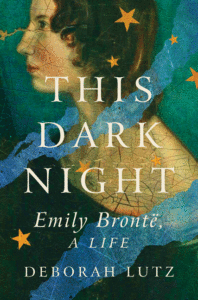
“Initially, I resisted the idea of reading an Emily Brontë biography. After all, Brontë was not renowned for being approachable—and perhaps never sought to be. If we trust Elizabeth Gaskell, she was “never happy nor well but on the sweeping moors that gathered round her home—that hater of strangers, doomed to live amongst them.” No one can claim to fully know what endowed her with such intensity or what compelled her to write what she did. Having read almost everything that survives from her, I admit I wasn’t eager to learn more. Brontë herself seemed to want readers to know as little as possible about her, not even her real name.
In Deborah Lutz’s new biography This Dark Night, the enigmatic Emily is not simplified or made more relatable. Instead, the work asks more questions than it answers. For some readers this vagueness may be frustrating for others (including this reviewer) it is precisely what makes the book compelling.
…
“The myth of Emily as a liberated ‘moor nymph’ began in part with Charlotte’s editor’s preface to the posthumous second edition of Wuthering Heights. Grief, and perhaps a struggle to convey what Emily was really like, led Charlotte to portray her gifted sister as a wild savant—a ‘native and nursling of the moors,’ as she wrote—somehow otherworldly.
…
“The aim is not to drag Emily Brontë down to earth by claiming (as the 2019 show Dickinson did to that later Emily) that she was just like us, with anachronistic feelings and hidden sapphic longings, but to anchor her in a world that was uniquely hers. Lutz’s book accomplishes exactly that. Her Emily is a compellingly grounded figure, both as distinctive and as inaccessible as any of us. To suppose that we grasp her completely would be to diminish her. Yet recognizing that we don’t fully know her helps us recognize that she, like us, remains out of reach.
“After finishing This Dark Night, I don’t feel I understand Emily Brontë any more completely, but I do feel I understand the world she inhabited a bit more—its landscapes, its climate, and the atmosphere that infuses her poetry and prose. Lutz avoids answering every question; instead she situates Emily where she chose to stay, in her own realm.”
–Sarah Chihaya on Deborah Lutz’s This Dark Night: Emily Brontë, A Life (The Nation)
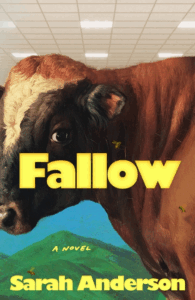
“There exists a breed of novel that sits just outside the apocalyptic while still feeling thoroughly speculative. Its world resembles our own—an immediately familiar present where surveillance capitalism is the backdrop. Its premise is plausible enough to trigger a peculiar unease, enough to hope Elon Musk stays far away from it and never borrows its ideas.
This fertile landscape has long attracted feminist writers, perhaps because it requires little more than scanning the newest proposals emerging from political spaces to spark worst-case imaginings. For women who have benefited from decades of progress—educated women working in rooms of their own—and who feel the stakes of loss, the not-quite-science-fiction novel serves as a space to explore those anxieties.
…
“By reframing surrogacy to address more than one model of labor within America’s already precarious economy, Anderson avoids common criticisms of surrogacy and the skewed control dynamic between carriers and intended parents. She treats surrogacy as one type of job in the broader labor market and poses a stark question: If surrogacy can be exploitative, who profits and who bears the burden?”
…
“There’s a reason forced gestation features in many feminist dystopias; for many women, such a job would be a nightmare come true. Yet Natalie’s character is the rare exception that unsettles tidy rules. A 2022 article in the International Journal of Comparative Sociology argued for the plural term ‘surrogacies’ to acknowledge the multiple forms and contexts of surrogacy. Fallow’s twists and the bonds Natalie forms illustrate how surrogacy ethics cannot be reduced to a single storyline; they depend on the power relations shaping each scenario. Natalie’s relationship to surrogacy evolves as those power dynamics shift—from exploitation toward respect and consent. Her entire approach to work shifts as her relationships with others transform: she discovers satisfaction in labor when it becomes a cooperative effort rather than a means of capitalist accumulation.”
–Anna Louie Sussman on Sarah Anderson’s Fallow (The New Republic)
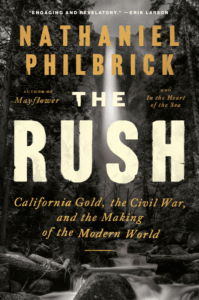
“The Rush is a sprawling, interwoven tapestry of people and episodes, dense with assertions about a land and a period as tumultuous as the goldfields it chronicles. Two main threads stand out. First, the argument that the California gold strike unleashed a fever for wealth, land, labor, and political influence that helped ignite the Civil War and shaped its outcome. Second, the contention that the most consequential aspect of the gold rush wasn’t the gold itself but the headlong rush toward it. Philbrick uses the headlong tempo of the era to illustrate a broader appetite for speed, novelty, and change that has defined American character from the forty-niners onward to today’s tech-driven ventures.
While The Rush is not entirely persuasive on either point, the book’s strength lies in its willingness to wade into a messy, larger story rather than offer a single, tidy causal narrative. A more fitting title might be California, 1848–1878, which isn’t dull by any stretch, given those decades’ peril and exhilaration. In a sense, the central question Schulz poses is not whether the past explains the present, but whether it can at least illuminate the present without becoming a precise blueprint for it.
…
“It’s a pleasure to meet these figures in The Rush, though not every character earns an equal place in the action. Primary sources are invaluable for historians, yet they can distort—magnifying some aspects while diminishing others. Philbrick shows sensitivity to those distortions, noting, for instance, that more than ten thousand Chinese workers helped lay the transcontinental railroad, yet no personal diaries or letters from any of them has survived, leaving a void where their California story should be. Still, The Rush ultimately rests on the balance between what it can show and what it cannot.
…
“In Philbrick’s framing, the splash of gold in California two centuries ago is presented as the root cause of today’s world: a society packed into jets, forever chasing the next novelty—an environment created in 1849 by the Gold Rush. But did the gold rush give rise to our present condition, or do the two merely echo one another? Yes, many features of mid-nineteenth-century California resemble today’s AI bubble—from the advantage of early arrival and outsized profits to infrastructure fantasies, political instability, environmental damage, and stark inequality. Yet resemblance is only superficial, and nothing in Philbrick’s narrative makes the gold rush feel like a universal motive force behind today’s rapid ascent. Nor does it explain why this urgency feels uniquely American; after all, many international participants joined the rush, sharing in the same impulse.
The more plausible explanation is this: whenever a group is placed within reach of extraordinary wealth, a familiar set of behaviors tends to emerge—risk-taking, competition, deception, improvisation, rule-making, rule-breaking, and the hungry pursuit of dominance. The Rush excels when it simply shows the mayhem as it unfolded in a concrete time and place, driven by real people who shaped events with courage, greed, and cleverness. In these uncertain times, readers may wish for the past to illuminate the present, yet the past remains a distinct kind of gold—rich, elusive, and priceless—and sometimes it suffices to let it glow.”
–Kathryn Schulz on Nathaniel Philbrick’s The Rush: California Gold, the Civil War, and the Making of the Modern World (The New Yorker)

Isabela Reyes