
There is a current that pushes against loss, as summer yields to the reflective turn of autumn, and destinies are cast with one’s own body. This opening gesture appears in Malgorzata Lebda’s poem “Trigger Points” as translated by Mira Rosenthal for Mer de Glace. I keep returning to Rosenthal’s notes on the collection, where she opens with a long string of terms that flow from “Bright” and “Brilliant” to “Obvious” then “Of Course!” and “Sure Thing!” Rosenthal explains that she hoped these words would prove useful whenever the Polish word jasne presented itself—a term that could take any of those translations, depending on context. She adds that Lebda positions the neuter form as a kind of abstract noun that endows the poems with a life force tied to brightness, radiance, clarity, and luminosity, while carrying a sense of alertness and care. Such precise attention and vast horizon feel fitting as we move beyond autumn toward the year’s longest night, discovering light in many sources—sun and streetlights, yes, but also reflections in mirrors, both in glass skulls (Bias) and glass heads (Chabitnoy), and in shadows, and in trees—“White aspens blink and flare vividly” (Gao)—and in people—“How I flickered at hearing your faint voices: I am beginning to dream of spring (Bias).” Our shared pursuit of illumination is everywhere. Of Course! Sure Thing!
November also introduces a fresh Patricia Lockwood collection, Agate Head / Stone Soup (Penguin Poets); Jana Prikryl’s The Channel (Norton), longlisted for the T.S. Eliot Prize; and Jacob Saenz’s second, substantial chapbook Love Hound (Next Page Press). Stay tuned as Craig Morgan Teicher brings the year 2026 to a close with our December Poetry column, and return in January as we begin 2027 with a collective Anticipated Poetry list.
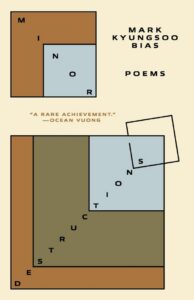
Mark Kyungsoo Bias, Minor Destructions
(Gaudy Boy)
“This /morning, there is a bird thrashing about in my glass skull, yet I answer only: I don’t know / who I am today.” The debut from Seoul-based poet Mark Kyungsoo Bias considers loss in its many disguises, portraying a speaker who has endured a multitude of bereavements: “I once received a call that/ a friend, after months of abuse, had overdosed and died. / Waiting for deployment, as if words / weren’t already waging war on his mind.” Amid glass, mirrors, and light, “shadows rally everywhere,” and the speaker’s own origin story radiates through the collection, as expressed in lines about being born “like a pistil, into something you will lose” and the hope of witnessing both mothers drift away if endurance allows. Loss also reappears as a critique of broken ideals: the speaker learns from his birth father’s record that a “traffic violation” concealed an arrest for sex trafficking, prompting the reflection that before that moment, he imagined his father dying in pieces while longing for the wife’s face in a prison cell. Bias crafts one of the year’s most moving and disciplined debuts: “The poem is not art; it is violence. There is no washing away / the blood, only drawing with it.”
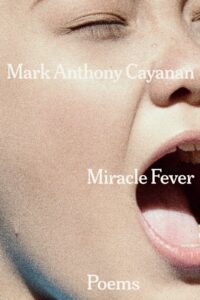
Mark Anthony Cayanan, Miracle Fever
(Northwestern University Press)
Is it a miracle or a trick? At the heart of Cayanan’s Miracle Fever lies Nieva, a fourteen-year-old of indeterminate gender, whose Marian miracles are thwarted by a church inquiry in a small Philippine town. Cayanan navigates between voices that speak as a collective “we” and “dramaticules,” complete with dramatis personae and stage directions, and sections that resemble hagiographies, visions, and timelines across a single century marked by invaders and catastrophes. In “Miracle Town: A Timeline of the Twentieth Century,” the town, in 1904, inhabited by American troops, “bops its heads to the music” in 1942, then “is chased up the mountains by new invaders” and, in 1943, “Ambushes a Japanese patrol and, moving from house to house, slits the throats of local collaborators,” surviving through earthquakes and dictators of the 1990s. Anecdotes and anachronisms prove essential as the poem gathers a history of colonization: “Giving the birthright of unease about one’s body / they made it a punishment we deserved, and so / they gave our grief a shape they called faith” by “the priest who doesn’t possess the angel’s tongue, where “god is never palliative but sword.” Displacement and death appear as constant companions in a world where colonizers “removed the name of a boy who, like the best of boys, was already a dead boy / and planted it on another coast.” By weaving together a town’s life as symbol and document, Cayanan presents a striking and revelatory performance of poetry.

Abigail Chabitnoy, Love Like a Body Carried to Shore
(Wesleyan University Press)
Isn’t this what the poem does: it sings? The voice in Abigail Chabitnoy’s powerful successor to How to Dress Like a Fish and In the Current Where Drowning is Beautiful keeps turning to song—“and again I find myself asking / can we not sing the world down this time,” she writes, while anchoring the dream in practical terms—“i hung the birds in churches / before industrial fans in the ceiling / in the rafters above the old women singing / where they might give the illusion of flight.” The arc remains rooted in the climate crisis and other consequential ecological upheavals, presented within an ark that implies both protection and peril: “the second bought for insurance claims inevitably to sink / into such scorched earth.” The speaker recognizes that agency and inevitability coexist, noting “the devil gets what it wants / if you believe each crack a sign / the rules of the game shift overnight,” and they ask what it means to look forward, to imagine a future extending beyond oneself, as a mother tells her daughter, “I tell her stories / of the sea / of her own / violent arc she must inherit / and fashion with her small hands to buoy the barrel.”
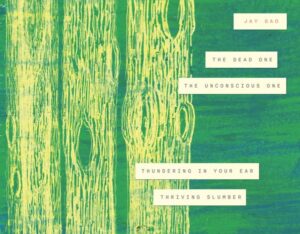
Jay Gao, The Dead One The Unconscious One, Thundering in Your Ear, Thriving Slumber: A Poem
(Nightboat Books)
Nightboat Books is producing some truly eye-catching volumes, and this is one of the standout examples. Structured as a sprawling landscape to house Gao’s long lines that feel like they stretch toward an endless sentence, the book unfolds over more than 100 pages, often returning to the refrain “Bark, archive, splinter,” with occasional epigraphic interruptions—Alejandra Pizarnik, Paul Valéry, Peter Larkin, C.D. Wright—that act like sectional markers. The poem pairs the natural world with human-made forms in a playful, and at times punning, exploration of perception, assertiveness, and malleability, as in lines like “Sloe film of itinerant poplar fluff” and “To save a grafted tree from its own mutant plot.” Reversals appear frequently—“Video surveillance rewinded. The cypress trees are caught fumigating their storage units”—and the language often lurches into idiomatic twists like “sleeping like a stone.” Gao’s rapid-fire riffs and silences accumulate into a poetry that interrogates its own address to a “you” who is “traveling to a conference concerning the pastoral. You pass shepherds on the train, a cadre of bridge translators / Why are you here.” Perhaps the book’s poetics lie in what follows: “Translating, in the last minute, an infinite poem you remember only inside this train carriage . . .”
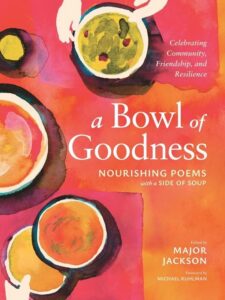
A Bowl of Goodness: Nourishing Poems with a Side of Soup, ed Major Jackson
(Storey)
What happens when poetry meets soup? Edited by Major Jackson, this volume arrived with the comfort-food promise—forty-some poems accompanied by a culinary frame and a sense of solace as we head into a fraught political season. The anthology nods to the tradition of The Hungry Ear, curated by Kevin Young fifteen years earlier, and includes an introductory piece by cookbook writer Michael Ruhlman and artwork by Hélène Blanc. The collection features familiar voices (Neruda, Young), poet couples (Robert Hass and Brenda Hillman among them), new names (Asa Drake), and voices of poets no longer with us (Robert Creeley), along with Vievee Francis’ standout love poem “Beast and Beauty,” which even makes an appearance by a tomato soup. You’ll also find choices that surprise—Mary Ruefle’s “Blood Soup” appears here as a poem rather than a recipe. The pieces invite readers to consider “How to Throw a Soup Party” as a playful, non-recipe piece, and, yes, Jackson’s remark that “I do not eat soup alone” can be read as an invitation to share a bowl with the book itself, or to pair a solitary bowl with other reading, as Gary Snyder’s “How to Make Stew in the Pinacate Desert: Recipe for Locke & Drum” suggests in its own way.
Malgorzata Lebda, Mer de Glace, trans. Mira Rosenthal
(Fitzcarraldo Editions)
“Today, the body was obedient,” opens the opening sequence, “From the Body,” threaded through Lebda’s award-winning Mer de Glace, a work that follows a marathon journey of 1,113 kilometers along Poland’s Wisła, the longest river in the country. Yet these are not simply body-centric poems; the animal and human body repeatedly appears, and the observer notes both sides of the relation. A woman in a window is watched: “I know a great deal about her: she angles her head while smoking / and leans on the frame, she cares about diffuse light / for the fuchsia, placed it in an eastern-facing corner. / She recognizes things. She eats alone.” The speaker encounters “some local men grubby with dirt: they slice bread, squint in the sun, stuff their mouths / with meat, offering some, as if the body’s not a stranger.” The poems remain lucid and restrained while tracing the mind’s wanderings along the river—politics, birth, poetry itself and its making, various deprivations and hungers, and the act of reading: “And here we reach for books that help us close the mouth of night and open our own—bulky tomes where loss is conceived as / a canticle. Beechwood blaze.”
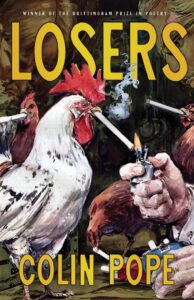
Colin Pope, Losers
(University of Wisconsin Press)
“I recognize with a jolt / I have been doing it all wrong,” declares the speaker at the outset of Colin Pope’s candid and meticulously designed collection, Losers. The opening poem, “Spitting off the Overpass in December,” frames the book as a coming-of-age within a rural North American setting that reveals the learned codes of masculinity and the violence that can accompany them, including abuse by the father, disclosed when the speaker chooses to tell another person about his past: “I could be in jail, I tell her. / That’s what happens to boys like me.” Pope brings forward the speaker’s wide range of jobs as part of the narrative, but in the book’s best-known piece, “On the Various Disciplines of Losers,” he interrogates how labor, class, and identity shape a person’s sense of self and protection—pondering, for instance, whether “two men can fit inside / a single body” and when a person, trapped in a daily grind not of their choosing, should claim themselves, or risk feeling condemned.
