
I. Taking to the Open Road
With a gait of leisure and a sense of unburdened expedition, I step onto the open road, buoyant and carefree, ready to choose my path as the world unfurls before me. The great avenue stretches ahead, a long, earthen trace that invites direction. The horizon yawns with possibilities, and the road itself seems to promise autonomy, an ascent into the unknown that lies beyond each bend.
These sentiments—these visions of unbound mobility—echo Walt Whitman’s verse, which first emerged in 1856 within the second edition of Leaves of Grass. The lines, penned more than three decades before Karl Benz’s invention of the modern gasoline-powered automobile, nonetheless foreshadow the road’s growing allure: a landscape of liberty, promise, and pursuit that would soon fuel a whole culture around driving. Since then, the phenomenon of car culture has not merely appeared alongside cinema; it has evolved in tandem with it, like two streams separated by a thin line yet running parallel in spirit. The open road has become one of the cinema’s most enduring and recognizable images.
You can envision it clearly: the car surging along the asphalt, the radio crackling, the windows rolled down, the road bending toward a distant, fixed point on the skyline beneath a still-blue heavenscape. This tableau is captured from within the car, as if encased beneath a transparent dome. When set against a pair of snow-dusted peaks, the vehicle almost seems stationary, as though trapped in a moment of suspended animation. Yet the nearby scenery—signs, diners, gas stations, overpasses, trees, utility poles, tourist shacks, muffler-men, rock faces, billboards, road signs, and the occasional roadkill—blur as if written by the wind of motion, reminding us that we are moving at a rapid pace. And in the rearview mirror, what we have left behind fades into distance. Ahead lies the unknown, the long, dark highway stretching forward to wherever we elect to go. It is a symbol of escape, movement, adventure, self-discovery, individualism, and, above all, freedom.
Yet when such celestial highways appear within the horror genre, they reveal themselves as something entirely different: highways that steer into hell. As I have argued elsewhere, if a house may promise safety, the house in a horror narrative exposes safety as a crafted illusion, a seductive façade. In the same vein, if roads tempt with freedom, the road in horror exposes that freedom as a mirage.
No matter how far you drive you can never escape yourself.
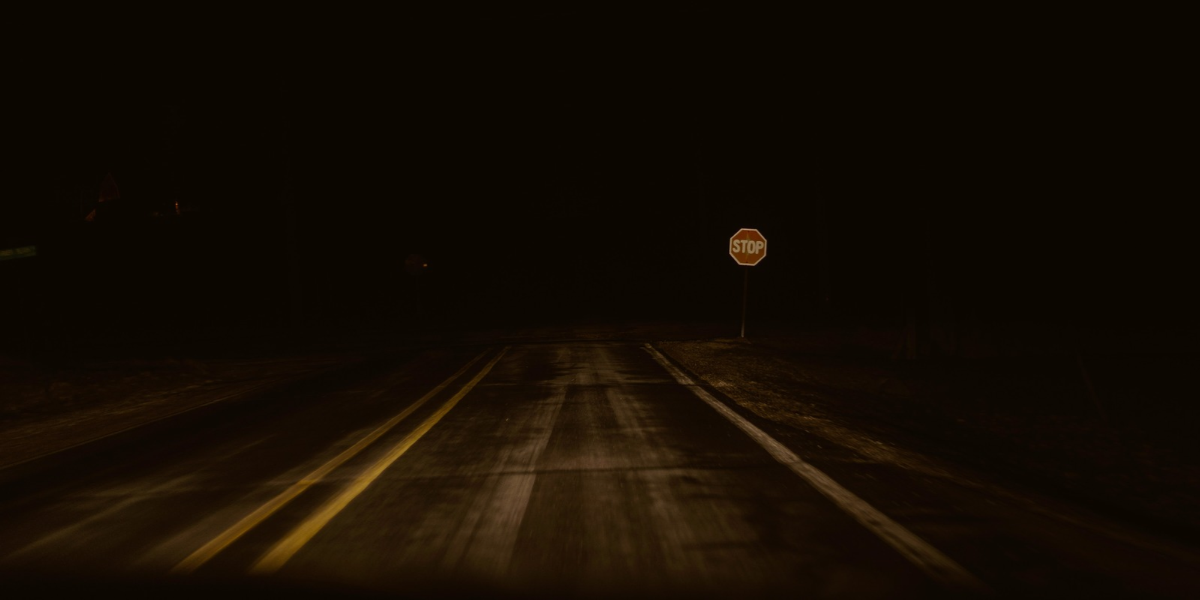
In horror, the automobile casts a luminous glare on the always-already-terror, that concealed world that lies in the shadows of our own, an arena that remains forever inexplicable, even as we glimpse only scattered evidences—the few illuminated lane markers ahead and the encroaching dark that swallows all else beyond the thinning beam of the headlights, much as in the opening sequence of Lost Highway.
II. No One Really Drives Away from Anything
When we peek into a hotel room at the outset of Alfred Hitchcock’s Psycho, one cannot help but notice the arousal of the viewer as Janet Leigh’s figure rises from a white bra, a pair of mountains looming on the horizon of the frame. We have just witnessed the tail end of a midday tryst between Marion Crane and her lover Sam Loomis. Marion confesses to Sam that she abhors the idea of sharing such a space in a setting like this. Sam, teasingly, quips that he has heard of couples who deliberately spend a night in a shabby hotel. Her rejoinder makes the point with perfect bluntness: “When you’re married you can do a lot of things deliberately.”
For a woman who is not wed in 1959, there remains a bank of prohibitions about what such a status would grant her in the name of “respectability.” Thus, her belief that marriage might serve as a doorway to greater liberties should come as little surprise: by tying herself to a husband, a woman in mid-century America could often secure a broader range of freedoms than she would sacrifice.
Sam, who has already endured a prior marriage—and is burdened by his father’s debts as well as the alimony obligations to his ex-wife—carries a different outlook. To him, marriage stands for constraint. It is not that he has lost interest in Marion; rather, he cannot allow himself the vow of wedlock again until his finances stabilize. In short, both Marion and Sam remain **caught within the same patriarchal matrices** that restrict them—though in distinct ways—by design.
In the scene that follows, Marion seizes an opportunity to steal $40,000. The film does not spell out for us that she regards this fortune as the means to a lawful marriage and the freedoms that would accompany it; the narrative invites us to infer this motive with ease. As she departs to bring the money to her companion, the highway may appear to her as a path to emancipation, yet it rapidly morphs into a nightmarish corridor of peril.
Once she is on the road, her thoughts begin to wander as she imagines the responses her crime will provoke. We hear her inner musings through voiceover in tandem with the visual cadence of her driving—a series of mid shots, close-ups, and extreme close-ups that intercut with moments from her point of view as she peers through the windshield at what lies ahead and casts glances into the rearview mirror at what she has left behind. Her sense of self appears split: she attends to the road’s realities while her mind travels outward into the past, her guilt, and the crime itself. No matter how far you drive you can never escape yourself.
Hitchcock lends the road an uncanny authority. Marion’s danger is not immediate, not yet, but the driving sequences are suffused with a mounting dread—the sense that danger stalks her from within, a private trap of her own design. The atmosphere is claustrophobic, and the cinematography intensifies the precarity, imbuing the journey with a sense of pending catastrophe even before the event itself arrives. Marion is trapped not in a physical cage but in an interior one, a psychic enclosure that she enters long before she actually encounters any external menace. The road is already a private prison, even if its gates remain closed to the world outside.
As night falls and rain slicks the windshield, Marion veers off the paved highway onto a byway that the modern road has long since bypassed. A neon beacon appears in the murk—a sign reading BATES MOTEL with a secondary line, VACANCY.
Here her road trip ends, only fifteen miles from her target destination, in a motel shower. Before stepping into that enclosure, she converses with Norman Bates, the establishment’s proprietor, about private traps and private islands. He remarks that “no one really runs away from anything.” He believes there is no true escape for any of us: “We’re all in our private traps, clamped in them, and none of us can ever get out. We scratch and claw, but only at the air, only at each other, and for all of it, we never budge an inch.” Freedom proves to be less a promise than a perception—illusory and elusive.
Marion does not ride off into the sunset with a man who could have been her future husband; she has careened directly into danger. Paradoxically, the danger is not a direct consequence of her theft; Norman Bates’s motel harbours a vacancy in comprehension, even if a psychiatrist attempts to rationalize it at the film’s denouement. In horror, the road leads to the un-understandable.
Psycho stands as the ur-text of road-horror, even though its driving sequences occupy less than a sixth of the film and unfold during the first third. It is precisely here that cinema’s perception of the road pivots, reversing the Whitmanian charm of the open road in favor of acknowledging the road’s always-already-terror.
The car becomes a private trap veiled as a private island. The illusion of escape dissolves when one thinks that escape is truly possible; think you are slipping away and you will collide with your own interior, because the essence of our burdens travels with us, hitching a ride every time.
The car is, first and foremost, a sex object.
III. Driving Is a Spectacular Form of Schizophrenia
David Lynch described Lost Highway as a “psychogenic fugue”—a state in which a person experiences dissociative amnesia, forgets their identity, and often adopts a fresh persona that wanders in confusion. This resonates with Jean Baudrillard’s assertion in America that “Driving is a spectacular form of amnesia. Everything is to be discovered, everything to be obliterated.”
Yet Psycho counters Baudrillard’s current of thought. While the outside world can take on a spectral sheen at high velocity, driving does not erase the driver’s mind. Movement does not erase consciousness; it merely rearranges it.
What if driving should be understood as a spectacular form of schizophrenia? The driver acquires a split self: on one hand, a detached observer who experiences amnesia, but on the other hand, a paranoid mind whose mental life runs wild with memories, fantasies, plans, and streams of thought. The claim is not that Baudrillard is wrong; rather, he is only half-right. The emptiness that the road provokes must be inhabited—by the mind’s own inventions. The brain manifests its own traffic.
The road demands attention: we must stay within our lanes, observe shifting speed limits, respond to the behavior of fellow drivers, watch for exits, and so forth. One mode of self remains focused on the road’s immediate requirements, while a second mode rides free—imagining, probing, dreaming, recalling, devising, and playing. Not only does the first self’s attention emancipate the second, but the second self often emerges from the body’s sedentary state, born of tedium and routine. Repetition of the drive—the mechanical acts that keep the car going—provides the ground upon which consciousness can proliferate and wander.
IV. The Royal Road to the Un-Understandable
The schizophrenic self forged within the confines of a vehicle links road-horror to dreamlike states. As in Lost Highway, the driving event is not merely a journey through external space but a movement of inner reality that may fracture the world around it.
Lynch’s film unfolds in ouroboric fashion, bookending with the same image: a highway’s sweep into darkness, the only illumination coming from the fractured lines of the road under the headlights.
One of the road’s perennial attractions is its linearity. Whitman’s expansive path appears to lead us wherever we choose. Even when the road curves, it still makes a clear path away from the starting point. It has a clear origin and an intended destination. It is a route outward. The nightmare of Lynch’s cinema is that the road’s linearity—and by extension, our own sense of progression—may be a fiction as airy as the freedom it promises. Movement is not universally progressive. The road can become a Möbius strip, a continuous loop that folds back onto itself, echoing the way we twist inward as we travel outward.
Distance is frequently warped in horror by spatial and temporal disjunction. Michael Myers, for instance, can stalk his quarry at a measured pace yet always seems to close the distance. This flattening of space becomes even more extreme on a highway, where a motorized reach extends far beyond what one can achieve on foot.
In Robert Harmon’s The Hitcher, the hitchhiker John Ryder appears at odds with both the road and its landscape. Whether he is a projection of Jim Halsey’s consciousness or a distinct, dreamed-up figure, Ryder never occupies a stable reality; he appears, vanishes, and reappears as a quasi-dream presence. This trait is not peculiar to that film alone but echoes across other hitchhiking specters in horror—the Dust Devil in Dust Devil, the Passenger in Passenger, and so on—as well as of other eerie, faceless vehicle antagonists like the tanker in Steven Spielberg’s Duel, ever waiting around another bend to strike.
Nevertheless, the dreamlike quality of road horror does not render the driving episode amnestic in the Baudrillardian sense. Even if it allows temporary escape from the past or from one’s identity, dreams nonetheless remain rooted in the self. It is precisely why Sigmund Freud championed dream interpretation as the royal road to the unconscious: dreams are not random or meaningless; they express repressed urges and hidden struggles wearing the costumes of fantasy in the theater of the sleeper’s repose.
Although dreams entwine with our desires, Freud’s royal road to the unconscious is not unlike the road in Lost Highway and in other Möbius-strip horrors such as the purgatorial Dead End. The unconscious refuses to be mapped or attained as a destination. If Freud’s path leads somewhere, it leads to the impossibility of arrival. It is, if you will, the royal road to the un-understandable.
V. Auto-Eroticism
The road toward horror is paved with a potent blend of sexual impulse and fatal attraction. Since the dawn of modernity, the automobile has consistently functioned as a focal point for Freud’s two primal drives—Eros and Thanatos (those delicious burdens).
Primarily, the car is a sex object. Its construction of masculine potency makes it a perfect emblem of virility. The need for velocity becomes erotic, and the car itself embodies and indulges this longing. The engine’s throbbing is a metronome for bodily pleasure.
Before cars became ubiquitous, movement itself carried sensual connotations. In an early essay, “Infantile Sexuality,” Freud remarks that there is a compelling link between the sensation of motion and sexual enjoyment: “A compulsive link of this kind between railway-travel and sexuality is clearly derived from the pleasurable character of the sensations of movement.”
The un-understandable which has dominion over our meat likewise has dominion over our machines.
Earlier modes of transport—horse-drawn carriages—gave rise to romantic encounters, yet the mass production of Henry Ford’s Model T opened up private spaces for countless youths to explore intimacy away from parental oversight. The car emerged as a sanctuary for experimentation, reshaping social norms around sexuality and helping usher in broader changes in sexual mores during the twentieth century.
In the discourse of Baudrillard’s The System of Objects, the car is a site of intimate ownership: “In the love relationship the tendency to break the object down into discrete details in accordance with a perverse autoerotic system is slowed by the living unity of the other person. When it comes to material objects, however, and especially to manufactured objects complex enough to lend themselves to mental dismantling, this tendency has free rein. With the automobile, for instance, it is possible to speak of ‘my brakes,’ ‘my tail fins,’ ‘my steering wheel’; or to say ‘I am braking,’ ‘I am turning’ or ‘I am starting.’”
He points out that the horse cannot sustain the same ownership logic: you would not claim “my hooves” in the same way you might claim “my tires.” The car becomes a machine that we are not simply owning but becoming—an extension, a prosthetic. This is the modern myth of the centaur, a cyborg-like fusion of human and machine.
In John Carpenter’s Christine, the car itself becomes a creature of sexual desire and possessive fixation. Christine functions almost as an autonomous lover, performing seductive self-presentation and acting as an externalized projection of Arnie Cunningham’s inner longings. Even if one accepts the premise that Christine is possessed, the relationship transcends a mere romance between two sexual beings; it becomes a narcissistic projection in which Arnie seeks in Christine a perfect image of himself.
Thus, auto-eroticism remains a form of auto-eroticism: the encounter with a true other persists only as a potential, because the driving encounter remains fundamentally bound to the car’s being an outgrowth of the self. The vehicle is the active agent, but its agency serves the same core drive—desire, extended and intensified through machine, rather than replaced by it.
In Christine, the possession of a killer car is a dramatic exaggeration of a universal truth: the vehicle’s capacity for violence is paired with its anodyne certainty—the crash is a foreseeable fate whenever the accelerator is pressed for too long. The notion of accident becomes inverted: what we call an accident is often the most likely endpoint of continuous driving, a tautology of modern driving culture. The thrill and the peril are bound together, and the pursuit of pleasure keeps inviting disaster.
European filmmaker David Cronenberg’s Crash, an adaptation of J. G. Ballard’s novel, places eros and Thanatos in direct collision where desire becomes an auto-erotic, accidental recreation. The cult leader Robert Vaughan, who organizes a circle of crash survivors to relive the iconic collisions of famous figures and seek erotic gratification in vehicular wreckage, contends that “the car crash is a fertilizing rather than a destructive event.” The film, however, makes explicit that these possibilities are not mutually exclusive: destruction wounds and reshapes the body’s relationship to pleasure, opening portals to new modes of desire.
Here, the two drives fuse; the crash becomes not only a catalyst for awakening but a recurring impulse to repeat and intensify the event, a compulsive quest whose aim is to recapture a moment of exquisite intensity—an orgasmic rupture—through perpetual recurrence. The proximity to danger heightens the sensation, and the essence of living becomes tethered to recapitulating the accident that once sparked it.
Following this trajectory, Julia Ducournau’s Titane extends the dialogue by presenting sexuality and bodily fluidity as phenomena born from a traumatic accident. Both Crash and Titane foreground the recurrent auto-erotic impulse, yet Titane pushes Vaughan’s premise about the “reshaping of the human body by modern technology” even further. Desire becomes a trans-mission-fluid coursing through mechanical interfaces, through which the machine, in turn, projects back onto the being. The cyborg myth of car culture promises mastery over technology while also exposing our precarious control over our own flesh: as the distinction between human and machine blurs, the boundaries of bodily autonomy may become even more uncertain. The un-understandable—the sovereign force behind our flesh—also wields sway over our machines.
VI. Rearview Mirror and Windshield Diplomacy
If the open road is supposed to offer escape from others, a space where the self proliferates and auto-erotic energies unfold into more complex encounters, the reality of any driving episode is far more relational: every journey in fact becomes a road-encounter with others—co-passengers, other drivers, pedestrians, hitchhikers, and people encountered in places where the journey pauses.
Diplomacy is always a two-way street. It is built on reciprocity. We must make concessions and compromises.
The windshield, the windows, and the rearview mirror of a car—together with the oneiric ennui and paranoid currents that acceleration can unloose—create a crucible for a distinct kind of voyeurism that is both passive and active.
Hitchcock’s Rear Window, though not a road-horror, leans into the ethical dilemmas of encounters with the other, especially in relation to voyeurism. The film’s central figures, L. B. Jeffries and Lisa Fremont, discuss “rear window ethics.” Jeffries, immobilized after an accident, fears the ethical implications of watching others through his binoculars and a telephoto lens; Stella, his caregiver, laments, “we’ve become a race of Peeping Toms.”
Richard Franklin’s Road Games, a loose remake of Rear Window set along Australia’s Nullarbor Highway, translates this quandary into a road-centered frame. In this film, Patrick Quid, a truck driver, delivers meat coast-to-coast. Although mobile, his mobility is nonetheless circumscribed by the cab that serves as his mobile home. According to Baudrillard, “The car achieves an extraordinary compromise, for it makes it possible to be simultaneously at home and further and further away from home.”
Thus the automobile remains a private space, yet on the road it becomes a private space within a larger public arena. Its windows enable those within to observe the world outside, but they also allow the outside looking in. We are at once unwitting exhibitionists and deliberate voyeurs.
Where Jeff’s neighborhood is shaped by built architecture, Patrick’s is organized—or disorganized—by movement. The road’s neighborhood is unstable, fluid, and precarious. The travellers he encounters along the way (and who encounter him) pass him by, fall behind, or surge ahead. Proximity is temporary, fleeting, provisional.
In Rear Window, Jeff can rest back and watch his neighbors in passive observation, but such a luxury is not extended to a driver in motion. A driver must participate; he chases, he is chased, he collides, and he becomes a mover in a drawn-out social drama. He may even pick up hitchhikers, among them a runaway daughter of a diplomatic official who jokes about life in Canberra’s diplomatic circles. The road thus becomes a theater of interaction, where diplomacy must be enacted and negotiated. It is not simply a matter of ethics of looking; it is about how to relate to others through the windshield and the rearview, about how to balance looking with speaking, and how to strike a course that preserves safety yet allows for contact.
Diplomacy, after all, is inherently reciprocal. Without mutual respect, the highway becomes a field of danger. This is why Steven Spielberg’s Duel lands with such unease: the driver of the tanker truck that menaces David Mann refuses any form of negotiation or de-escalation. His behavior is anti-diplomatic—almost psychopathic—and his lack of regard for others turns the road into a land mine of menace. The unseen driver’s face is deliberately concealed, reducing him to a priori machinery, a thing whose actions are opaque and terrifying in their lack of motive. The car, in that sense, is a machine as much as it is a conduit for terror, and the road becomes a space where human communication collapses into confrontation.
VII. Here Is a Man Tallied
Even if the road itself resembles a Möbius strip that loops back upon itself and leads nowhere, it is far from barren of meaning. The road grants opportunities to come face-to-face with the self, with the other, with the raw materials of existence—a confrontation with matter, machine, sexuality, fear, dream, desire, drive, and memory.
In this sense, the legacy of Whitman persists as a shared horizon, even as horror revises the tone of that horizon. There remains a certain kinship with Whitman’s vision of realization and the concept that a man is “tallied” by what he carries within: the past, the future, grandeur, and love. Yet if the road promises realization, it is a realization of the always-already-terror—the hidden vacancy that lies at the heart of every journey. The long, black highway that lies ahead is a perpetual test of our ability to endure, to navigate, and to recognize that we are perpetually colliding with the same internal empty space, the same accidental recreation of ourselves as we traverse the road.
