
To inquire about Tolkien’s view of God resembles the task of probing what Karl Marx thought about socialism or how Samuel Pepys regarded keeping a diary. In each instance the subject dominates the surrounding world to such an extent that it behaves like a force of conquest, reshaping everything it touches, inevitable, an overpowering engine gathering the entire scene into its wake. Tolkien, it would be fair to say, perceived divinity everywhere: in the finest grain of his daily routine and in the landscapes beyond it, in his friendships, in his hopes and aspirations, and most of all in his artistry. If he did not share the enthusiasm of his friend Charles Williams’s lurid supernatural thrillers—where evil stalks the city streets and demons loom from rooftops—then he would have agreed with Williams that God’s hallmark is ubiquity.
There exists a revealing letter addressed to his friend, the Jesuit priest Robert Murray, written just before The Lord of the Rings began to emerge, which marks the imprint of that divine influence. In it Tolkien states that the work is “a fundamentally religious and Catholic work, unconsciously so at first, but consciously so in the revision.” He meant that during the revision process he had carefully removed references that might point to a belief system in Middle-earth, while allowing the religious essence to be “absorbed into the story and the symbolism.”
Tolkien, it is fair to say, saw God everywhere…above all, in his art.
As a teenager raised in a fairly conventional Anglican milieu, I felt the subtle stirrings of these symbolic currents, the sense that beneath the sword-and-sorcery and the hobbit songs lay something deeper, elemental, crafted with quiet precision, so that nothing appeared entirely as it seemed. Much of this sprang from the well-known themes of penance, redemption, virtue, burdens that must be borne, assignments handed down to those who began them, or to their heirs who must carry them forward. A larger part traced a strong sense of determinism, sometimes bordering on fatalism, and the suspicion that some distant force in Middle-earth—or beyond it—had plans for Frodo and Sam, and for Gollum, that those tools of an otherworldly agency have yet to understand. Yet the most significant portion consists of straightforward biblical resonances: Gandalf being carried up to the peak of Orthanc by Saruman to glimpse a realm he could command if he wished; Gandalf miraculously returning from what had appeared to be certain death, much to the relief of his companions; and the Marian overtones that hover over Galadriel’s conduct in the woods of Lothlórien.
Introducing God into a narrative almost always raises tensions for both author and reader. The core difficulty is that the divine presence often supplies an easy escape hatch, allowing the writer to bypass a rigorous, realistic approach when the going gets tough. Piers Paul Read’s The Upstart (1973), one of my favorite “Catholic” novels, follows a rather spoiled middle-class ingrate named Hilary Fletcher, who, in his belief that the aristocratic family down the road patronized him, ruins their son financially and seduces both their daughters. Fletcher’s solution to the mess is to stroll into a confession booth and repent. Given the improbability of such a turn from Fletcher’s previous behavior, Read would probably reply that divine providence operates in mysterious ways, with the aim of guiding sinners back toward the fold.
If Tolkien, in introducing God into his fiction, manages to avoid having to choose between a flawless doctrine and a plausible narrative, it is because his God appears only where one knows to search for Him, unadvertised and operating in a stealthy fashion, so that a completely secular reader could interpret the moment of a re-clothed and revived Gandalf appearing in Fangorn forest without feeling a moral tremor. A wizard in a fictitious world or God’s will manifested on a reimagined earth? Either reading works, and both are defensible.
All this, as Tolkien himself notes in the same letter to Father Murray, represents the gradual discharge of a kind of existential debt—a debt that reaches back to childhood and becomes evident in gratitude for being brought up “in a Faith that has nourished me and taught me all the little that I know.” The author’s mother, Mabel Tolkien, “held fast to her conversion and died young, largely through the hardships of poverty resulting from it.” One can infer that she bore the burden of her faith. It falls to her son, if not to avenge her death—Christian deaths are not to be avenged—then to emulate her and safeguard her immortal spirit by means of his own virtuous conduct. All this endowed Tolkien with a powerful spiritual purpose that shines through his life, yet it also rendered him inflexible, too ready—by early twentieth-century standards—to sacrifice human psychology on the altar of faith. Even in his treatment of Edith, his courtship can appear autocratic by modern eyes: the world he envisioned for his future wife required that she convert to Catholicism, a condition as simple as it was fraught.
Meek, trusting and confident that at all times his path through life was lit by divine lamplight, Tolkien swallowed his Catholicism whole.
To someone who does not share his belief, the conundrum of Tolkien’s Catholic orthodoxy is that it coexists with a stubborn skepticism in nearly every other facet of his daily life. To specify, he projected beliefs about God, Heaven and Hell that he would never assume about any medieval manuscript he encountered. Yet there exists abundant evidence of his sincere piety. He not only believed in miracles, visions and what he called “Christian joy,” but also eagerly shared his personal experiences. A letter to his son Christopher written in the 1940s recounts a moment of spiritual awakening at St. Gregory’s, his Oxford parish church, in which he “perceived or thought of the Light of God and in it suspended one small mote (or millions of motes to only one of which was my small mind directed), glittering white because of the individual rays from the Light which both held and lit it.” He concluded that the ray was “the Guardian Angel of the mote: not a thing interposed between God and the creature, but God’s very attention itself, personalized.”
That same pattern appeared in the accounts of divine interventions in human affairs that he heard from the pulpit at St. Gregory’s. He recalled the Lourdes episode of a small boy with tubercular peritonitis who met a little girl who had been healed and brought back to health, remarking, “So plain and matter of fact: for miracles are. They intrude into real life, and so they must be sustained by ordinary means.” In the end, God, if anything, is revealed as part of the ordinary. When he watched the Hollywood drama The Song of Bernadette, the patron saint of Lourdes, he regarded it as a most remarkable story in both its human and its spiritual dimensions. Meek, trusting and confident that at all times his path through life was lit by divine lamplight, Tolkien embraced his Catholic faith wholeheartedly. This gave him a moral compass and a humility that many twentieth‑century writers lack, but it also made him stern and unyielding, especially in matters of spiritual allegiance. Edith could not alter his insistence that she join him in conversion; she either accepted Tolkien as he was—and thereby accepted the implications for her own life—or moved on. The tests that Tolkien’s own characters must face are equally stark. In The Lord of the Rings, no one wins through detachment or liberal equivocation; the stakes are simply too grave for such comfort.
_______________________________
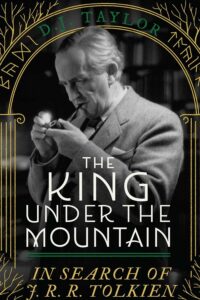
From The King Under the Mountain: In Search of J.R.R. Tolkien by D.J. Taylor. Copyright © 2026. Available from Pegasus Books.
