
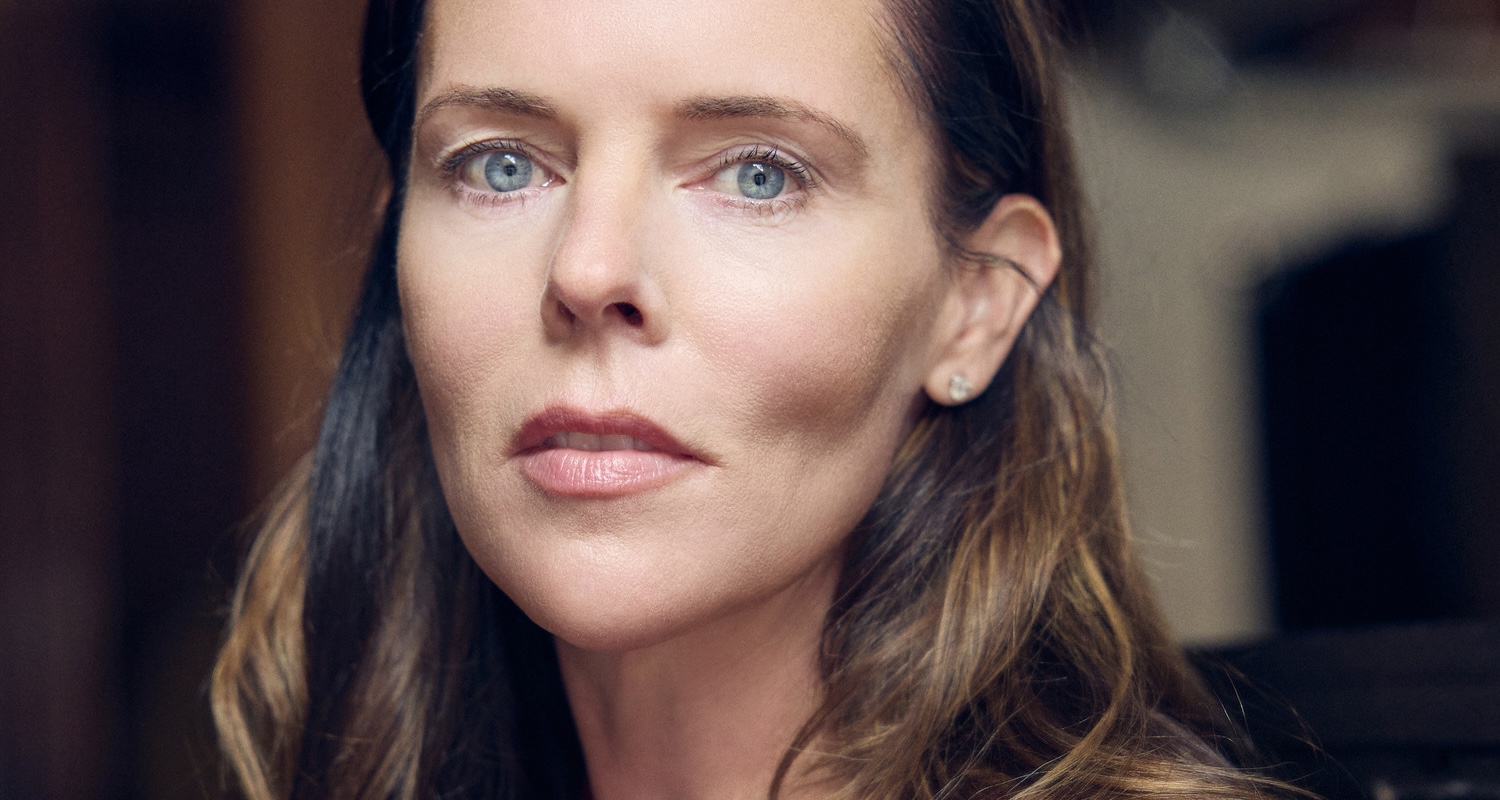
I’ve long found Ireland and its history deeply compelling, partly because my own family line includes a paternal great-great-grandmother who left County Cork for Galveston in the 1800s. Mary Beth Keane’s Whale Harbor, her fifth novel, proved to be revelatory. It traces several generations of a single Irish family as they relocate to England, Montana, and New York beginning in the 1960s, conveying intimate, emotionally nuanced moments. Keane’s talents as a storyteller shine through the voice of the narrator, Mac—the second oldest of the brothers—rendering the tale with a magical quality.
After I finished Whale Harbor, I passed the book to my beloved Mark, who descends from Italian and Finnish lineage and grew up among many Irish immigrants in Butte, Montana (the city shows up in a handful of early scenes). He was equally captivated; he described this saga of eleven brothers in the Irish diaspora as “captivating.”
Naturally, I was curious whether this historical novel drew from Keane’s personal history. What inspired her to write it? I asked. “I hate to begin on a sorrowful note, but this story found its roots just after my father’s death in 2022,” she explained. “When his dementia progressed to the point that, at times, he spoke only in his first language—Irish, which my sisters and I don’t understand—my uncles translated for us and mentioned a fixation on a choice he made in 1963, shortly after his mother passed away. In our family lore, my dad emigrated to America at nineteen, and one of his younger brothers—now motherless—begged to come along. That brother was too young to leave, so my dad told him to be patient; in a few years, with a solid job and stable housing, he would bring him to New York. About a year later that brother ran away. I only realized how much guilt my father carried until his final days, when he kept revisiting that moment.”
*
Jane Ciabattari: You mention in an author’s note that Whale Harbor shares “certain plot points” with your father’s life, and that he grew up in an Irish-speaking village in Connemara, the second of eleven siblings. Does your family history align with this tale of multiple generations tied to Ireland, who migrate to England, Montana, and New York City?
Once I began writing this family, they quickly moved away from their real-life inspirations and became entirely themselves.
Mary Beth Keane: The two central events of the book come from my family history—the death of my grandmother just weeks after giving birth to her eleventh child, and one of my uncles running away when he was thirteen. Those incidents were discussed at countless family gatherings for years, and even though no one explained them to the next generation, we were perceptive listeners who picked up on everything. No one wound up in Montana, but I did have an uncle who settled in Alaska and worked on the pipeline for thirty years. He visited New York annually, and some of Mac’s Montana impressions borrow from his experiences. I chose Montana for Mac’s journey because my father harbored a lifelong fascination with the state, and I regret not arranging a trip for him there. Despite these overlaps, the novel remains a work of fiction. For me to write convincingly, I must feel fully authorized over the characters and the story, so once I started shaping this family, they swiftly diverged from their real-life counterparts and became wholly their own. If I had attempted to mirror real life more closely, I doubt I could have written with free rein without feeling constrained.
JC: How did you manage to craft a roster of eleven siblings—five “oldest” who sleep in the loft, the next four who share the room below, and the newborn who sleeps with the parents—so that each character lived in a distinct place within the household?
MBK: This was one of the most daunting tasks in the early drafts. Three dozen names would have stretched the imagination, given there are eleven children in real life. A fortunate turn came when Coleman, who is sixth in birth order, stays close to home because developmental delays at the time would have left him without support. He embodies warmth and innocence and I began to treat him as the family’s heart. Once Coleman existed in my mind, I divided the others into two groups—older than him and younger than him. I wanted readers to sense that a chorus of boys surrounded the family, each grieving in his own way, without needing to keep exact track of every single one. I assigned small, distinctive traits and aimed for the impression that, in certain scenes, exact attribution of who says what mattered less than the presence of a thought being voiced.
JC: Why did you settle on a third-person perspective with Mac, the second-born, serving as the principal narrator?
MBK: I find I can approach a character more closely through close third-person narration than through first-person. I can observe aspects of a character—things they cannot see about themselves. I enjoy reading novels in the first person, but for me writing one has always felt a touch disingenuous.
JC: In the novel’s opening pages, Mac walks with his mother as she asks, “Are you missing your brother very much Macdara,” noting that his elder brother Sean is in Manchester, England, working at a railyard. Mac marvels at his mother’s ability to understand every possible emotion, even when the person himself might not recognize it. How did you manage to draw out the emotional layers of leaving home and feeling left behind—grief, anger, loneliness, isolation, and the frayed ties?
MBK: The feelings surrounding leaving home have haunted me throughout my life. As a first-generation American, I’ve lived with paradoxes. My parents deeply loved America and believed in its promise; they saw its flaws and discussed them at home, yet, for them, America was still the land where you could begin with little and eventually build something close to prosperity. Meanwhile, home remained Ireland. Given the choice—if work and opportunity had existed in western Ireland in the 1960s—my parents would have stayed. So, there’s a baseline grief among new immigrants I knew while growing up. Even after decades in the States, there’s a lingering sense of whether, had they stayed and endured lean times, things might have turned out differently—perhaps a house filled with Irish kids rather than a house filled with Americans. Moreover, returning to homeland visits over the years can confront you with a stark difference between past and present.
JC: Mac’s mother dies not long after Vincent, the youngest, is born. This blow scatters the family. Mac’s father, a postal worker, is so overwhelmed by sorrow and the demands of raising children that he disperses some of his sons (the infant Vincent goes to a cousin) and takes as his wife Nuala, a single woman who has just returned from Chicago, to help. This marks the first of many losses for Mac. How did you convey the impact of grief on Mac and his family as a central theme?
We’ll recognize grief when a character does this or that tiny thing. The things we utter and perform carry their own meanings, as well as something more.
MBK: I don’t deliberately fixate on big emotions like grief, sorrow, or even joy while drafting, especially in early versions. Instead, I place the characters in action and try to grasp what they might say and do—the everyday worries and hopes they carry. It’s rarely helpful to spell out a feeling in words; I aim to bring the perspective as close to the character as possible and observe them carefully. If I know them well—and if the reader does too—then we’ll recognize that a small action can signify grief, and every utterance and action holds a double meaning.
JC: What kind of research went into portraying Cuan, the small Connemara village where your story begins in 1963, the Irish-speaking Joyce family, and the legends of bygone days?
MBK: Not much formal research was necessary because the village is modeled after my father’s hometown. Almost every anecdote shared at family gatherings could be set in Ireland in the 1960s, and I had already sketched a fairly rich picture in my mind.
JC: How did the whale come to hold such symbolic weight?
MBK: The whale’s significance grew as the drafting progressed. I knew it would knit the village together in the opening, but I hadn’t anticipated how often it would reappear in later scenes. Once I recognized that possibility, it made sense to keep the whale as a throughline connecting different sections and time jumps.
JC: When Mac’s neighbor PJ (the older brother of his friend Martin) leaves the Cuan for Montana, their teacher tells the children about the Irish in Butte and shows them a photo book of a cemetery bearing the same names as in Connemara. When PJ visits the Cuan from Livingston with his wife and Martin eventually travels to Montana, Mac follows. How did you craft the episodes that depict the Irish community in Montana?
MBK: I’m not avoiding the question, but I simply imagined them. First, I considered what Mac would have known in Ireland—the sensory textures, smells, sounds, and landscapes there. Then I envisioned how those elements would translate to Montana. The initial difference would be the absence of proximity to the sea, which would alter the air and the feel of the skin. In Ireland, neighbors were often close by; their sounds—bicycle bells, a nearby cough, a roadside conversation—were part of daily life. In Montana, everything felt larger and farther apart. We rarely notice our ordinary sensory experiences until they shift.
JC: Which sources aided you most in charting the Irish migration routes to New York over the decades covered in the book? (For example, by 1982, lingering tourist visas no longer sufficed for staying; to reach the Bronx, the youngest brother Vincent had to fly to Canada, stay a week, and re-enter through the trunk of a car.)
MBK: That kind of knowledge comes from lived experience in my family. My father was the second eldest of eleven siblings, all of whom emigrated to New York. My mother was the seventh of nine, with several of her siblings also making the move. Their social circles followed similar patterns after settling here, and if there’s a stereotype about Irish people, it’s that they enjoy telling stories. We lived in small houses, and I was an eager listener, so I understood early on that people reached America through a variety of paths depending on the era.
JC: What are you working on now or next?
MBK: I’m at an extremely early stage with a new project, and it’s hard to describe at this point. I have bits of characters and scenes here and there, but I don’t outline, so I’m not completely sure what it is yet. Sometimes I begin with separate scenes, and the connections among them only become clear much later in the process.
_______________________________
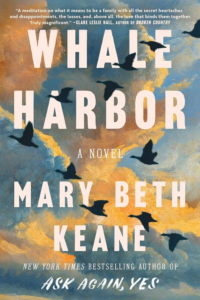
Whale Harbor written by Mary Beth Keane, published by Scribner, an imprint of Simon & Schuster.
