
During the summer of 2024, I began searching for fairy tales that carried LGBTQ+ subtext. In a moment when queer identities face renewed assaults, I find solace in the proof that we have always existed, even within the oldest narratives. Queer authors wrote queer love poetry two thousand years ago, and they continue to do so today. Since fairy tales are close to my heart—the first stories I heard in childhood—I wanted to explore what hidden depths might lie within them.
I did not anticipate finding much. The most famous fairy tales lean heavily on heteronormativity and rigid gender roles—Snow White, Sleeping Beauty, and Cinderella are all expected to wed princes, and after that, their journeys end—but I was confident there would still be something to uncover. There always is.
With a bit of digging, I uncovered a tradition of folktales, myths, and fairy tales that carried not only queer subtext but openly queer content. Dozens of stories follow a broad pattern:
1) The central female figure adopts a male disguise.
2) She develops affection for, becomes engaged to, or marries another woman.
3) In the end, the heroine is magically transformed into a man.
In the Aarne-Thompson-Uther Index (ATU) system of folkloric classification, which catalogs thousands of tales in groups based on shared plot elements, this pattern is identified as tale type 514, “The Shift of Sex.”
Some of these tales are extraordinarily ancient. The Greek myth “Iphis and Ianthe” and the North Caucasus Nart saga tale “Alimbeg’s Daughter” both trace back thousands of years. Many of the stories are clearly interrelated, sharing motifs that surface with frequency across diverse traditions—such as a talking animal, often a horse, or a sequence of trials meant to prove the disguised heroine’s masculinity. They may have originated from a single tale that was reshaped as it spread through different lands and cultures. Yet the stories can also diverge widely within the loose ATU 514 framework. In one version the heroine might be tasked with collecting back taxes from venomous snakes; in another she might need to free a woman imprisoned inside a hazelnut. Fairy tales can be wonderfully strange.
I found myself wondering what would happen to a nonbinary protagonist, someone outside the traditional roles entirely.
When I first encountered these narratives, I felt a sense of delight. Trans-positive fairy tales! And some truly fit that description: in the Serbian tale “A Woman Became a Man,” the title character deeply desires the transformation and achieves it through a complex ritual that involves a duck stolen from the head of a sleeping outlaw. (Why the duck matters remains a mystery.) I’m especially fond of the ending of the Finnish tale “Satu,” where the protagonist simply hands a pile of money to a witch to complete the transformation. A couple of the tales are also notably lesbian-friendly; the two women who share a romance are pleased when the heroine sheds her masculine disguise. The Chilean fairy tale “Florinda” and the Spanish tale “The Story of the Unicorn” are particularly strong examples of this. In “The Story of the Unicorn,” the two women even live as a married couple for years before the protagonist’s final metamorphosis into a man.
But as I studied the stories more closely, I realized that most of them weren’t as queer-affirming as they appeared. Fairy tales shift depending on who’s telling them. Over the centuries, many of these stories traveled through eras and regions that didn’t look upon queerness with approval. When that happened, queer erasure often followed. In these cases, the queerness couldn’t be erased completely without destroying the plot, but it could be downplayed. So the heroine usually doesn’t actively seek the transformation; more often, it’s imposed by an external force, such as a curse. Most of the time, it seems to occur solely to secure the “right” ending, with everyone locked into traditional roles by the time the tale concludes.
Like many queer writers, when I encounter a story that makes assumptions about gender, I feel compelled to question those premises. I began to wonder what would happen to a nonbinary protagonist, someone outside conventional roles altogether. Much of Jules’s experience with gender draws from my own journey (and isn’t meant to be a universal portrait of nonbinary people). Like Jules, I traversed a long, winding path to accept my own gender identity. We both grew up in eras and places where the term “nonbinary” wasn’t part of the conversation—Jules in a medieval fantasy setting, and me in 1980s America. Yet nonbinary people have always existed; they simply had not always been labeled as such.
_______________________________
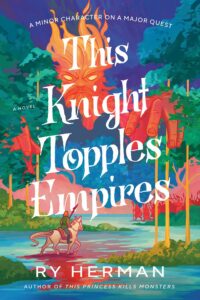
Excerpted from This Knight Topples Empires by Ry Herman. Copyright © 2026 by Ry Herman. All rights reserved. Available from Dial Press, an imprint of Random House, a division of Penguin Random House, LLC. No part of this excerpt may be reproduced or reprinted without permission in writing from the publisher.
