
Hidden beneath the seventeenth-century Palace of Westminster lay a medieval undercroft, enduring like a line of erased poetry that new verse never quite erased. The space measured roughly 77 feet in length, 24 feet in width, and 10 feet in height, a geometry well suited for hiding 36 barrels of gunpowder. If that mixture of sulfur, charcoal, and saltpeter had exploded when King James I opened Parliament on November 5th, 1605, it would have blown apart the patchwork of medieval and Tudor structures where the realm conducted its business, killing not only the monarch but more than five hundred parliamentarians, bishops, and judges as well.
Although the plot to blow up the House of Lords involved thirteen conspirators— recusant Catholics who believed toppling James’s government would bring greater freedom to their persecuted brethren—Guy Fawkes is the figure who most people associate with the scheme. Often joked about as the one man with honest intentions entering Parliament, Fawkes was discovered in the late hours of the eve of the attack, the auburn-haired soldier illuminated by an iron lantern and waiting in the damp basement with a box of matches.
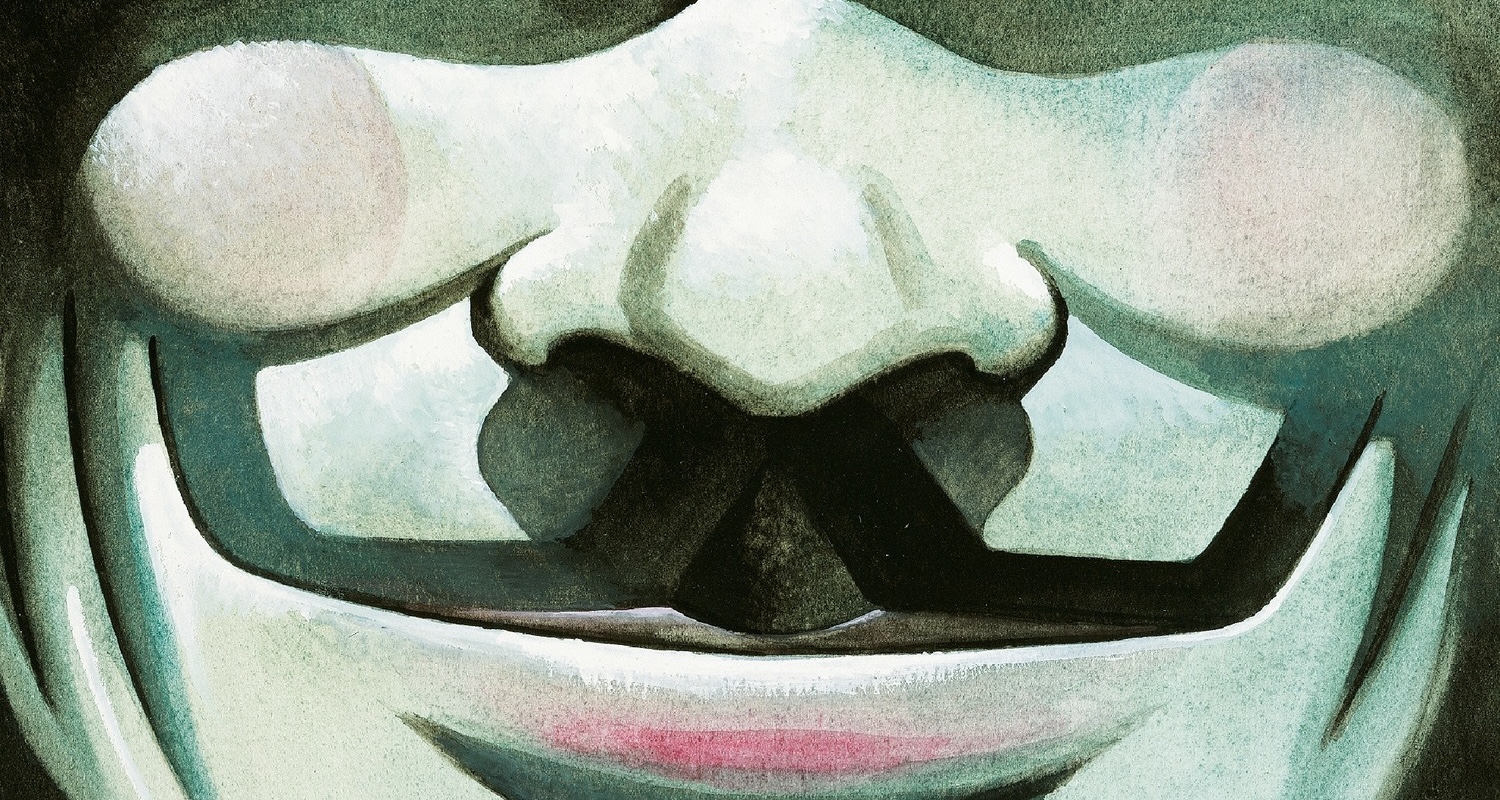
In the centuries that followed, the zealous Catholic Guy Fawkes would be cast as a bogeyman, burned in effigy each year during anti-Catholic “Guy Fawkes Day” celebrations. Today, however, he has emerged as an unlikely subversive icon. Comics author Alan Moore and illustrator David Lloyd, later joined by Lana and Lilly Wachowski, resurrected a stylized mask of Guy Fawkes—with rosy cheeks, dark eyes, a distinctive Van Dyke beard, and a broad-brimmed hat—as the twenty‑first century’s premier emblem of defiance against totalitarian power.
The Guy Fawkes mask has become a signifier for opposition to not just injustice or inequity, but against the pervasive, and not unfounded, feeling that we’re all speed-running towards dystopia.
V for Vendetta, in Moore’s graphic novel and the Wachowskis’ film adaptation, presents a science-fiction saga about a vigilante who battles a future Britain governed by a totalitarian state. In both renditions, Fawkes ultimately achieves his target. The Neo-Gothic edifice of Parliament is toppled amid a roar of righteous fire, while Big Ben’s clock face shatters as Tchaikovsky’s The 1812 Overture blares from loudspeakers.
That Fawkes has attained such a status is peculiar. The monarchy he challenged was unquestionably authoritarian. Yet the Gunpowder Plot’s aim was not so much to abolish a church establishment as to replace Protestant governance with a Catholic version. Still, as Lewis Call notes in Anarchist Studies, Guy Fawkes has been “liberated from all permanent meaning,” the mask of his bearded, harlequin countenance now a “potent instrument for the promotion of postmodern anarchism.” The mask has since become linked with the hacker collective Anonymous and with the #Occupy movement, the Arab Spring, and pro-democracy protests across nations as diverse as Turkey and Thailand. It has been banned in Saudi Arabia and Bahrain, just as the film V for Vendetta was barred in Russia as “LGBT propaganda,” turning the mask into a symbol not merely of resisting injustice or inequality but of a widespread, perhaps justified, sense that we are racing toward dystopia.
Moore’s graphic novel, published as an omnibus in 1989, depicts a nuclear war between the United States and the Soviet Union and the subsequent ascent of the fascist Norsefire party in the United Kingdom. Here, the eponymous hero V is explicitly an anarchist, even as he remains a mysterious swashbuckler wearing a Guy Fawkes mask. “Since mankind’s dawn, a handful of oppressors have accepted the responsibility over our lives that we should have accepted for ourselves,” V declares from behind his mask. “We’ve seen where their way leads, through camps and wars, toward the slaughterhouse.” The political milieu is unmistakably Thatcher-era Britain, with Moore, a self-proclaimed anarchist, drawing on critical theory and a distinctly English punk sensibility.
During the Bush era, the Wachowskis’ screen adaptation seemed to speak more directly to liberal American anxieties. That shift in emphasis did not please Moore, who is famously wary of every adaptation of his work. Still, the filmmakers deserve some credit for articulating a plot that effectively becomes a pro-terrorism narrative—“righteous terrorism,” as some would call it—just a few years after 9/11 and less than a year after the London bombings claimed numerous civilian lives.
Yet, despite the film’s edge, which some find sharper than the source, Moore isn’t wrong to worry about a sentimental Hollywood politics creeping in. V is transformed from a morally ambiguous superman into another Marvel-style action hero. Moore argues that the Wachowskis and James McTeigue have irrevocably Americanized his material, turning a complex moral allegory into a tale of a heroic, self-made individualist, promoting not a genuinely anarchist politics but a bland liberal humanism—palatable to NPR‑toting audiences (and that’s before Stephen Fry’s kitschy if sympathetic appearance as a dissident late-night host).
Not everyone agreed with Moore, however. Lloyd judged the film on its own terms. The renowned anarchist anthropologist David Graeber, in a 2006 Village Voice interview, suggested that “I thought the message of anarchy got out in spite of Hollywood.” Indeed, some far-left groups used the film as a recruitment vehicle.
Nevertheless, upon rewatching the film, now reissued for its twentieth anniversary, one can’t help but notice more of the vengeful Count of Monte Cristo than of Peter Kropotkin in the movie, more Zorro in the swordplay than Mikhail Bakunin—more entertainment than anarchy.
V’s mentor Evie Hammond (portrayed with greater effectiveness by Natalie Portman than critics often allowed, despite a far from perfect accent) contends that her guide “was you… and me. He was all of us.” Yet it remains difficult not to conclude that the true hero of the film remains the archetype of heroism the movie presents. He reads less like a character from George Orwell or Arthur Koestler and more like a figure from a Rudolph Valentino melodrama. The over-the-top swordplay, the witty alliteration, and the Phantom of the Opera-inspired lair where V converses with rescued masters while listening to jazz records are undeniably entertaining. Hugo Weaving, as the masked crusader, savors every moment of his performance from behind that perpetual facade. William Hurt’s casting as dictator Adam Sutler proves a masterstroke, recalling his portrayal of Winston Smith in the New Wave adaptation of Nineteen Eighty-Five. The saddest-eyed Stephen Rea (an actor who later supplied Gerry Adams’s voice on television after Thatcher barred anyone associated with the IRA leadership from speaking) remains the standout in any film he appears in. Yet after Westminster’s masonry and concrete have fallen, there’s little sense of what comes next—how a new society will arise when the fireworks are spent and the Tchaikovsky fades away.
Drawing on the era of the War on Terror when the Patriot Act was still fresh, V for Vendetta nods to the Anglo-American “Coalition of the Willing” in the Iraq War, with hints of Abu Ghraib in the secret prisons where dissidents are whisked away. Yet two decades later, watching the film again, it feels unnervingly prescient.
The film opens with a televised address by Lewis Prothero, a former concentration camp guard now serving as Norsefire’s chief propagandist, delivered with oily efficiency by Roger Allam (an uncanny stand-in for the Iraq War cheerleader Christopher Hitchens). Prothero rails against the collapsing, godless “Ulcerated Sphincter of Arse-erica” and denounces “immigrants, Muslims, homosexuals, terrorists. Disease-ridden degenerates. They had to go. Strength through unity. Unity through faith,” a rhetoric that could easily echo contemporary pundits. Meanwhile, Moore’s original comic reveals that Norsefire’s leader (named Adam Susan in his version) is enamored with a powerful supercomputer that actually wields ultimate authority—a plot point that mirrors the technocratic forces that have since insinuated themselves into modern governance.
Two decades after its release, in an era of Palantir surveillance and algorithmic persuasion, ubiquitous surveillance cameras, and ICE’s public executions, V for Vendetta feels unsettlingly familiar. Yet, by contrast with other dystopian visions, the film’s world appears oddly hopeful in its ending. What once functioned as a warning seems to offer a kind of wish fulfillment.
“Utopia,” a term Thomas More coined in his 1516 romance, is a pun on the Greek for “No Place.” Its opposite, dystopia, first came into use perhaps in the mid-nineteenth century, and it serves as a negation of utopia. The two ideas are inextricably linked, such that one person’s perfect society can be another’s chamber of torture.
Thrilling to totalitarianism and apocalypse at the movies and in our pages, we were perhaps content to fantasize about living in anything short of true dystopia.
Today the adjective “utopian” is more often a political epithet than a descriptor of a genuine ideological project. “At best Utopia can serve the negative purpose of making us more aware of our mental and ideological imprisonment,” writes Frederic Jameson in Archaeologies of the Future: The Desire Called Utopia and Other Science Fictions. In an era when utopia seems nowhere and dystopia feels ubiquitous, what use is this particular narrative, or any of these stories? With no shortage of dystopian tales—Children of Men, Snowpiercer, Mad Max: Fury Road, Blade Runner 2049, and more—the mind struggles to imagine any equivalent utopian fiction.
Mark Fisher, among Jameson’s sharpest readers, writes in Capitalist Realism: Is There No Alternative? that ours is an age defined by the “slow cancellation of the future… a deflation of expectations.” Thrilling to totalitarianism and apocalypse in cinema and on the page, we perhaps settled for anything less than true dystopia. Our nightmares, it seems, have closed off the possibility of our dreams.
Dystopias are meant to empower resistance and critique—yet even these works belong to sprawling corporations. The Handmaid’s Tale is owned by HBO, and the Guy Fawkes mask is copyrighted by Warner Brothers, now under Skydance, controlled by David Ellison, a political ally of Donald Trump. So what do we need to imagine not only opposition to dystopia but something genuinely hopeful?
Even as every utopia carries seeds of its opposite, every dystopia offers, even momentarily or contingently, glimmers of another way of living. Of possibilities for a better world born from the struggle against totalitarian power. The possibility of hope.
Orwell’s Nineteen Eighty-Four, with its chilling image of a future in which humanity is crushed under a boot stamping on a face forever, nonetheless includes a brief glossary that hints Big Brother’s order might end someday. Margaret Atwood’s Handmaid’s Tale reaches a similar conclusion in its epilogue. While neither novel promises a happy ending or a true utopia, they do imply that this, too, shall pass.
V for Vendetta’s significance, in that sense, lies not in a spectacular finale but in a concentration-camp letter written on toilet paper and left for Evie to find when she is ostensibly imprisoned by the regime. The testimony of an actress named Valerie, jailed and tortured for being a lesbian, offers a poignant—beautiful—philosophy of life lived within the confines of an oppressive state.
Valerie recalls being rejected by her parents after coming out, meeting her partner Ruth on set in 2015 (a date that felt disturbingly close as the film arrived), and their subsequent arrest and presumed execution. Despite the grim end to her life, Valerie frames it as a life lived with integrity and honesty, telling a reader who she can never meet that she loves them despite their mutual unknowability. In recalling the love she shared with Ruth, she simply says that “for three years I had roses and apologized to no one.”
Roses, then, stand as the antidote to dystopia. Though blossoms wither, so too do regimes eventually collapse.
As a principle this isn’t merely liberal sentiment. It carries a near-theological, almost mystical weight about the sovereignty of the individual, about the republic born from loving those who are not us. In the meantime, we should gather our rosebuds as best we can, but also dig up the bulbs so our orchards might still bloom. For in the moment a rose exists, there is—no matter how fleeting—that fragile perfection which resists the corrupted kingdoms of this world.
