
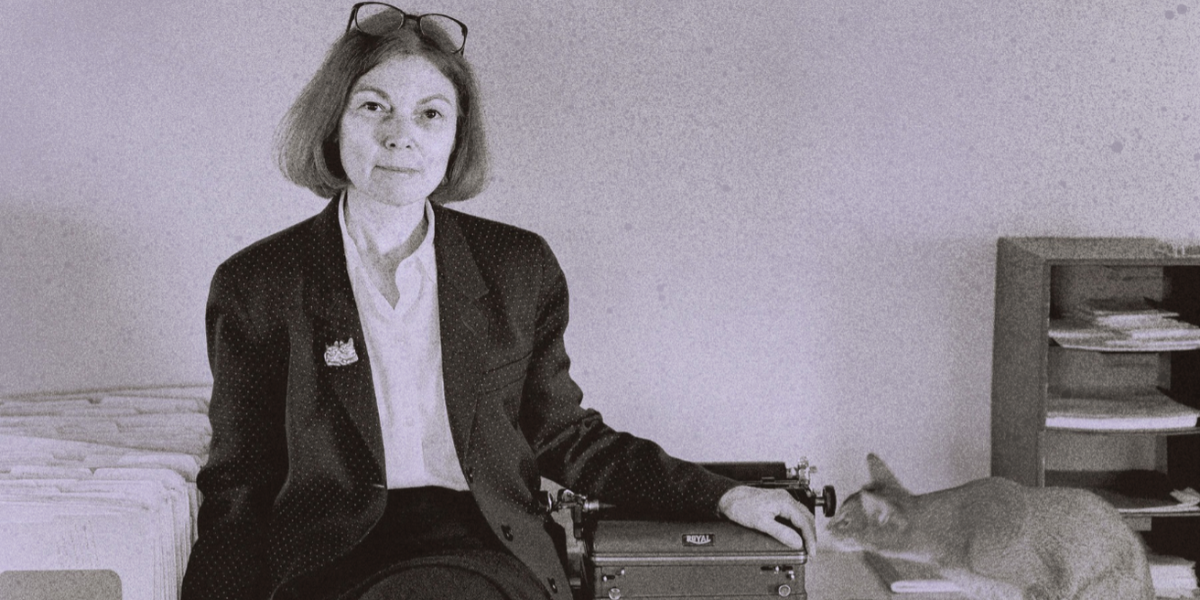
By the time I discovered who Janet Malcolm was, I realized I had been circling around her for quite a while. I had encountered her work long before I knew her name—reading some of her essays during college, enjoying them for pleasure, having a few of her books urged upon me by cherished mentors—but I hadn’t ever had any reason to notice the byline. If you belong to the circle that recognizes her, this may sound almost ridiculous. When you know Janet Malcolm, you’re able to spot her influence everywhere. You sense that she stands as a colossal figure in American letters—a longtime staff writer for The New Yorker, a member of the American Academy of Arts and Letters, a National Book Award finalist, and a trail of distinctions that seems to go on. Even so, if you don’t actively search for her name, her imprint can slip by unnoticed.
This was deliberate. It would be an understatement to say Malcolm cared little for fame. She resisted it with intention. While many prominent writers in her orbit—Susan Sontag, Joan Didion, Renata Adler—became recognizable public figures, the literary “It Girls” of their era, Malcolm did what she could to vanish from the spotlight. She avoided discussing her work. She rarely posed for photographs, avoided interviews, and rarely read aloud in public. When she and Didion celebrated their eightieth birthdays in 2014, New York Magazine proposed a joint tribute, and Malcolm refused. Even for rare appearances, such as a live discussion in 2012 with writer Katie Roiphe at NYU for The Paris Review, she insisted on delivering a prewritten transcript rather than speaking improvisationally. “There was something sublime and deranged about this arrangement,” Roiphe later wrote about the event, “but there was also an elegance to her solution: She had found a way to be both present and not, at the same time.”
Above all, she was fixated on the realities of a writer’s subjectivity long before it was fashionable for journalists to interrogate the limits of their own perspective.
There are several plausible explanations for Malcolm’s celebrated reticence. As a woman, a Jew, and an émigré, she was always part of a minority, albeit one she did not continually dwell on. She was also a late bloomer: her first substantial piece of investigative long-form journalism—what would define her as a writer—appeared in 1978, when she was forty-three. Then in 1984, Jeffrey Masson, a Sanskrit scholar, psychoanalyst, and the subject of Malcolm’s In the Freud Archives, sued her for libel, marring her reputation even though she eventually prevailed. In tandem with that legal marathon—which stretched over more than a decade—Malcolm published The Journalist and the Murderer, a lengthy report about another journalist who had been sued by a subject. The opening line of that piece—“Every journalist who is not too stupid or too full of himself to notice what is going on knows that what he does is morally indefensible”—became one of journalism’s most controversial and frequently cited statements (a reviewer once labeled it Malcolm’s Law). Her peers raged, both because she challenged their vocation and because she initially failed to acknowledge the overlap between her subject and her own life. They branded her a tattler, a backstabber, a watchdog, “journalism’s school slut.” When possible, Malcolm pulled back from the public sphere.
Yet she never ceased writing. In fact, the years during Masson’s case—and the steady criticism from her colleagues in the press—proved to be the most prolific period of her career. She turned to portraits of artists, produced incisive criticism of books and photography, and published several extended journalistic works that would later be celebrated as landmarks of the form. Her approach bore traces of the New Journalists, who used first-person immersion to render nonfiction as vividly as fiction, yet she charted a different path. Perhaps owing to a deep-seated interest in psychoanalysis, she remained intensely preoccupied with the inner lives of her subjects, the psychological dynamics that unfolded in the scenes she witnessed, and the moral consequences of the act of narrating.
Above all, she fixated on the realities of a writer’s subjectivity long before it became common or chic for reporters to question their own vantage point. No matter the topic, each piece she produced was also a meditation on how people tell stories—about themselves and on behalf of others—and on the ethical murkiness of any act of narrating. In her writing, she pursued these concerns with a precise, audacious confidence that invited sharp critique during the years she stood on trial, and earned her the reverence of many readers in the decades that followed.
When I first became truly aware of Malcolm in 2018, this thorny meta-discussion drew me in. She existed in view while remaining shrouded in mystery. At the time, I was a Yale student, hungry for insights into journalism, Freudians, and the messy, intimate detritus of other people’s lives—three rather esoteric fascinations I discovered later were shared with Malcolm. In 2013 she had donated her papers to Yale’s Beinecke Rare Book and Manuscript Library. But when I began examining them five years later, they were only just being opened to the public, making me among the earliest visitors to the Janet Malcolm archive.
Day after day I descended into the library’s subterranean reading room—a place Malcolm herself had spent time in during the early 2000s while working on a book about Alice B. Toklas and Gertrude Stein—to pore over another tangle of her papers. I learned to decipher her handwriting, grew accustomed to the cadence of her short memos to friends, and learned to recognize the stern tone she used when editors crossed her boundaries. Above all, I learned to endure the patience required to comb through overstuffed boxes of unruly, repetitive, and often tedious documents.
Accordingly, Malcolm acolytes will tell you that she is everywhere and nowhere within her work.
What began as material that looked like routine administrative matter gradually revealed itself as a window into her private life. I uncovered childhood documents from Czechoslovakia, her American citizenship certificate, and a middle-school report card tucked away within a shroud of miscellaneous correspondence. I stumbled upon carefully typed instructions for a house sitter about tending to her cherished plants and cats. I began to notice that drafts of the same passage—four or five variations—showed how a writer hustles to begin a sentence, and how a life unfolds in the making of prose.
Most of all, I became entranced by the letters. Malcolm understood the pull: “Only when he reads a subject’s letters does the biographer feel he has entered the subject’s true presence,” she once wrote. As with the rest of her archives, most correspondence was ostensibly work-related. Yet even notes between colleagues or editors carried moments of quiet revelation. While she appears in published form as a calculating, often cool observer who believes a writer’s duty is to judge as well as tell, the messages she exchanged reveal her humanity.
She was warm. She cared about the daily rhythms of her subjects’ lives. She cared about how they perceived her writing and about whether she could influence their reactions. Even as she wrote extensively about the uneasy ethics of the journalist–subject relationship, she could move beyond it: it was not unusual for her to maintain contact with people after finishing a piece about them. Some even became close friends.
My immersion in Malcolm’s archive felt intimate and unsettling in equal measure. I grew intensely attached to her while pursuing a project that I understood she might disapprove of. Much of Malcolm’s writing circles the strange sensation of watching someone else while you write about them. “Biographical research leads to a kind of insufferable familiarity,” she observed in an essay about the Bloomsbury Group. Or, in discussing nonfiction in general, “It is a reckless practice, telling a life story that isn’t yours using an avalanche of random, potentially unreliable information.” Reading those reflections at night after long hours surrounded by her drafts, letters, invoices, and doodles, I found both humor and unease. I could sense, from my own experience in the practice Malcolm loathed, that she might have been right.
Complicating the process was the fact that Malcolm was then alive and in New York City, not just a voice in a book; I simply could not access her directly. Early on I reached out to her, asking if she would participate in the project. She declined. “I’m very sorry, but I must say no to your proposal of talking with me about my work,” she replied. “I simply never do that. I feel my writing must stand on its own. As Isadora Duncan reportedly said, ‘If I could talk about it, I wouldn’t have to dance it.’” This echoed the response she gave most interviewers: the work speaks for itself. So I decided to take her at her word and ask what the work reveals about the writer behind it.
As with the archive, you have to search a little to locate Malcolm within her own pages. Up to the end of her career, she largely refused to write anything that was overtly about herself. As she once told a friend, “No, I don’t think I’ll ever write a book where I do all the talking—too exhausting.” Even in the memoir she produced late in life, she structured it around a sequence of family photographs, which she evaluated with her characteristic distance.
Accordingly, Malcolm fans will tell you that she is everywhere and nowhere in her work. She appears or intrudes when you least expect it: a casual remark about her psychiatrist father, a note asking after a cat’s health. The critic James Wood once described her as moving around her subjects “like a janitor at an orgy.” She treated everyone with the same sharp, detaching gaze. Yet she did not spare herself. Almost every piece about someone else—nearly all of her writing—told two intertwined stories: the tale of the subject, and the tale of the retelling itself, laden with tension and frequently veiled about her own stance and motives.
For instance, in The Silent Woman, her 1994 chronicle of the heated race among writers to tell Sylvia Plath’s story, Malcolm maps the fraught positions of Plath’s biographers, friends-turned-memoirists, and even a former lover, before, about seventy pages in, conceding a personal bias toward one figure in particular. “My narrative would be revisionist,” she wrote, implicating herself in the very problem—namely, the impossibility of any biographer to truly see the subject with complete clarity—that she diagnosed.
Or, near the end of her 2017 profile of liberal political journalist Rachel Maddow, Malcolm allows a peculiar exchange to stand: she becomes obsessed with a distant relative of the news anchor who seems barely connected to the subject, then exposes the mechanics to her reader: “When I told Rachel about my fascination with Ben Maddow and my sense that inserting him into a piece about her was a test of her reportorial stance, she nodded. ‘It seems as inevitable as it is wrong that Malcolm should try out her subject’s method on for size.’”
Once, reading Malcolm’s 1999 legal drama The Crime of Sheila McGough, the writer Ruth Gay—one of her close friends—marveled that “the world according to Janet” functions as a kind of compass for the story. “Someday,” she wrote, “I hope you’ll write more directly about ‘the world according to Janet.’ I feel as if I’m always getting tantalizing glimpses. I’d like to know more.” Reading Malcolm’s writing in search of Malcolm herself feels a bit like that. You glimpse just enough of a personality—observant, clever, biting—yet the details stay just out of reach, leaving you perpetually hungry for more. She’s not absent; she’s not fully present. She lingers at the margins, reminding you that you can never fully trust your narrator, that journalists value the narrative more than the people who populate it (and who make their work possible), yet she does not definitively reveal where she stands within that fraught equation or why she chose to devote her life to a practice she clearly thought riddled with flaws.
Still, Malcolm’s choice to render herself in this way speaks volumes on its own. By turning the “I” of journalism into a character who is self-consciously subjective, she reminded readers that every creative decision in a given piece—every detail recorded, every letter quoted, every subject questioned—stems from her position as a person in the world, not merely as a writer. “We are all in our work,” she once told a wary subject during an interview. “What I write here will probably have more to do with me than with [others].” As she grew more established, this habit became a source of fascination in its own right, inviting readers to look at their strange, elusive narrator rather than away from them. “With its undercurrent of ‘Look at me looking at me looking at them,’ it isn’t voyeuristic, as Malcolm suggests, but a more solitary act,” a reviewer commented on The Silent Woman. “I long for a biography of the brilliant but unreliable Janet Malcolm.”
Spending time with a person whose writing I knew so well was both disorienting and wonderful.
The first body of Malcolm’s writing I encountered was her foray into psychoanalysis, and from that early exposure I absorbed the notion of transference as a guiding concept. Here is Malcolm on the matter: “The idea of transference destroys faith in human relations and explains why they fail: we cannot truly know one another. We must stumble toward one another through a dense thicket of absent others. We cannot see one another clearly.”
With that frame, I started noticing how the facts of Malcolm’s life surfaced throughout her writing, not only in moments where she used the first person but also in the specific details she chose to emphasize about her subjects, and even in the stories she elected to tell. It seemed inescapable that writing about other people functioned as a way for her to parse aspects of her own life and mind. I became fixated on the idea that the people Malcolm wrote about and who were close to her overlapped with certain identities she embodied herself: the émigré, the humorist, the photographer, the observer of the psyche, the defendant, the writer, the artist, and the archivist.
Malcolm did not pretend to be oblivious to this. “How can one see all the ants on the planet when one is wearing the blinders of narrative?” she asked in The Silent Woman. Her central concern—the problem of the nonfiction writer’s subjectivity—remained a driving force. Yet she did not abstain from participation. Take, for instance, The Silent Woman itself: its premise is paradoxical in a quintessentially Malcolmian way—it condemns biography while becoming a biography of biography itself. In it, she casts the biographer as a burglar who rifles through another’s life—especially their papers—selecting details to tell a story that is largely the product of the biographer’s own creation. She almost invites readers to approach her work in a similar fashion.
At the close of The Silent Woman, Malcolm visits the home of a source named Trevor Thomas and finds it overwhelmingly cluttered: appliances and objects occupy every corner, the kitchen so packed there’s no room to prepare a meal. She comes to view the house as a metaphor for the entire enterprise of writing. “This is the way things are, the house proclaims. This is unmediated actuality, in all its abundance, randomness, and authenticity,” she writes, a description that could just as easily describe an archive. The writer’s task, she suggests, is to tidy up, to impose sense on a mess that resists it. “Yet this act of cleaning (of narrating) is not only exhausting; it is dangerous. There’s the risk of discarding the right things and keeping the wrong ones,” she notes. “Once you start discarding, you may find it hard to stop. It might be wiser not to begin. It might be wiser to hold on to everything.” In short, every piece of writing reveals what the writer chose to keep and what to discard. It is treacherous work. Yet Malcolm found it irresistibly compelling.
In 2019, as part of my own research, I began planning an exhibit drawn from Malcolm’s archive to go on display at Yale’s main library in the spring. I’ll admit to feeling a certain irony in the project: I would become the kind of biographer Malcolm warned against, exposing someone else’s life, presenting it as if it were mine. I assumed Malcolm would despise the exhibit if she ever learned of it. After all, she had sold her papers to Yale, so surely she understood they would be used by others. And the odds of her visiting New Haven to see the show seemed slim.
So I was astonished when an email arrived months later from her, with the subject line “from Janet Malcolm,” and I recognized her familiar AOL handle (Despard9, named after one of her cats). She had attended the show. “I dreaded going to see it,” Malcolm wrote, “and instead I found it delightful.” Would I like to come over for tea?
Over the following two years we met several times, staying in touch as we exchanged essays and books we both admired. Being with someone whose writing I knew so intimately was at once disorienting and profoundly rewarding. I hadn’t anticipated that Malcolm would speak candidly about her friends and family or ask me about my own romantic life. The first time we met, Malcolm asked whether she seemed in person as she appeared in her papers. I told her that she did. But as she well knew, we all invent our own versions of the people we spend time with, in life and in writing, and biographers are among the theories’ worst offenders. My research shaped these meetings as much as my own impulses and anxieties shaped what I searched for in Malcolm’s papers and what I chose to write about now. My portrayal of Malcolm is, after all, my own creation.
__________________________________
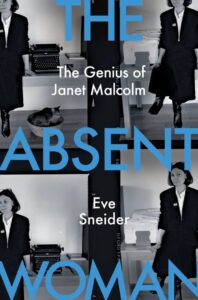
From The Absent Woman. Used with the permission of the publisher, W.W. Norton and Company. Copyright © 2026 by Eve Sneider
