
Electroconvulsive therapy is frequently reserved as a final option for mood disturbances. It involves delivering brief electrical impulses to the brain to provoke a seizure. The method originated in Italy, where a succinct verb was coined to capture the machine’s effect: zapare, translating to “to zap.”
As a grateful zappee, I’m occasionally asked: Why do so many writers undergo ECT? I don’t think there’s a simple answer. I suspect we simply tend to write about it more often. A more candid explanation might be that writers are drawn to high-stakes experiences or to experiment with different paths in life.
For years I hesitated to document my voluntary electroshocks or the memory gaps that followed. It didn’t feel like something to boast about. Yet I kept facing frustrating questions about the process. “Were they punishing you?” Or, “Isn’t that just a high-tech lobotomy?” Not at all. Alongside music and genuine love, electroshock stands as one of the few true miracles I have personally witnessed.
So I authored a memoir about it, Jolt: My Electric Journey Out of Darkness. The title may strike some as a bit dramatic. But the treatment itself carries a certain drama: you lie down on a table, are given a potent blend of anesthetics and muscle relaxants, and—after the prescribed number of sessions—you emerge changed enough that the impulse to vanish no longer dominates your life.
One early reader of Jolt, who undergoes maintenance ECT treatments on a semi-regular basis, wrote to me recently: “I recall a real doctor telling me just last year that he couldn’t believe ECT was still a thing. It frightened me. I want to hand Jolt to him. Maybe even press it into his hands, harshly if needed.” That sentiment is a bit strong for my taste, but I recognize the impulse behind it.
What matters here is that books can become lifelines for readers undergoing treatment. Here are a few that offered one to me.
*

Sylvia Plath, The Bell Jar
I’ve long puzzled over why Sylvia Plath is often depicted as a cautionary example of ECT. In reality, Plath—just like her fictional stand-in Esther—was saved by the therapy. It’s true that Esther’s first experience with unmodified shock therapy is harrowing:
…something bent down and took hold of me and shook me like the end of the world. Whee-ee-ee-ee-ee, it shrilled, through an air crackling with blue light, and with each flash a great jolt drubbed me till I thought my bones would break and the sap fly out of me like a split plant.
I wondered what terrible thing it was that I had done.
But once Esther enters the care of a far more sensible and kind doctor (a loosely fictionalized version of Plath’s own Dr. Ruth Barnhouse), she receives modified ECT, administered with an anesthetic and muscle relaxant. (“If It’s done properly,” Doctor Nolan said, “it’s like going to sleep.”) After her first modified treatment, Esther reports on the experience of anesthesia and awakening:
…darkness wiped me out like chalk on a blackboard….I woke out of a deep, drenched sleep…. All the heat and fear had purged itself. I felt surprisingly at peace. The bell jar hung, suspended, a few feet above my head. I was open to the circulating air.
Given that Esther was suicidal until this breakthrough, it’s a little odd to see Plath’s continued association with a chorus of ECT voices. In biographies, Plath is described as experiencing long-term remission after her course of ECT with Dr. Barnhouse. Importantly, if you read The Bell Jar, or anything else by Plath, you’ll see that ECT does not kill creativity. (It’s the illness that does.)
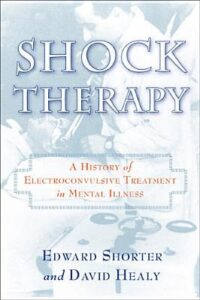
Edward Shorter and David Healy, Shock Therapy: A History of Electroconvulsive Treatment in Mental Illness
A crucial and engrossing history, fair and thorough in its portrayal of the precursors of ECT (including insulin coma therapy and metrazol shock treatment), and in tracing the entire arc of its vibrant past. In these pages you’ll be astonished by the historical abuses of ECT—and you’ll equally marvel at the remarkable success stories. The authors evoke the historical ironies with striking clarity. Consider the tensions between psychoanalysts and advocates of somatic treatments like ECT:
For the analysts, ECT was a brutal, primitive procedure, cruelly inflicted, and masochistically accepted as a form of expiation. Yet behind the scenes many analysts were warmer toward ECT because they needed it to help their patients recover…ECT, one could say, was the hidden love of psychoanalysis.
A carefully balanced and richly informative account. It’s best read when you’re already on the road to recovery.

Robert Pirsig, Zen and the Art of Motorcycle Maintenance
During the 1970s and 1980s, Pirsig rose to a near-revered status among readers, and this sizable book became something of a counterculture scripture. The narrative’s pivotal moment comes when the narrator recalls being involuntarily subjected to ECT. As the narrator describes his former self:
[He was] destroyed by order of the court, enforced by the transmission of high-voltage alternating current through the lobes of his brain. Approximately 800 mills of amperage at durations of 0.5-1.5s had been applied on twenty-eight consecutive occasions, in a process known technologically as “Annihilation ECS.” A whole personality had been liquidated without a trace in a technologically faultless act….
Like The Bell Jar, Pirsig’s major philosophical novel (which the narrator describes as a “chautauqua”) contains autobiographical strands. Yet its fictionalized life is looser than Plath’s. Still, many readers formed a parasocial affection for the narrator—and grew furious on his behalf, to the point that the novel is sometimes invoked as a sweeping critique of electroshock. Yet the main character’s electroshock closely reflects a fictional portrayal rather than the author’s own experience. As David Healy and Bruce G. Charlton noted in 2009 in the journal Medical Hypotheses:
…newly published biographical information on Pirsig from Mark Richardson (Zen and Now: On the Trail of Robert Pirsig and the Art of Motorcycle Maintenance, New York: Knopf; 2008) has shown that the ECT role in ZAMM is a literary device, added later in the drafting process. In reality the ECT caused some short-term memory loss, but Pirsig’s long-term memory recovered quickly….It appears that one of the most famous depictions of ECT, once thought factual, was actually a work of fiction.
As literary devices go, it’s a brilliant one: the long-anticipated smoking gun in the narrator’s quest to uncover what happened to him. The narrator’s charm and Pirsig’s accessible style make readers understandably attach to him, sometimes granting excessive loyalty to his fictionalization.
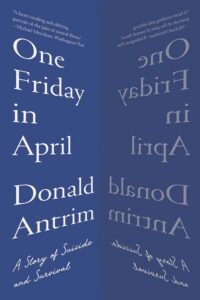
Donald Antrim, One Friday in April
In this striking report on depression and deliverance, Donald Antrim recounts that David Foster Wallace urged him to pursue ECT. Antrim describes nearly miraculous improvements:
We talk about the weight of the world. After ECT, the sense of overwhelming heaviness in my body disappeared; I felt a new physical lightness….Today I think of ECT as a form of clean energy—good electricity added to a wet, saline environment where neural signaling had become chaotic and mis-timed.
Like so many, ECT remains stigmatized, and Antrim memorably calls stigma “society’s unacknowledged violence toward the ill.” In One Friday, his work contributes powerfully to countering that violence.
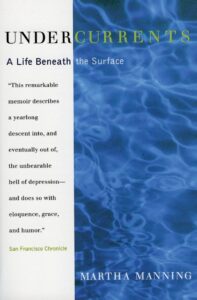
Martha Manning, Undercurrents: A Therapist’s Reckoning with Depression
Manning is a delight on the page (and reportedly in person), whether she’s discussing parenting or mental illness. Her lucid observations about the ECT that lifted her from unbearable despair felt to me like light finally entering a terrible container where I’d been confined:
Nobody bats an eye when electricity is delivered to a stalled heart. There is no outcry. In fact, it’s considered a miracle….I will never be the ECT poster-child. I admit the downside—confusion and memory loss. But damn it, it worked. I didn’t want to have it. I didn’t want to have a caesarean either. I ended up with a terrible infection, a long scar, and a difficult recovery. Yet I gained a beautiful, healthy new life in the end. I’d do it again in a heartbeat. In choosing the hospital and ECT I chose to fight for my life.
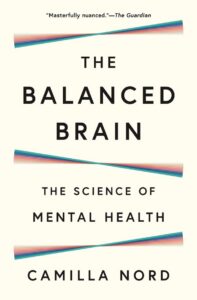
Camilla Nord, The Balanced Brain: The Science of Mental Health
Nord is a neuroscientist who excels at translating intricate science for a broad audience. Among her interests is neurogenesis—the brain’s capacity to grow and renew itself. Critics from the anti-psychiatry camp, especially those opposed to ECT, often claim ECT causes “brain damage.” Based on conversations with scientists, I’d say that verdict is off the mark. At its most generous, that critique conflates disruption with damage. Among its many insights, The Balanced Brain presents a compelling perspective on how successful electroshock can stimulate hippocampal growth: “On balance, rather than brain death, ECT may be more likely to foster brain cell life.”
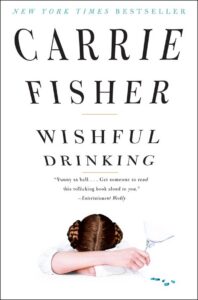
Carrie Fisher, Wishful Drinking and Shockaholic
I read Fisher’s memoirs before my electrotreatments. Her writing prepared me for localized memory loss—and implicitly reassured me about many other things, including one’s ability to retain a sense of humor, even after a deep disturbance and the shock that restores balance. Fisher handles memory loss with a breezy touch, noting that she has learned “to live in the present, now that the past seems otherwise engaged.” I’m fortunate to have lost far less memory than Fisher did. (While I endured 23 treatments over several months, Fisher faced many more across years.) Not once does she suggest these memory gaps were debilitating, nor that they were anything but worthwhile.
Charles Fernyhough, Pieces of Light: The New Science of Memory
It completely reframed my thinking about autonoetic consciousness—i.e., the personal sense that memories belong to a single self. “Memory is an artist as much as a scientist,” Fernyhough writes. As I slowly recovered lost memories and learned to live with the ones I cannot recover, this sharp and compassionate book offered immense help and reassurance.
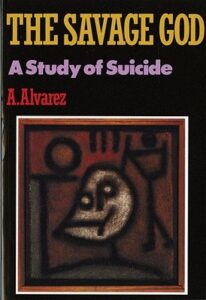
A. Alvarez, The Savage God: A Study of Suicide
Kay Redfield Jamison has called this singular 1971 study “rather romantic.” It may be, but alongside Jamison’s Night Falls Fast: Understanding Suicide, it remains one of the best books on the subject. It’s richly psychoanalytic, deeply literary, and unflinchingly personal. It helped me understand the rational, almost chilling part of me that longed for an escape from life. I needed to understand that part in order to move beyond it. There were many people and influences that pulled me back, including friends and family, as well as ECT—and this book.
_____________________________
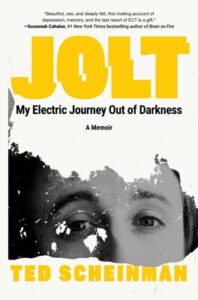
Jolt: My Electric Journey Out of Darkness by Ted Scheinman is available from Scribner, an imprint of Simon & Schuster.
