

When I first took up writing my second poetry collection, Future Tense, a memoir rendered in verse, I hoped it could be something readers don’t often associate with poetry: a true page-turner.
The work chronicles the three years I fought to become a mother while watching my own mother slip away, culminating in my daughter’s adoption just before my mother’s death. Because life shifted in micro-movements and diagnosis after diagnosis, I trusted the book might follow a similar rhythm.
I aimed to build a collection that dragged readers forward—not because they needed to know what happens next, but because they had to discover what the next poem would disclose. Each poem would deepen the tangled narrative, generating the emotional momentum of a novel. I wanted readers to lift their eyes and realize they had just devoured fifty pages of poetry.
Because poetry can accomplish this. It can accelerate and dive deep, invite us to feel before we understand, and hold contradiction, mystery, and hard truths all at once. Yet poetry still carries a reputation for being hard—a slog you wade through rather than an experience you can’t wait to continue.
With Future Tense, I sought to push my lifelong aim of broadening what poetry can accomplish even further: to demonstrate that a genre does not determine velocity.
Here are five craft approaches, along with the questions I asked myself, for shaping a poetry collection that moves with urgency and momentum.
What Makes a Story Worth Following?
Story sticks—it’s the emotional framework through which we perceive the world: what the speaker wants, what stands in her path, and what’s at stake. Plot is the concrete sequence of events that drives her through those obstacles.
This is what makes collections like Edgar Kunz’s Fixer and Sharon Olds’s Stag’s Leap linger: they anchor us in a concrete event with clear stakes, then reveal how the speaker navigates and evolves.
When I ordered Future Tense, I wanted the opening poems to promise a story. I used “A Maybe, A Yes, a Not” to signal that I hoped for a baby, even though we’d already been trying for a while:
The gaps. I measure. I math. Worn by wait.
The coats, the labs: hint age, test rot: ovaries,
Eggs. A maybe, yes, then not.
We lose. We gain. Try again. Bury names.
An almost-boy, a close call-girl, two weeks
then no. I hoard my hope. Tread time to cope.
I wanted to throw the reader immediately into the fray—in medias res—so the speaker isn’t at the very start of a journey but already entangled in trouble. The book promises no neat answers, only ongoing tension.
In “Late,” I present my mom, newly relocated from New Jersey to California, buzzing with excitement about potential future grandchildren—and the life she rearranged to share with us. But the last line hints at something darker: “Does the future ever arrive in the dress we pick out?”
Two poems later, my mother is diagnosed with Stage Four cancer. Suddenly the future the speaker dreamed of begins slipping away.
Two stories and two conflicts unfold at once, leaving readers with one lingering question: Will the speaker become a mother before her mother passes away? That question becomes the thread that holds the book together.
How Do You Build a Book That Moves?
Structure—how a book is assembled and how its poems are packaged—can render a collection both inventive and inevitable.
Consider Victoria Chang’s Obit, where each poem acts as an obituary for the living and the nonliving, literal and abstract; Caitlin Conlon’s Burning the Ghostlight, written as a four-act play; or Matt Rasmussen’s Black Aperture, in which the speaker revisits the day after his brother’s suicide from multiple angles. In each case, structure and form intensify the content, adding another layer of narrative and another facet of the book’s argument.
Across Future Tense, I used structure to propel momentum and to give the collection a countdown-like feel. Time accumulates, and so does pressure; grief deepens and time both accrues and drains.
Future Tense follows a classic three-act arc. I knew I needed an inciting incident—a door that must be entered—along with rising conflict and tension. I also needed propulsion, so I arranged revealing poems strategically and placed apparent resolutions beside fresh, deeper complications.
Each segment opens and closes with a cliffhanger and is named for a unit of time: Six Months In, One Year In, Two Years In, and so forth. Time becomes a countdown, a kind of antagonist.
What Can Be Lost—and What Are You Withholding?
Stakes define what can be lost—and tension is the distance between what the reader longs to know and what you’re willing to reveal.
In Writing the Breakout Novel, Donald Maass argues that a book needs conflict on every page to stay propulsive. Poetry collections require a comparable sense of consequence. Each poem should serve a purpose: to show why what’s happening matters and how it complicates what has come before.
I wanted readers to grasp what the speaker stood to lose—and what she was prepared to risk. As the stakes intensified, I tracked every storyline in a spreadsheet: each character’s arc, when information was disclosed, where emotional climaxes occurred, and how pressure built up.
In Future Tense, my mother’s Stage Four cancer diagnosis coincides with my struggle with infertility. Her dying wish is to become a grandmother—a wish I cannot grant. Then my marriage begins to fracture. We cannot conceive and cannot agree on how to form a family from our sorrow.
In the title poem, the speaker debates waiting with her husband to see if they can conceive, yet she refuses to wait. “The cost of anything is how long you’ll wait.” The question isn’t merely, “Will she become a mother?” but “What price will she pay to become one?”
There are moments when it seems she must choose between marriage and motherhood. The second section closes with “Year of Thirst,” where she tells her husband, “I’m moving forward with adoption…With or without you.” The river forks: “No telling if it will find its way again.”
But stakes alone aren’t enough. A poem must earn the next page—altering what we understand, sharpening the questions we need answered, or withholding what we’re desperate to learn.
Tension can arise through information, emotion, or form. In “What I Wish I Could Say to My Daughter’s Birthmom,” I employed strike-throughs to signal hesitation and the struggle to articulate the most honest sentiments aloud—gratitude and hurt together.
What I Wish I Could Say to My Daughter’s Birth Mother
I know what it’s like to go home empty. To harbor a version of yourself
you cannot keep. In the white-walled hospital, we wept. You: refusing
to hold her. Me: sick with what I couldn’t carry. How she belonged to both
and neither of us. So grateful (jealous) of one another’s luck.
One of my favorite sources of tension is interiority—the chance to inhabit another person’s heart and mind. Once inside, the reader learns what other characters don’t know. I wanted to grant readers access to rooms filled with silence, stigma, and shame: waiting rooms and bedrooms, dinner-table conversations, and the silences where the hardest things could not be spoken. And the pain of watching the world grow something new when you cannot participate any longer.
In “Infertility,” I write:
Everything hurts: wildflowers
on the freeway, beached
kelp wild with wind, a sea
otter drunk on a mother’s
warmth. This world keeps
remaking itself—without me.
I oar alone. I stare
at the horizon, gray
as oyster meat.
I wanted to demonstrate that infertility is far more than a simple longing for a baby. It tests every belief about yourself: how you define family and love, and how much you must control each outcome. It generates financial, physical, and emotional strain.
In “A Fertility Clinic Is the Coldest Place on Earth” I write,
When will you fail yourself / again / It’s so easy for some / and others $50K later / $100K later / You can’t afford to be here To want
In “My Mother Asks About Adoption,” my mother’s health continued to decline, heightening the pressure and raising the stakes.
Maybe next year, I interrupt, thinking only of my own ruin. If I don’t salvage my marriage, a baby might never arrive. I don’t consider the cancer choking every organ. Mom nods, softer. It’s just—I won’t be here forever.
The tension stemmed from not knowing how any of it would resolve.
What Has Changed by the End?
All great art moves. As Vivian Gornick notes, a narrator must guide the reader on a journey, make the piece arrive, and finally bring us out into a clearing where the sense of things is larger than it was before. We need to witness alteration before our eyes and understand how it grows, becomes deeper, and gains significance.
Images must acquire new meaning. Characters reveal aspects we didn’t anticipate. By the finishing pages of Future Tense, I hoped the reader would feel the accumulation of it all—the traces left by grief and love, not only what was lost but what was carried forward. Symbols such as flowers and sailboats, the sea and its tides, start with one meaning and arrive at something entirely different by the end. They carry fresh stories.
The speaker evolves, and experience reshapes some of the speaker’s most basic beliefs. The ocean, which once signified isolation in the opening and middle sections, shifts in meaning; in “Infertility,” I write,
There is no land
or other side in sight.
I drown inside
my tiny boat.
I continue
to sink.
I continue
to row.
Throughout the collection, the speakers’ connection to the ocean changes in both meaning and weight. In “Dearest Everything,” about the birth of my daughter, that interpretation shifts again,
You open your eyes for the first time. Pacific deep.
Iris ringed with indigo. Now, I understand every sea
we needed to cross to call you home.
The speaker’s understanding of motherhood matures; she recognizes what it takes to fight for it, and how love redefines itself under pressure. A question that once seemed impossible can become a question the speaker is finally ready to inhabit.
To me, that is evolution: not merely that something happened, but that the meaning of what happened has changed. This is how the book earns its ending.
And if I’ve done my job well, by the time readers reach the final page, they don’t just grasp what happened; they understand why they kept turning the pages to arrive there.
__________________________________
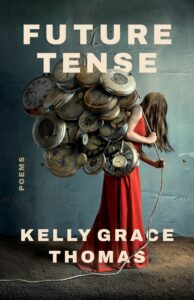
Future Tense, a collection by Kelly Grace Thomas, is available from Alice James Books.
