
Our troubles began the moment we touched down in Miami. Men in black vests greeted us as we stepped off the plane. Somehow our reputation had preceded us—the enigmatic trio moving without papers—and we were ushered into a cramped room. Nico and I were seated, while our father was interrogated and eventually freed only after he rang through to the consulate.
On the way out, the guards had our father pass through a metal detector. It emitted a shrill beep. We attempted to explain to the guards that his prosthesis was an iron femur, but they dismissed us out of hand.
“No, it’s true. They had to reconstruct his entire femur after a motorcycle crash in Barcelona,” Nico clarified. “He has no watch, no belt, no loose change—only this iron leg.”
Our father stepped through the detector again and again, smiling, cordial, his pockets turned out, provoking beeps every time, as if he were preparing to bow before the astonished security officers who stood like statues. It felt almost like a magic trick.
“Proceed, check beneath my clothes. But don’t get any ideas! I’m not carrying anything, I swear. It’s my leg. You could arrest me for piracy, though. Arr!”
The machine beeped once more. The Miami guards wore expressions akin to the bemused stare I’d seen on the Boston clerk’s face: a kind of stunned perplexity that did not provoke laughter in the face of something so absurd—a vagabond prince, a pirate professor—but rather a rush to find a quick solution. My brother tried to reason with them; our father kept up his show, and I played the loyal audience.
“What do you mean ‘an iron leg’?”
They summoned a police officer who spoke a blend of Spanish and English. Nico claimed the man was Cuban. My brother possessed an unusual curiosity that granted him knowledge about the world, languages, and places. My father and I were too wrapped up in our own contraptions, our acrobatics, to notice the world around us.
“That isn’t possible, amigo. If he truly had an iron femur, he wouldn’t be able to walk or bend that leg,” replied the officer, who looked more like a model, one hand resting on his weapon.
“It’s just a figure of speech. The leg isn’t actually iron; it’s aluminum. That’s why it keeps beeping,” Nico explained.
“The machine doesn’t detect aluminum, amigo,” the officer retorted.
“Then it must be metal!”
“The X-ray machine isn’t picking up any metal.”
In retrospect, their misunderstanding seemed to spring from the subtle differences among the English words metal, steel, and aluminum. The conversation stalled. The line behind us grew longer.
“It didn’t beep in Boston,” our father insisted. “Listen, we can’t waste time; our driver is outside. You’re very kind. I think this belongs to you.”
A pile of money appeared in his hand. It was an obscene amount, an implausible sum, but that is how things operated with our father. When I try to narrate our reality, the rules of fiction bend, and not placing that money in his grasp would be akin to lying, to concealing what actually happened, no matter how impossible it may seem. Here’s how it played out: my father pressed a wad of bills into the officer’s palm, a gesture of elegance. Where had he acquired such cash? Did he carry it with him every day, tucked in his sleeve or in a hidden pocket like a magician’s ace, ready to grease palms?
Rather than accepting the money and releasing us—as we imagined would happen—the officer merely stood there. He seized my father’s hand and twisted it back, pinning him in an arm lock. Then he warned him not to move, or he might injure himself, “usted solito.” Two more officers arrived and told Nico and me to wait.
“I’ll have to ask your father to come with us for a moment,” one of them said. “We’ll be right back. Stay here with your mother.”
He gestured toward a white woman who was blond, motherly in appearance. She seemed to sense we were alone and stepped into the role of guardian. In my brother’s memory, I recall that I saw myself “crying on the inside.” It marked the first of many internal sobs that, in hindsight, all fall under one umbrella: adults cry because they know, children cry because they do not. I’m not entirely sure what occurred during those months. Then again, why should my current understanding supersede my earlier ignorance? The officer kept his word and returned our father to us a few minutes later. As they moved toward us, my father wore his feigned criminal mien. They escorted us out of the terminal together.
“So, dónde está el conductor? Where’s the driver?”
The driver, of course, was another invention. During the year we spent with our father in the United States—first up north, then unexpectedly in the south—he had no real apparatus to sustain his life. A man unused to driving or cooking in Spain seldom had a driver or a housekeeper in America. I wish I could say that I don’t know how we endured; I do know, precisely, how we managed to endure it.
“He’ll arrive any minute. You can go.” But the officer did not depart.
“I can’t believe he’s running so late,” I admitted. I was accustomed to stepping in as my father’s rescuer whenever his fabrications went astray. “Should we call a taxi?”
“Buena idea, my dear. Let’s do that.”
The three of us laughed as if in a television commercial, feigning a shared family confidante. He never called me “darling,” but I offered him a darling smile, for I had learned to transform into whatever version of myself he invoked. Rather than bending to the world, my father bent the world and its inhabitants to his will. Instead of conforming, he warped the surroundings so that we all conformed to his premise, however unconventional, and deep down he refused to accept anything not of his design. He carried the temperament of an artist, and there is little difference between an artist and an emperor. Why should the logic of reality prevail when his will had always prevailed, when his world was, in essence, his will, when for decades his desires, his schemes, had triumphed, until at last his map dictated the geography, until at last his painting swallowed the landscape?
__________________________________
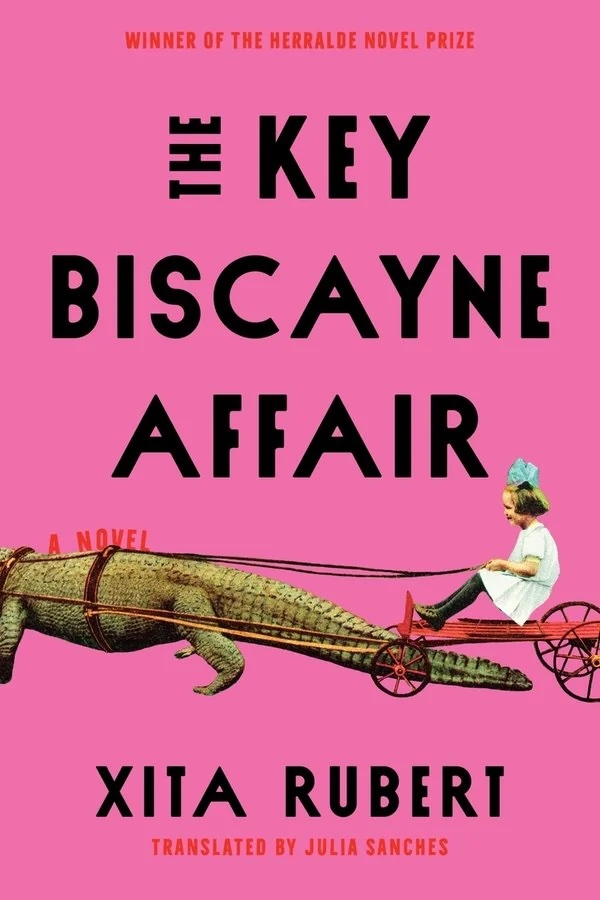
From The Key Biscayne Affair by Xita Rubert, translated by Julia Sanches. Used with permission of the publisher, Ecco. Copyright © 2026.
