
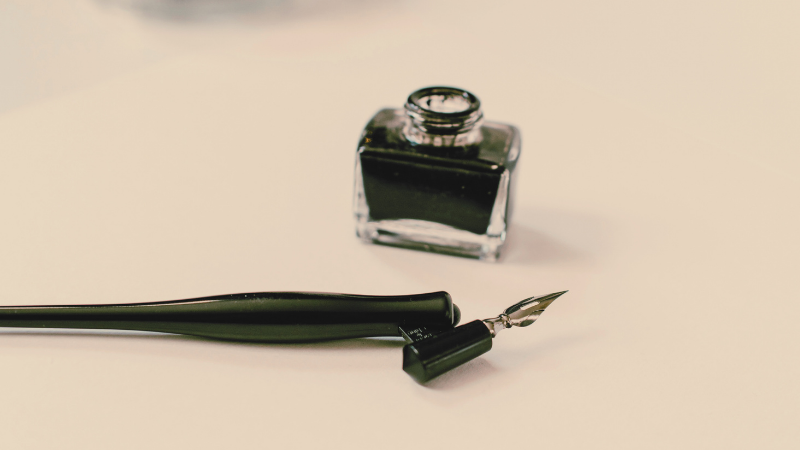
This piece reveals the method behind the ink that has penned Magna Carta, Hamlet, Samuel Pepys’s Diary, Robinson Crusoe, Gulliver’s Travels, Candide, the Declaration of Independence, A Vindication of the Rights of Woman, Beethoven’s Fifth, Les Misérables, and countless other works. The recipe originates from the UK National Archives, dating to roughly the year 1483:
To craft ink. Gather gall and coporos or vitrial quartryn, and gumme from each item—one full quartryn, or perhaps a quarter to half quartryn more—and one additional half-quartryn of gall. Break the gall into pieces and place every component together in a pot, stirring it often and warming it so that the writing becomes possible within about two weeks after the mixture is prepared. If you own a full quartryn of each ingredient, add a quart of water; if you have roughly a half-quartryn of each, then use half a quart of water.
If that isn’t entirely clear, there are other paths. First, pause beneath an oak tree. Second, seek out oak galls—also called oak apples—the hazelnut-sized spheres that form when a gall wasp lays an egg on the underside of a leaf. Remove two ounces of galls, dry them, and grind them with mortar and pestle. Mix with a pint of water and let it sit for a day or two (medieval manuals often favored wine or vinegar as alternatives to water to reduce risk of illness). Then strain through fine linen or gauze, and add an ounce of ferrous sulphate (the “coporos” referenced in 1483). Now introduce three shards of gum arabic (a golden sap harvested from acacia trees) to improve gloss and flow, and keep the mixture in a cool place—a windowsill is ideal—for about a fortnight, stirring daily. Your rich purplish-black ink will then be ready for use. (To speed drying, dust the writing surface with a fine powder called pounce, made from pumice stone or salt, or sometimes ground dried cuttlefish bone. A letter would then be considered “done and dusted.”)
This “iron gall” ink enjoyed greater popularity than earlier carbon inks made from soot and animal glue, or inks produced by burning pines and mixing with oil, not least because it tended to endure longer. Yet its longevity was somewhat overstated; those who examine century-old documents have found that the deep ink gradually lightens to brown and can be highly corrosive to parchment, especially when exposed to extreme temperatures. So you are advised to wear gloves while handling it, and perhaps a light mask if you react to volatile substances, and of course keep it away from your eyes. And for safety’s sake, use it only with a quill or dip pen, never with a fountain pen, lest the metal or resin components corrode and clog the feed. Apart from that, enjoy your writing.
The hallmark was permanence: a liquid that starts clear blue and dries into a deep, inky black.
The brisk rise of Birmingham’s steel-nib industry happened at roughly the same time as the emergence of England’s premier ink company—and the two developments fed one another. The Pen Museum’s shelves display a familiar chorus of brands—Pelikan, Sheaffer, Parker—yet the most prominent in the nineteenth and early twentieth centuries belonged to Stephens, a London family business whose story stretches back to 1815 and a medical trainee who shared lodgings with John Keats.
Henry Stephens was born in Holborn in 1796 and grew up near St. Albans, where his parents kept a thriving coaching inn. His medical studies at Guy’s and St. Thomas’s hospitals in Southwark required affordable lodgings, and for about a year he shared rooms with a fellow student who would become a famed, though unpublished, poet: Keats. According to Stephens’s daughter Martha Walsh, her father also wrote verse and played a role in shaping one of Keats’s most celebrated lines.
My mother told me [that] during their evening walks [they] quoted verses to each other. They were not content with a single line from Endymion—“A thing of beauty is a constant joy.” Each line sparked collaboration, and together they revised it to “a joy for ever,” which they both endorsed.
Stephens earned high regard as a country doctor, and his reputation rested in part on his contributions to hernia surgery; a 1829 treatise, written when he was thirty-three (Keats had passed away four years earlier), remained a standard method for years. Yet he also pursued a sideline. Frustrated by the inconsistent and fugitive nature of ink for steel dip pens, he created a small laboratory near his home to produce “an indelible writing fluid,” and his precise scientific training enabled a formula that could be scaled for mass manufacture. In the infancy of industrial chemistry, his efforts were revolutionary. The Stephens Ink Co. registered in Southwark in 1832, with its first patent granted five years later.
By the time the Great Exhibition of 1851 opened in Hyde Park, Stephens’s line included wood stains as well as their writing fluid, both earning royal favor from Prince Albert. The selling point was permanence: an ink that begins as a clear blue and becomes a saturated black when dry. “It writes smoothly and pleasantly,” one early label claimed, “and its fluidity remains remarkable under exposure.” Before long, government documents, banking contracts, and legal agreements—indeed, substantial swathes of official business—were considered final only if signed with Stephens Blue-Black.
It also had a striking logo: a large ink blot formed when an advertising manager accidentally dropped an ink-soaked sponge on a tiled floor, and someone traced around the splash.
The earliest formulas for Stephens’s “carbonaceous black writing fluid” were guarded secrets; the patent mention referred only to “certain improvements in manufacturing colouring matter,” while the listing of acids and solvents suggested a highly flammable process. By the 1870s, Henry Beasley’s The Druggist’s General Receipt Book had documented the core ingredients for the most common carbon-based ink: a mixture of commercial soda with shellac or resin, plus oxalic or tannic acid and water. The solution was boiled, cooled, and blended in a large mortar with fine lamp-black and other pigments.
The company relocated to Aldersgate Street (today part of the Barbican) in 1860, and opened a New York office the following year. It faced two challenges: a shortage of glass bottles forced the ink to be sold in stoneware bottles designed for beer, and intensifying competition spurred a string of legal disputes. Each edition of Henry Beasley’s manual introduced new but similar recipes from a growing list of rivals: Runge’s Black Writing Fluid vied with Coathupe’s Writing Fluid, while Puscher’s Indelible Ink and Dr. Normandy’s Blue also competed. Stephens’s superior product continued to dominate the market into the 1920s, aided by bold advertising campaigns.
“Stephens’ Ink—Blue-Black But Unbeaten,” read the shop-front signs, while towering enamelled mercury thermometers on railway platforms announced the weather—“Freezing,” “Temperate,” or “Blood Heat”—to assure travelers that the product worked in every climate. The company’s distinctive logo—a large ink blot—reappeared as a recurring motif since 1891, when an advertising manager’s accident became an enduring symbol of the brand.
After Henry Stephens’s death in 1864, his son Henry Charles Stephens—so steeped in chemistry that everyone called him “Inky”—took the helm. He saw opportunity in the fountain pen, and his campaigns boasted that Stephens ink, with its precise formulation, would not leave sediments, would not clog feeds, would not corrode nibs, and would not damage rubber components. He oversaw the opening of a large factory in Islington and the creation of a ten-acre research and testing grounds in Finchley, where Stephens served for thirteen years as a Conservative MP and, even longer, as a local benefactor. The revival of Henry Keats’s poetic fame in a later generation stands in stark contrast to Stephens’s long-lasting but quieter influence; the author who wrote with a quill and gall ink could not have imagined a modern empire built on pigments and patents. I live nearby and have passed the old house countless times without appreciating the industry that funded it; discovering a Victorian enterprise not built on slavery felt especially meaningful.
The Stephens Collection—an appointment-only museum—houses a vivid assortment of ink bottles, advertisements, and writing implements, along with a thorough record of the Stephens lineage, which effectively ended in 1967 when the firm was acquired by the Royal Sovereign Pencil Company. During a visit in early 2025, the visitor manager Melanie Wynyard spoke of a precarious future, saying, “We’re clinging to the rock face now,” as heritage funding waned. Her aim is simply to keep the place open; government cuts have left little appetite for an archive devoted to inks and adhesives. I photographed the old thermometers and other enamel signs once proudly displayed on railway platforms as steam trains rattled by. Wynyard notes that people send her pictures from around the world—“There’s one in Beijing in Chinese. We did have one in Syria, though I’m not sure it’s still there.”
__________________________________
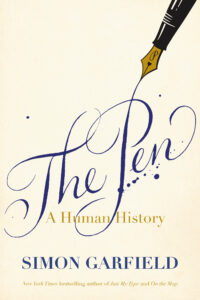
Excerpted from The Pen: A Human History by Simon Garfield. Copyright © 2026 by Simon Garfield. Published in the United States by Crown, an imprint of the Crown Publishing Group, a division of Penguin Random House LLC.
