
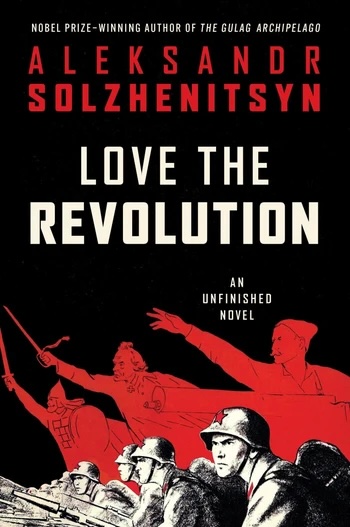
In 1948, Aleksandr Solzhenitsyn, then twenty-nine and incarcerated in a Soviet facility—serving an eight-year sentence for having criticized Joseph Stalin in his private correspondence—began drafting an autobiographical novel titled Love the Revolution. The manuscript, which remained unfinished, was published in Russia in 1999, and will reach English readers for the first time next month via HarperCollins. The passage here, drawn from the book’s fourth chapter, unfolds in the village of Durnovka in January 1942—the first winter of war after the Nazi invasion of the USSR. The autobiographical narrator, Private Gleb Nerzhin—attached to a horse-drawn convoy but determined to secure a place in the artillery—starts to glimpse a turn in his fortune with the arrival among his squad of Political Commissar Petrov and Junior Lieutenant Brant.
—Ignat Solzhenitsyn, middle son of Aleksandr Solzhenitsyn
*
Brant’s Magnificent Night
On the anniversary of Lenin’s death, January 21, a tranquil evening softened by a damp, mournful mist, the platoon’s newly assigned political commissar, Petrov, came to address them about Lenin. His hair was pale and flaxen, his blue eyes clear, his nose compact, and his voice and manner quite ordinary. Bathed in the warm yellow glow of a kerosene lamp in one of the farm buildings, Petrov sketched a modest account of Lenin, underscoring the significance of victory in the present circumstances. After the talk, Nerzhin decided to approach him, inquire about the fate of his reports, and seek Petrov’s counsel regarding his troubling situation.
“Ah, so you’re the author of those reports! And here you are in person. We did forward two of them to battalion HQ. But they’ll probably stay there, filed away. Reports from ordinary soldiers rarely reach the district headquarters.”
“So what am I supposed to do, Comrade Political Commissar? How can I enter the artillery?”
“When we advance to the front, we may have a chance to transfer you to another unit.” He regarded Gleb with a sympathetic look. “Truth be told, mathematicians are needed in the artillery. I’ve seen units where a few such men work. So where could I send you? How about the artillery depot, as a clerk? That would be easier—you’d be balancing ledgers.”
This proposal would have been deeply insulting were it not for Petrov’s genuinely kind nature. But no—never! Depot? Clerk?—that would be a completely useless transfer. Nerzhin shook his head.
The commissar offered a patient, knowing smile:
“All right… I’ll keep my eyes open, of course. But I can’t promise to help. I simply can’t.”
Yet he did assist, and with Brant’s involvement.
It began on a snarled February night for the platoon. In the evening, after most men had retired to their quarters, orderlies rushed through the village summoning everyone to gather for an alarm. The notification unsettled those who had formed bonds with their landladies, while Nerzhin’s heart sped with hope. Unaccustomed to such alarms, the convoy men stumbled from their beds, pulled on clothing, and shuffled out toward the dairy farm. There, in a calfless room that could have served as a barracks, an attempt was made to marshal the men in fours, and with the room filled to capacity, the entrance of Junior Lieutenant Brant emerged—his smoky-gray greatcoat crisscrossed by taut leather straps, standing out in the lamplight. After glancing at the momentarily confused second-in-command, Brant began barking rapid-fire orders and opinions in a way that might have suggested the farm was already ringed by Germans and that one would have to fight through fifty kilometers of enemy-held territory to reach safety. This ominous impression grew when, in the middle of his swift commands, a door opened behind him and two young convoy men entered, shy and unalerted by the alarm because they’d been out courting girls. Brant’s large eyes, darkened by the lamplight, seemed to fill with red.
“Silence!”
(They were quiet instantly.)
“No excuses!”
(They hadn’t offered any.)
“You’ve forgotten your military duty!” Brant raised his hand in a dramatic gesture, his index finger casting a long shadow across half the ceiling. “You are undermining our mission! I’ll show you—” Brant must catch his breath—“I’ll teach you to obey!” And then he roared again with amplified force: “There is a war going on!!! Yes!!” He shot a keen look at the platoon crowded in the tight calf quarters and again repeated the line he’d adopted as if he were the first to bring this news to the squad: “There is a war going on!!! Get into formation! We must defend the Fatherland! Sergeant, I see no formation!”
But before the second-in-command could request permission to straighten the ranks, Brant spoke in a grave, tragic voice:
“Forget it! It’s too late! You had months for that! It’s too late!!”
With mounting fear, the platoon began to grasp the peril they faced. Yet Brant—appearing not as the man who had just shouted but as a much younger subordinate—switched to a cool, restrained, and solemn register:
“Attention, comrades. In two hours, we’ll depart Durnovka. You must provide fodder for the horses. Sergeant, distribute the platoon’s entire reserve. Ensure the harnesses are in full working order. Double-check the horses’ shoeing. And any dry rations available should be allocated to the men.” (Occasionally the army’s fourth category—flour, millet, even meat—completed the supply.) “That’s all! Clear out your quarters and gather your belongings. That’s all!!”
The ensuing chaos and frantic activity continued for hours. Lanterns flickered between the stables, the sergeant cursed without end, the convoy’s voices filled the air, there was a struggle over a pail, someone in the dark nicked another’s oats, two carts crashed somewhere and their axles snapped. Yet the horses remained calm—snorting in displeasure, but obediently permitting the harnesses to be fastened.
Amid the clamor of creaking carts, the clamor of voices, peasant oaths, the lantern’s glow, and the horses’ neighing, the tall, striking Brant did not feel beneath him the role of a general on a battlefield. Instead, he dashed about like a figure from a heroic film, continually finding new ways to raise his voice, barging in here and there, fists raised, declaring that he would not tolerate this. He invoked an imagined guardhouse (which, in truth, did not exist in the company), threatening to sever heads or unleash further terrors. Though his exaggerated threats bordered on the absurd, they did achieve the effect he sought: jolting a group that had grown complacent into readiness for battle in a matter of hours and tens of kilometers.
In the midst of this tumult, Nerzhin himself became Brant’s target. He hadn’t managed to determine exactly how the carts should leave the farm, nor had he assumed his prescribed place in the five-cart column, ending up on the column’s edge. Brant, striding forward with long steps, arrived in a fury, shouting in the darkness with a montage of rage visible in the lamplight:
“Where the hell are you standing? Are you taking a military unit to a dive bar? I’ll break your arms and legs!”
It was a glorious night for David Isaevich Brant.
Meanwhile the farm’s veterinary intern—who had accompanied Brant—was evaluating the horses and discovered six that were too sick to continue and should be left behind. When Melodia and Iskra had fallen into the last row of carts, Nerzhin was summoned before the platoon commander. Brant stood in the dairy farm’s small pantry, dimly lit by a kerosene lamp, arms folded in a stance reminiscent of Peter the Great contemplating the founding of St. Petersburg (as depicted in Aleksandr Pushkin’s famous 1833 verse, “The Bronze Horseman”—Ed). When Nerzhin entered, Brant fixed him with a solemn, almost mournful look that had none of his earlier outburst and declared:
“Well, Nerzhin! You will always remember David Isaevich Brant.”
Nerzhin wondered, Was this a farewell? Would Brant be leaving with them?
Then Brant, for reasons that only made sense to him, lowered his voice to a grave whisper:
“You’ll stay here with the sick horses. You won’t be going. I did this for you. Hand over the cart and horses to Polulyakhov.”
In Brant’s mind, this was the moment when Nerzhin should express his gratitude.
But if they were bound for the front, that wasn’t the point.
“David Isaevich! May I ask where the platoon is headed?”
Brant offered a crooked smile that mixed pity, sorrow, and doom:
“The platoon is going where the company goes. And the company goes where the battalion goes.”
“And the battalion?” Nerzhin pressed, quietly seeking the military secret in question.
Brant did not conceal it:
“To the Khopyor River. We’re going to construct a new bridge to secure communications during the spring floods.”
“Ah, so this isn’t a front assignment…”
Brant stood taller, with a certain dignity:
“This is more important than the front.”
“Will this last long?”
Brant shrugged:
“I’m a soldier. How should I know?” He raised his voice, giving the impression of merciless certainty: “I receive an order—and I say ‘aye-aye.’ I’m a soldier, Nerzhin. When you become a soldier, you’ll understand.”
Brant looked at the reflected image of his heroic pose on the dark window panes and added softly:
“It’ll take three months or so.”
“And then you’ll return here?” Nerzhin found himself asking, realizing he’d spoken in terms of the future rather than the group’s fate.
Brant merely shrugged—after all, he was a soldier.
“I know, Nerzhin, that this must have been hard for you. That’s why I’m leaving you here with the sick horses. Of course you know nothing about horses, but Poryadin will stay with you and take charge. You’ll go to the post office and pick up the mail for everyone… You will always remember David Isaevich Brant, Nerzhin.”
And so Brant persisted in Nerzhin’s memory: a figure in the dimly lit separator room, standing among milking pails, clothed in his perfectly tailored smoky-gray greatcoat, and uttering that proud line that would prove to be prophetic.
__________________________________
From Love the Revolution by Aleksandr Solzhenitsyn, translated from the Russian by Alexis Klimoff and Michael Nicholson. Used with permission of the publisher, Harper Perennial. Copyright © 2026.
