
I first encountered the idea of an unreliable narrator during a ninth‑grade English class. We were reading Catcher in the Rye, that quintessential coming‑of‑age novel teachers lean on to illustrate unreliable narration, since Holden Caulfield is, famously, “the most terrific liar you ever saw in your life.” From that lesson I carried a stubborn question forward: what exactly qualifies a narrator as reliable?
We’re inclined to take the world at face value when it’s filtered through a storyteller’s point of view. Yet every narrator, even the most omniscient and steady, interprets events in a personal way. Nonfiction that claims objectivity often carries bias, too. History itself has long been the story of the victors. We live in an age flooded with misinformation and AI‑generated content. So the act of trusting a narrator becomes an essential question. Fiction can toy with that premise, complicate binaries, and invite us to rethink ideas about sanity, truth, and the nature of the self in striking new ways.
My debut novel, Universe of Grace, plays with the unreliable narrator as it probes some of these concerns. The book is written in a tightly scoped third person and Grace is voiced with a distinctive, intimate subjectivity. Because the perspective sits so close, a reader can never be sure whether what’s unfolding is truly happening in the novel’s world or if it exists only in Grace’s head. Might she actually be from another planet? Could her fast‑food job turn her into a literal robot? Could her plush‑cat companions stage plays and debate philosophy with her and her wife? In a sense, this question sits at the heart of genre: the book can read as magical realism or as realistic fiction in which the extraordinary elements reside inside a character’s mind. Either way, the reader accompanies Grace in asking whether the fault lies with her perception or with the surrounding world. For Grace, magic is possible—almost obvious; what never seems normal are the everyday injustices that persist around her.
What follows is a selection of my favorite unreliable narrator works—novels in which a singular voice interrogates trust and subjectivity in ways that upend assumptions about what’s real, who is sane, and what gets lost in storytelling.
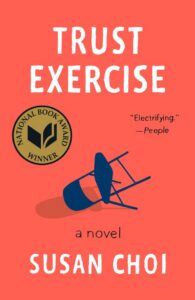
Susan Choi, Trust Exercise
In Susan Choi’s novel, “trust exercise” refers to a set of acting drills in Mr. Kingsley’s theater class at a competitive performing arts high school in the 1980s. But it also brilliantly describes the experience of reading this book. The first section follows a teenager named Sarah and her infatuation with her classmate, David; at first, Trust Exercise felt like an easy read. Then I got to the second section and everything changed. We skip twelve years and shift perspective to one of Sarah and David’s classmates; this new character re-casts the events from part one, and made me realize that the story I thought I was reading was only a sliver of what was really going on. I felt reoriented, and betrayed, in the best way. And, primarily, indignant with myself. Because I trusted too wholeheartedly in Sarah’s fun, light, gossipy, sexy, simple, self-centered version of the world, and missed the rest—the sinister stuff—even though I, we all, should have been able to see it. I don’t know if I’ve ever so profoundly changed my mind about a book halfway through. It’s really genius.
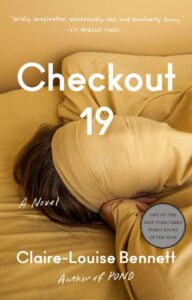
Claire Louise Bennett, Checkout 19
My friend Mia recommended Checkout 19 to me saying she’d never read anything like it. I haven’t either, and it’s such a weird, wandering, voice‑driven book that it’s also incredibly hard to describe. Checkout 19 is a novel about reading, or it’s a novel about this unnamed narrator’s coming of age primarily as explored and anchored through her relationships with books and stories—both books that already exist in the world, and also stories written by this narrator, some of which are included in their entirety, and thus become, in a very real way, part of the story of this person’s life. It explores how reading and writing can shape and mediate our lives, relationships, and ways of understanding. It feels like an unreliable narrator novel to me because there is so much slippage between which stories are just stories and which ones are the Real Story. It troubles that distinction in a way that I love. I read Checkout 19 while I was writing Universe of Grace and it was a powerful influence for me in following a voice into the murk of a character’s strange, subjective, internal world. And Claire Louise Bennett’s narrator has such an exciting and delicious voice that I would follow her anywhere.
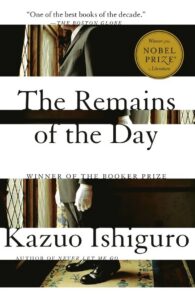
Kazuo Ishiguiro, Remains of the Day
This is one of the most quietly devastating novels I’ve ever read. Remains of the Day follows Stevens, a traditional English butler, in the postwar era as he contemplates dignity and what it takes to be a exemplary servant. The narrative unfolds in a slow, meticulous unspooling that rewards patient readers. Stevens recalls decades of loyal service to Lord Darlington, whom he insists was noble, righteous, and beyond reproach. As the story reveals more about his former employer, it becomes clear that Darlington was an influential Nazi sympathizer—and yet Stevens clings to a narrative that preserves his own life as meaningful and virtuous, even as the house of cards begins to fall. His devotion to discipline, restraint, and emotional detachment also shapes painful dynamics with his father and with Miss Kenton—painful for us to witness, since Stevens insists on a rational, almost clinical mode of narration rather than an emotional one. That self‑denial, and his attempt at self‑command, makes him a gripping unreliable narrator. A mentor of mine once said that tragedy is a story in which the protagonist discovers too late what would have given life real meaning. By that measure, Remains of the Day is a true tragedy. The ending narrative pummelled me, and it also served as a prompt to be honest with myself.

Olga Tokarczuk, Drive Your Plow Over the Bones of the Dead
In a remote, snowy village near the Polish‑Czech border, Janina practices astrology, translates Blake, and investigates the mysterious deaths of the area’s animals and its game hunters. Janina is an atheist, a vegetarian, and a genuine recluse—an utterly eccentric, and often hilarious, narrator. Though she’s fond of astrology, she warns us: “I’m not a good Astrologer, unfortunately. There’s a flaw in my character that obscures the image of the distribution of the planets. I look at them through my fear, and despite the cheerful mask people naively attribute to me, I see everything as if through a dark mirror, as if through smoked glass.” She’s talking about astrology, but she’s also, in a sense, warning us about her narration—Don’t trust me, I’m telling all this through a dark mirror. Drive Your Plow Over the Bones of the Dead hinges on a serious plot, and Janina’s unreliability drives its major twist. This novel is a luminous meditation on sanity, solitude, and the kinds of life we value.
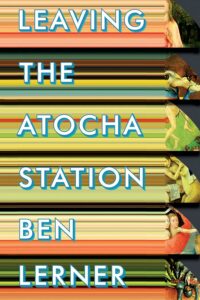
Ben Lerner, Leaving the Atocha Station
I think about this slim little book all the time. It follows an American twenty‑something named Adam who’s on a creative writing fellowship in Madrid. Mostly the narrative traces Adam’s anxiety about his own authenticity—his sense that he’s a fraud as both poet and person. He’s, frankly, rather insufferable, and like Holden Caulfield, a masterful liar, which makes you question how much you can trust him. As with many of the other books on this list, we become deeply immersed in Adam’s interior life, which creates distance from what seems to be happening outside. For him, the central question is: how can he be real? This concern recurs in his relationships, in his poetry, and even in the moment he witnesses a bombing. Readers are drawn to wrestle with the same question. The novel opens with a museum visit in which he longs for a “profound experience of art” that never fully arrives. In a strange way, reading Leaving the Atocha Station felt like a profound encounter with art for me. I was moved by the book because, despite Adam’s flaws, there remains a small, stubborn honesty that gives the work an unexpected, hopeful pulse.
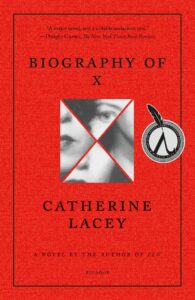
Catherine Lacey, Biography of X
This is a novel that presents itself as a biography (an utterly brilliant conceit) of someone known simply as X, a charismatic, expansive, multidisciplinary artist living in an alternate-history United States. The biography is narrated by X’s widow, CM, who uses this account to make sense of X’s life, their bond, and her own process of grieving. A bereaved widow uncovering a trove of startling, wondrous, painful truths about her spouse makes for a superb setup for an unreliable narrator, and the tension between what can be trusted and what’s colored by intense love and hurt is especially potent given that CM is attempting to “set the record straight”—to supply a genuine portrait of X. Yet truth remains slippery, fluid, and ultimately vast in this novel; X remains a figure who refuses to be reduced to a single factual self. “Who can say who I are, how many I are, which I is the most I of my I’s?” X asks. My favorite aspect of CM’s unreliability lies not in the gaps in how she perceives X, but in the gaps in how she perceives herself. A biography centers on its subject, but, inherently, it also reflects its narrator—especially when the narrator is emotionally invested. In CM’s devotion to X—both during their life and after—she loses sight of herself. Still, I finished this book feeling moved by CM’s power and grace.
__________________________________
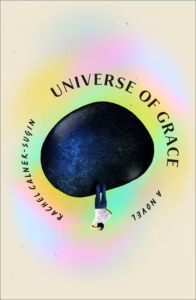
Universe of Grace by Rachel Calnek-Sugin is available from Henry Holt and Co.
