
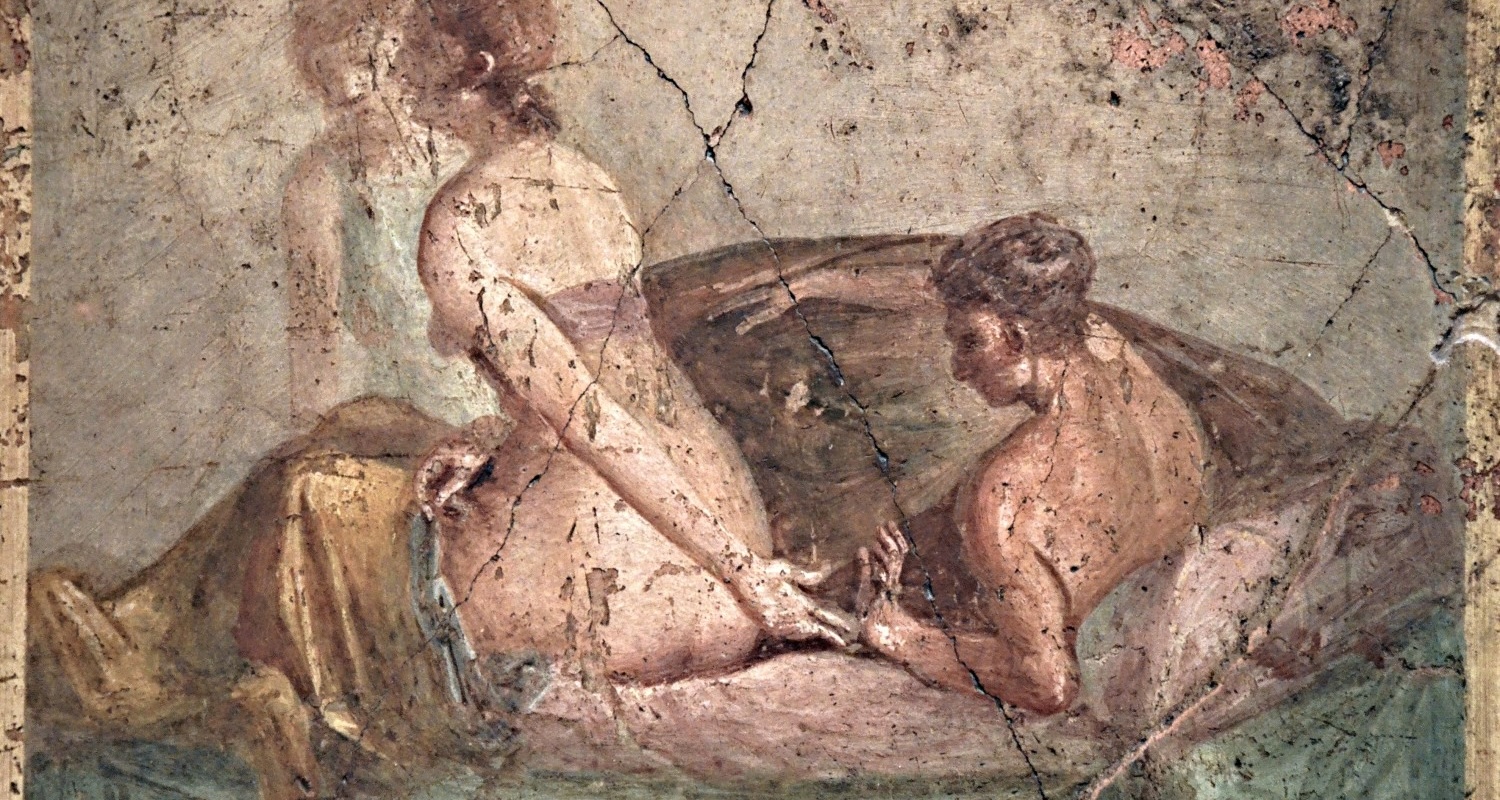
The preserved ruins of Pompeii and Herculaneum, buried for millennia by the eruption of Mount Vesuvius in 79 CE, have long provided a remarkable window into the fabric of daily life in the Roman world, a wealth of detail uncovered since excavations began in the eighteenth century. Yet the degree of explicitness in some pieces proved disconcerting. In 1819, Francis I, then the heir to the Kingdom of the Two Sicilies, visited the newly uncovered treasures at what is today Naples’ National Archaeological Museum, seeking to marvel at frescoes, paintings, and sculptures that had lay hidden for almost two thousand years. He was so shocked by the frank nature of certain works that he ordered much of the material to be concealed once more.
The moment of regal embarrassment marks the birth of the Gabinetto Segreto—“secret room”—in the Neapolitan museum, a repository that would accumulate an abundance of artworks depicting every possible act of lovemaking among women, men, figures who cross gender lines, and even deities (not to mention swans and goats). This testimony to the ancient Romans’ unreserved appetite for erotic fantasy and pleasure stood in stark contrast to the prudish Christian mores that came to shape Europe in later centuries, prompting those in charge to shield the public from it, lest corruption take root.
The story of Pompeii…reveals how pornography has long been the battleground on which morality and power and control are contested.
For most of the next two hundred years, the erotic paintings and sculptures kept within the Gabinetto Segreto were accessible only to scholars with credentials of virtue or to those who could manage bribes. The fear of the corruptive power of Roman fantasy ran so deep that, at one point, the entrance to the chamber was bricked up altogether. Except for a brief interval during the peak of the sexual revolution, the “secret room” remained largely closed to the public until its reopening in 2000. When it did reopen, it was accompanied by explanatory texts intended to illuminate visitors about ancient Roman attitudes toward fertility, life, and pleasure and to deter readers from viewing the works through a contemporary, cruder lens.
According to Floriana Miele, the museum’s scientific curator, much of the art from antiquity indicated that people held a “very different” view of life and nature. Yet as Christianity spread across Europe, attitudes began to shift. By the late Middle Ages, a distinct “prudish secrecy” had taken root—a mindset Miele says fostered a climate of “prurient curiosity.” This is the frame in which much of today’s discourse still operates, and it helps explain the predicament we find ourselves in. Pompeii’s tale demonstrates not only how notions of acceptability and taboos have evolved through time, but also that pornography has long been a battlefield for struggles over morality, authority, and control.
*
Perhaps precisely because it lay beyond prohibition, the erotic art of Pompeii and Herculaneum came to exert a powerful influence on Western conceptions of pornography, even shaping its first English-language dictionary entry. The word itself traces back to ancient Greek roots—pornē, meaning prostitute, and graphien, meaning writing—and originally referred to texts or depictions connected to sex work. Yet in 1864, Webster’s, the American dictionary, defined it as visual stimuli intended to arouse sexual desire—or, more specifically, “licentious painting […] examples of which exist in Pompeii.” Fueled by the sensational press surrounding the Neapolitan excavations, Pompeian relics had effectively seeped into nineteenth-century pop culture. But choosing such an ancient frame to define pornography allowed a degree of respectable distance and perhaps a willful ignorance of the more contemporary erotic material circulating at the time—from flagellation novels and clandestine memoirs to explicit photographs exchanged in drawing rooms.
The erotic art of Europe was not unique in this respect. In China, chungonghua, grounded in Taoist ideas about the cultivation of sexual energy—believed to link pleasure, health, and spiritual harmony—often depicted lovers in lavish, sensuous settings. Japan’s shunga woodblock erotica preferred close-ups of engorged genitals. And in India, centuries of guidance on kama—desire—inspired not only the Kama Sutra but the erotic sculptures and reliefs still widespread in Hindu temples. Yet in these regions too, erotic expression has long been shaped—and frequently constrained—by power dynamics and political change.
For centuries, the visibility of porn within a society has served as a gauge of that society’s approach to bodies and pleasure, as well as how authorities respond to dissent. The enduring question has always been where to draw the line. In the late Middle Ages and early Renaissance, these tensions even surfaced in Christian prayer books, where bespoke copies sometimes bore sexually explicit marginalia. When erotica remained a private luxury—books were expensive commodities and most homes contained none—the papacy was comparatively tolerant of erotic material appearing in sacred texts—so long as it did not challenge the Church’s aversion to non-procreative sex—until the rise of the printing press transformed erotica from a privilege of the few into a widely accessible, provocative resource.
With each technological leap forwards…pornography has tested those limits, reviving the tension between our hunger for transgression and our fear of what it may unleash.
By the sixteenth century, not only Bibles but a broader array of sexual imagery circulated across Europe. Among the era’s most influential printers was Marcantonio Raimondi, celebrated for his collaboration with Raphael and for helping to popularize Renaissance art. His project I Modi, or The Ways, a collection of pornographic engravings also known as The Sixteen Pleasures, earned him imprisonment by papal order, with a demand that all copies be destroyed.
Today there are no surviving copies of I Modi, which was completed with sixteen explicit sonnets. The papacy succeeded in suppressing the book itself, but the printing plates endured, ensuring that the engravings and verses persisted, alongside a vast trove of printed erotica that would continue to proliferate in the centuries that followed.
Remarkably, the advent of erotic cinema did not immediately provoke the same prolonged public furor that would follow later. The earliest surviving erotic film, Le coucher de la mariée, emerged in 1896. It centers on a newly married woman preparing for her first night in bed while her husband waits, anxious and excited, beyond the screen. It is also notable for being one of the few early films to carry an identifiable director’s name: Albert Kirchner, who would a year later direct the first cinematic portrayal of Christ’s life.
Its premiere in Paris signaled the playful opening of a form that would eventually sweep the world, even though pornographic cinema remained controversial and largely hidden for a long stretch. In those early years, the people behind and in front of the camera often remained unnamed, though several titles survive. In the 1907 Argentinian film El Satario, a cadre of women encounter a devilish satyr in a forest; in the 1910 German film Am Abend, a woman is seen masturbating through a keyhole before a voyeur comes into view; and in the 1915 film A Free Ride, thought to be shot in New Jersey, a wealthy car owner offers two women a ride, and the trio secretly watches one another urinate during a roadside interlude as they embark on a ménage à trois.
In the decades that followed, pornographic filmmaking largely remained underground. Yet people continued to produce, consume, and critique sexual content, just as they have throughout history. It is a form that has evolved continuously, forcing each generation to redraw the boundary between curiosity and coercion. With every technological advance—from the printing press to moving pictures and eventually the internet—pornography has tested those limits, rekindling the tension between our desire for transgression and our fear of what it might unleash.
______________________________
From Guilty Pleasure: The Pornification of the Internet, the Economy, and Everything Else by Patricia Nilsson. Copyright © 2026. Available from Farrar, Straus and Giroux.
