
No one is well served by listening to pedants, but I think I’ve found an exception.
This past weekend, I was a reader at The Power Broker Marathon, where 400+ volunteers took turns reading the entirety of Robert Caro’s magisterial book, in ten minute chunks, over the course of 66 hours. The event’s organizers found their readers through an open call. A startling number of my friends and family forwarded the sign up form to me. It asked, among other things, when you would be available to read. I selected “Afternoon,” “Evening,” and after a pause, “Morning” too. I’m an early riser with a young son, after all, so I didn’t foresee any issues.
A few week’s later I got my assigned time: 3:10 AM on Sunday. Technically, a morning slot. But I’m more of a fan of Robert Caro than I am of sleeping in. I confirmed.
I’m a devoted reader of Caro, and I’ve taken up the Bob beat on Lit Hub too, where I’ve covered fellow Caro-heads, his posts on Instagram, and the 50th anniversary of The Power Broker, Caro’s 1162 page book about Robert Moses and his transformative tenure as New York City Parks Commissioner, during which he built miles and acres of highways, roads, bridges, and parks, at the expense of low-income families, farmers, and other less powerful New Yorkers. It’s a great book.
So much to say, I had no trouble popping up with my 1:15 AM alarm and heading out into the cold to read. I traveled northwest across Brooklyn towards the harbor, where the marathon was 50-hours or more old, having stretched from Thursday, through Friday, Saturday, and now into Sunday. I guessed that the story was probably well into the mayoralty of Robert Wagner at that point. I walked by a few giggly couples, walking in the other direction and on a different timeline, enjoying the end of their late Saturday, and soon found myself at Judgy Baby.
Judgy Baby is an industrial warehouse space in the shadow of Moses’s Gowanus Parkway; the event was organized by Brad Vogel, their director of special projects. Vogel told The New York Groove that the idea for the marathon came out of a Power Broker reading group he ran last year.
“Instead of people saying ‘no that’s ridiculous,’” he said, “people were actually excited.”
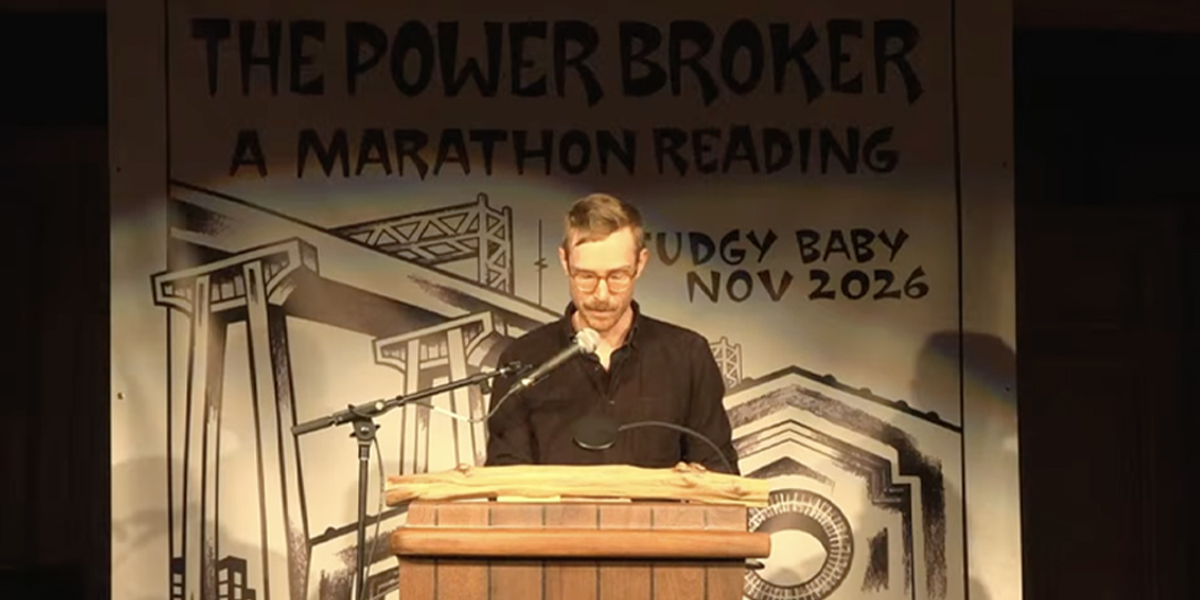
I’d seen the set-up inside on social media, later covered glossily in places like The Times: a banner, a microphone, and a podium with a copy of the book. In pictures of the marathon’s opening, the stage was filled with luminaries like Caro’s editor, the voice of the NY subway system, and a number of current government officials. Power Broker fans are everywhere, like some kind of nerd Illuminati.
None of those big names were in attendance when I arrived at 2:00 AM, but I was happy to see a small and dedicated crew of volunteers, readers, and fans. The big warehouse was much livelier than I’d anticipated; a few people were curled up napping, but the majority were awake: hanging out, chatting, grabbing a quick meal. At least one person was engrossed in a novel. There was coffee, and wine, and a pile of commemorative t-shirts. I took a cup of coffee and a small.
A volunteer checked me in and oriented me. When it was my time, a volunteer would point out where the last reader had left off, and then step back on stage when my ten minutes were up, when I would need to find a natural place to stop. He stressed that this might not be the end of a full sentence, so I might need to find a comma to pause on. Caro is long winded, I was warned, but little did this volunteer know that I was hoping for one of Caro’s famous lists to be in my section (though the most famous one, inspired by Homer, had already long passed.)
I was also asked to read slowly, if I could. The readers before me had been over-eager, and the marathon was ahead of schedule. Caro really does get people excited.
I still had about an hour until my slot, so I found a seat in a back pew (appropriately devotional seating) and listened. In the book, the Tavern on the Green controversy was just coming to a head, one of the rare moments when Moses was personally exposed to public scrutiny. One by one, each reader was replaced by a guiding volunteer, with hearty applause at each transition. Unlike a typical reading, there was no introduction of each new reader (though all our names were in a program, in a tiny font). We were each anonymous, a succession of Vestal priestesses keeping the flame of this project warm.
One reader took the slowdown command very literally, and read his section with long and deliberate pauses between each word. There was some delirious laughter at the careful pacing, and he ended with a round of appreciative cheers and applause.
At 2:50 AM, I was shown to a chair next to the stage. To my right was the on-deck reader, with her own copy of the book to follow along. When she was brought on stage, I took her seat and her warm-up Power Broker. I forgot how small the typeface was in this book, and immediately started feeling like a panicked sixth grader again, skimming ahead and trying to count paragraphs. We were in chapter 43, “Late Arrival”, with the press finally starting to get wise to Moses and his vast, unelected power. Over 1,000 pages in, Moses was nearing the end of his public life.
And then I was up and on stage, following the volunteer’s finger. “Robert Moses still ran the show,” my section began. I stumbled once or twice—“daises” briefly looked like “daisies,” and I read “Rockefeller 3d” as “three d” until I corrected to “the third.” But I was delighted to find a list in my three pages, a comma-laced sentence detailing all the elements that were a part of Moses’s plan for Lincoln Center.
When my time was up, I rejoined the crowd for a few more pages, and then tiptoed into the green room to gather my things. I talked with a few of the volunteer organizers, and compared notes on how the reading went, when we had first finished the book, and which of Moses’s highways confounded us the most in our daily lives. The bleary but bright-eyed energy reminded me of other big efforts I’d been a part of, like the City Marathon or the WGA Writers Strike. Everyone was stretched, but proud. We were doing something, together, and no one would risk letting the rest down. No wonder we were speeding through the book ahead of schedule.
I took a longer walk home, since my train was skipping stops, and passed under the Gowanus Expressway, feeling the crumbling yet still powerful hand of Moses’s ghost on my shoulder.
The feeling of history’s living nearness is why this book is catnip for New Yorkers. It’s a way for us to navel gaze, to talk about how much we love our big, beautiful, messy town, and to gush about how exceptional it is, that even its flaws are so grand to be worth a thousand pages of beautiful prose. But it’s also a way into our other favorite topic of conversation: which trains are delayed, why, and how it’s ruining our day. As one volunteer put it, reading The Power Broker in New York feels like running into an ex—every corner you turn, there Moses is again, standing in your way.
It was nice to be home at 4:30 AM, and nice to know that the Marathon was still marching along. The next day—or rather, later the same morning—I pulled up the livestream on my phone to catch the last sections of the book.
Clocking in to read the last page was Robert A. Caro himself, there on pre-recorded video, the final volunteer reader. Watching the livestream on my phone, I misheard the penultimate line, swapping “he” for “we”: “Couldn’t people see what we had done?”
I teared up a little—from sleep deprivation as much as anything else—to hear it in Caro’s thick, New York accent.
