
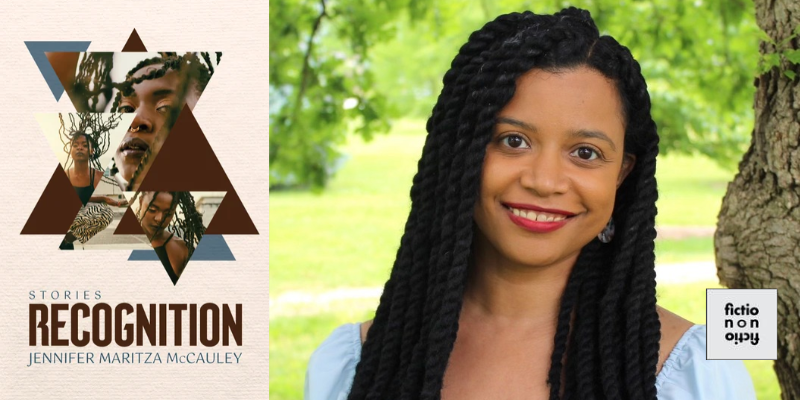
Multigenre author Jennifer Maritza McCauley, who also co-hosts the show, steps into the guest chair for this episode to talk about her upcoming short-story collection Recognition with V.V. Ganeshananthan and Whitney Terrell. McCauley discusses writing about family history and the process of turning nonfiction into fiction; how Jacques Lacan’s mirror-stage concept informs the collection; the relationship between this book and an earlier volume, When Trying to Return Home; and what it’s like to publish with an academic press and undergo peer review. She also reflects on portraying race and popular culture in her work. McCauley reads selections from her stories “Home Ghosts” and “Black Planet.”
To hear the full episode, subscribe via iTunes, Google Play, Stitcher, Spotify, or your preferred podcast app (include the slashes when you search). You can also listen by streaming from the player below. Video versions of our interviews are available on the Fiction/Non/Fiction Instagram account, the Fiction/Non/Fiction YouTube channel, and our show website: https://www.fnfpodcast.net/ This podcast is produced by V.V. Ganeshananthan, Whitney Terrell, AJ Abernathy, Sienna Hoopingarner, and Grace Workman.
Jennifer Maritza McCauley
Recognition • When Trying to Return Home • Scar On / Scar Off • Neon Steel • “Recognition” | Wigleaf
Others
Jacques Lacan, The Mirror-Phase as Formative of the Function of the I, NLR I/51, September–October 1968 • Four Cycles By Jorge Luis Borges • Erasure by Percival Everett • Fiction/Non/Fiction Season 10, Episode 2: Ten Years of Fiction/Non/Fiction: An Anniversary Episode • Fiction/Non/Fiction Season 8, Episode 6: Jennifer Maritza McCauley on Puerto Ricans, Trump, and the Election • Kurt Vonnegut, Shape of Stories (YouTube) • Fear of a Black Planet by Public Enemy (Wikipedia) • The Art of Fiction by John Gardner
EXCERPT FROM A CONVERSATION WITH JENNIFER MARITZA McCAULEY
V.V. Ganeshananthan: Aya’s relatives thread the narratives together, and there are moments of mutual recognition as we follow stories about her family. Yet there are other points where characters search for themselves within culture, or try to find themselves reflected in media, particularly when considering race and the film industry. In one of my favorite pieces, “Black Planet,” a Black and Puerto Rican screenwriter named Marcus (sometimes referred to as Malcolm) has a conversation with a producer who presents as white or white-adjacent and professes some Black and Indigenous roots. Could you read a portion of that story for us?
Jennifer Maritza McCauley: Absolutely. This piece, as you noted, takes aim at many people, including journalists, while also offering a candid snapshot of Hollywood’s methods. I’ll read the moment where Galvin and Marcus have long argued about race and the plan to stage a show about Orishas wielding Samurai swords. The mood is tense, and Galvin is eager to wrap things up. He says something along these lines:
Galvin, resuming his most charming persona, asks, “Anything else you want to ask me? Look, I’ll be straight with you. I don’t actually need you to draft anything; I just want ideas and for you to be there. If we face heat, I can claim we have a Black Latino staff, so you won’t have to do any writing—just sit in the room and shoot the breeze. It’s what a writer’s room does, isn’t it?”
Marcus felt the urge to be present for the photo shoot, but he knew that this wasn’t how most writers’ rooms operated. He had earned degrees and had produced writing before personal struggles hit him; he knew he could craft a script. Marcus would simply serve as a Black Latino face carrying the project’s Blackness. He surveyed Galvin’s office—the carved African statues and the photo of him posing with Ice Cube—and a surge of anger rose within him. He imagined the entire staff of Black developers Galvin would hire, all eager to share their stories so that Galvin could be hailed as a genius, while this man would claim the credit for pursuing their lives in search of material, with the aim of funding a new house for himself. Marcus recognized how he felt used, irrespective of whether Galvin was truly Black. He felt like a caricature for a short-sighted opportunity.
“I’ve got an idea for a movie,” Marcus said. “I’ve never told anyone about it. It’s top secret. It’s called Black Planet.”
“I’ve got ten minutes left,” Galvin retorted. “So… tell me what it is.” He reopened the notebook and waited.
Marcus watched him fall into the trap he’d laid for them both.
Galvin looked up. “Black what?”
“It’s called Black Planet,” Marcus continued, his fury kept in check. “It isn’t extravagant. It’s about a Black planet that’s nothing special. It’s about Black people living there, free to be themselves with all their flaws and brilliance, and no one meddling with them. Everyone Black is welcome, no matter how dark or light they are. The point is there’s no plot; it’s simply Black people coexisting with other Black people on their own world.”
Whitney Terrell: Thank you for that. It’s a very funny scene, and it’s almost believable that producers would tell someone, “I just need your face in the frame; you don’t have to write anything,” which is insulting on multiple levels. Yet the story’s complexity lies in its meditation on representation and the tension between what people claim to be writing and what is really being written. Galvin ultimately appropriates the idea of Black Planet, turning it into a success, while Marcus continues to write for shows like Family Rules, American SongStar, and GlitterGirl, which you’ve described as “an American bastardization of a Japanese senshi anime.” If I’m interpreting correctly, my phrasing may not be perfect in Japanese, but you get the intent.
Then there’s the moment when Marcus’s Puerto Rican girlfriend remarks, “Wait, isn’t that from Public Enemy’s Fear of a Black Planet? It can’t be your original idea. And if you didn’t actually write the script, is anything anyone calls an original idea?” It raises the question: what exactly do you mean by identity and authorship in art?
JMM: My collection asks a cluster of questions rather than presenting a single solution. I’m not claiming one definitive answer. There’s a playful jab at authorship in this piece; Marcus may appear to have originated Black Planet, but Thalia quips, “Aren’t all stories basically the same?” That’s the line I wanted to evoke—acknowledging that a long tradition of stories has revolved around familiar plots. It echoes Borges’s claim that “we will keep telling stories in endless variation,” and it aligns with Vonnegut’s determination that most narratives follow common emotional arcs. He identifies patterns that recur in storytelling, such as “Boy Meets Girl,” while John Gardner’s concept of “The Stranger Comes to Town” highlights a shape that keeps resurfacing in literature. Tolstoy, too, has touched on similar ideas about returning to familiar, resonant plots. The broader aim is to consider how art is received, copied, and repurposed, and how opportunism can ride along with that process. I wanted to gesture toward that complexity without prescribing a single answer.
Transcribed by Rev. Condensed and edited by AJ Abernathy, Sienna Hoopingarner, and Grace Workman. Photograph of Jennifer Maritza McCauley by Jesse Biehn.
