
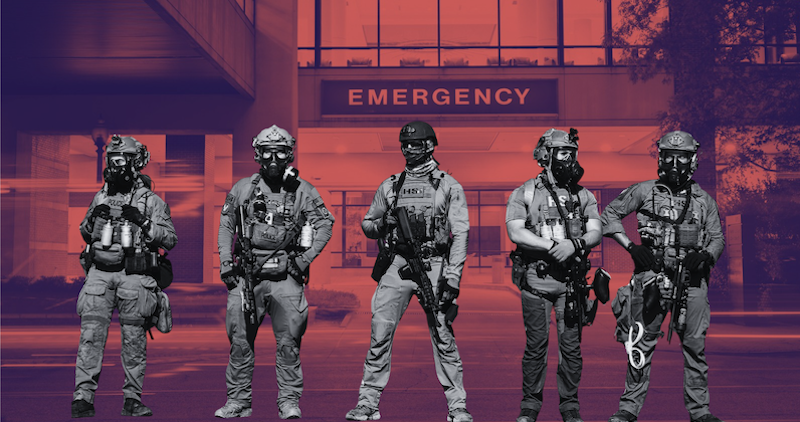
On November 7th, federal officers in Los Angeles escorted a detainee into Adventist Health White Memorial Medical Center in Boyle Heights, a district where the population is over 90 percent Hispanic and Latino.
There is disagreement among ICE, the hospital, and neighborhood activists about what actually occurred that night. On social media, some activists claimed that ICE, when not allowed to operate freely inside the hospital, deliberately targeted the community. Regardless of the exact sequence or motive, three aspects are generally acknowledged.
First, the emergency department entrance was blocked by federal agents for roughly two hours. The hospital explained that they cared for the person in custody with the same respect and privacy afforded to any patient, and that ambulances were redirected to nearby facilities to ensure timely care for all patients, since they did not authorize the line at the entrance used by the agents.
“White Memorial,” the hospital spokesperson insisted, “does not participate in immigration enforcement. We know last night frightened our neighbors. No matter what happens outside our doors, everyone who comes inside is our patient, and our focus will only be on that patient, and it will not change.”
Second, around the same time, local residents learned that ICE was at the hospital. As has happened across Southern California, Minneapolis, and around the nation in recent years, rapid-response community defense measures sprang into action. Activists on the scene included Abraham Zavala of Union del Barrio. Zavala, who was born at Adventist White (as were his children), described the place as sacred ground. At least two protesters, both U.S. citizens, were detained by ICE, according to the Boyle Heights Immigration Rights Network.
And third, the intended damage was done: ICE aimed to instill fear, and that fear proved understandable. We may never know if anyone died during those two hours when the ER was unavailable at White Memorial. We may never know if someone’s life was shortened because emergency care was inaccessible that Saturday night. And we will likely never know how many people chose not to seek care at all after seeing on TikTok or local news that ICE had blocked access to their neighborhood hospital.
The event could push Latinos to hesitate about seeking medical help, or to avoid it altogether—especially when their immigration status adds another layer of vulnerability.
Blocking that ER stands as a tangible example of how medical racism operates: armed state agents not only threatened to arrest anyone seeking care, but they physically blocked access to essential medical services in a predominantly Latino neighborhood. Such brazen acts are not common, and the harm inflicted that night is only the beginning of a broader pattern.
How this harm will unfold remains unpredictable. It could cause Latinos to rethink seeking medical help, or to skip it altogether—especially if their immigration status increases their fear. It may discourage undocumented family members from accompanying their sick relatives to the hospital, leading to potentially substandard care. If racism is, as Ruth Wilson Gilmore writes, “the state-sanctioned or extralegal production and exploitation of group-differentiated vulnerability to premature death,” the seed planted by that one night will likely yield measurable health disparities and needless premature deaths.
Narratives that blend health and racism hold real power. I grew up not far from Boyle Heights, in Oxnard, another predominantly Mexican American community. The specter of raids and the occupation of an ER will no doubt worsen an ongoing crisis. Too many children in my hometown miss school because their parents fear that a relative could be snatched on the way there. When I speak with Latinx medical professionals—from a dentist in Oxnard to an eye doctor in Queens, New York—they tell me how their once-busy calendars have emptied as many Latinx patients forgo routine care (teeth cleanings, eye exams, Pap smears, or mammograms) because the narrative is working: ICE can grab you anywhere, so you’d better stay put as much as possible. (Likewise, a recently deported gay immigrant told me that after months of hiding from ICE, he stopped taking HIV-prevention medication PrEP and subsequently became HIV-positive.) In a single night, ICE amplified the idea that seeking medical care could cost you your freedom and your family.
This is not a new pattern in the United States, and it echoes a storyline born from the abbreviated life and tragic death of Dr. Charles Drew. Although he lived only about 46 years, he remains one of the most accomplished Black physicians in history. The narrative surrounding his death grew in predictable ways nonetheless.
Like many Black children of my generation, I learned about the legend of Dr. Drew early on, and the irony of his death left a deep impression.
Before entering medical school at McGill in the late 1920s, the young Drew had already taught biology and chemistry at the college level. After earning his medical degree, he joined Howard University’s faculty and became a surgeon at Freedman’s Hospital in Washington, D.C., dedicating himself to the health of Black people. He then pursued a Doctor of Science at Columbia, where he authored Banked Blood: A Study on Blood Preservation. Blood banks existed, but their capabilities were limited. The scientific community and the public often clung to erroneous beliefs that different races possessed different types of blood. Although the main blood groups (A, B, AB, and O) had been identified at the turn of the 20th century, racial segregation persisted in how blood was stored and used. Early blood banks used during World War I faced uncertainties in blood typing, and crude storage methods made shocks and infections common, rendering transfusions less useful than they could have been.
Yet, despite his immense accomplishments, racism haunted Drew throughout his career and—through the force of narrative—long after his death.
In the 1930s, Drew achieved a watershed development that benefited all of humanity: he demonstrated how to separate plasma from the cellular components of blood and how to store it in a way that kept it usable for up to two months. Because plasma could be given to anyone in an emergency, regardless of blood type, his findings vastly increased the life-saving reach of transfusions. He also invented the “bloodmobile,” broadening the reach of blood donations. By these contributions, he became known as the father of the modern blood bank, and the Allied Powers relied on his method to save countless lives during World War II.
Yet, despite these monumental achievements, racism haunted Drew throughout his career—and, through the patterns of storytelling, long after his death.
Drew was named the first director of the American Red Cross’s blood bank program in 1941. However, when officials insisted that blood from Black donors be stored separately, he stepped down in 1942.
Every year for more than a decade, Drew traveled to a free clinic in Tuskegee, Alabama, giving free surgical care to poor Black people. In 1950, he and three other Black physicians drove more than 700 miles from Washington, D.C., to perform this service. On the clinic’s final night, he worked overnight in the operating room, then drove home, exhausted, and his car crashed in a field. The other doctors survived with minor injuries, but Drew faced serious injuries. And many Black children my age likely heard one of several versions of a troubling myth: that he was taken to the nearest hospital and denied a transfusion because his blood was not considered “white,” or because there was no “Negro blood” available, or that he died en route to a segregated Black hospital because there were no Black beds.
In truth, according to the other doctors who were with him that night, he received prompt and competent care at the nearest hospital; his injuries were so severe that survival would have been unlikely. Yet the myths persisted because they reflected a broader truth about the era: Black people routinely died in the Jim Crow South due to the lack of accessible Black-friendly care, longer ambulance rides, and the segregated medical system. Dr. Drew himself became a casualty of the very phenomenon Ruth Wilson Gilmore describes—the state-enabled or extralegal production of vulnerability that shortened Black lives. He traveled to Tuskegee because there was insufficient care there for Black Americans, he worked all night because of the scarcity of resources, and he drove home exhausted because there were few or no motels for Black travelers along the route.
Narratives are powerful because they reveal fundamental truths, even when the exact incident that sparks them differs. Whether or not those ICE agents meant to intimidate Latinos on November 7th, the effect—denying care and inducing fear—will have lethal consequences for years to come. Likewise, Drew’s death did not prevent Black communities from recognizing that racism influences medical access. When racism and access to care intersect, the harm is not limited to substandard treatment; it also shapes people’s behavior. It can manifest as someone avoiding 911 out of fear that a rescuer might arrest a loved one, a Black patient delaying treatment for a suspected infection, or a prospective patient hesitating to approach a hospital because they fear rejection or mistreatment due to gender identity, immigrant status, or race.
Narratives are undeniably influential. One that has troubled me is the notion that the Democratic Party is inherently anti-ICE. Many voters go to the polls believing that ICE belongs to one party while Democrats are its opposites. (It’s troubling to witness I Voted stickers attached to the legacies of cases like Rene Goode and Alex Pretti, given that Democrats have long funded the immigration agencies responsible for such harm.)
Then, on election night, I watched the Democratic U.S. Senator-elect Peggy Flanagan vow to dismantle ICE. May she and Dr. Abdul El-Sayed have success. Perhaps, in their roles as lawmakers, they can help craft a new story—one in which racism and access to medical care are no longer entwined, but decisively separated.