
I have worn nearly every hat in the music industry: performer, songwriter, A&R rep, producer, label director, studio owner, and more. Yet the core of what I have done—and loved the most—is creating music, and then taking that music on tour to share it with others.
If nothing else, it’s a life that is rich with stories. And many of those stories have found their way into my collection “Dancing with Poets” directly or tangentially.
Some poems focus on people who perform music; others illuminate studio engineers or the rowdy crowd at a dive bar; some center on instruments; some on specific songs; and some place music in the background, audible from the overhead speakers of our days.
As I’ve strived to tell these stories, and experimented with incorporating music and musical moments into poetry, I’ve sought poems that do not treat music as a vague abstraction, but approach it with a truth that only careful listening can uncover.
What I admire most about the collections that follow is their devotion to the granular. Regardless of the author’s personal familiarity with particular artists or tunes, each book commits to precise detail, enabling fresh insights and wonder by attending closely to music, its instruments, and the people who bring it to life. These volumes continue to teach me, not only how to write about music, but how to observe—how to see, and to write, the world anew.
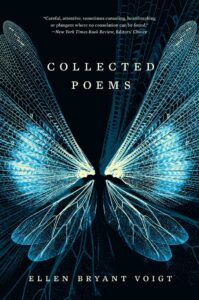
Ellen Bryant Voigt, Collected Poems
Voigt’s collection assembles a corpus rich with music as subject, underpinning force, and wellspring. I want to call out two sequences that use piano as a way to embody and illuminate, focusing on the instrument as a living presence. From “At the Piano”:
At the piano, the girl, as if rowing upstream,
is driving triplets against the duple meter,
one hand for repetition,
one hand for variation and for song.
She knows nothing, but Bach knows everything.
And here are moments from three portions of Voigt’s Rubato sequence, which begins by naming the instrument’s particulars and then broadens to reveal the music, and the people who bring it to life, whose lives are reflected in the instrument itself.
For the action: hammers of walnut—Nussbaum, “nut tree”;
the pinblock, hard-grained beech;
the keyframe, oak; the keybed, pine;
the knuckles, rosewood. In the belly, to ripen the tone,
And here, in the third section, Voigt lets the piano converse with its surroundings to reveal the characters who orbit it:
not what my parents might have played
if my father had ever learned how to play
and if my mother had ever played
anything other than her one song,
And in the ninth section, Voigt gathers biographies, generations, the instrument’s physicality, and the specifics of music theory and performance into a single, integrated world:
Today, that child turns one
so I play Grieg, her countryman,
then play Schumann’s “Kinderszenen,”
and then: ragtime, American stride left hand
a steady measurement, the free right hand
a stitch ahead of the beat, then a stitch behind,
the stammered math of feeling
Voigt’s artistry lies in her intimate knowledge of the instrument, the act of performance, the music itself, and the lives of those near the piano—so thoroughly that the world it sustains becomes inseparable from the music at its core.
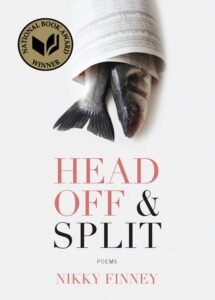
Nikky Finney, Head Off & Split
Finney’s sequence Condoleezza Suite offers a four-poem biography of Condoleezza Rice as both a private individual and a public figure by foregrounding Rice’s background as a pianist. What stands out to me is Finney’s ability to describe physical aspects of Rice’s playing—built upon a tradition of major scales that depend mainly on white keys—using those concrete details as metaphor and image for Rice’s inner life.
These passages come from “Concerto no. 11: Condoleezza and the Chickering.”
“When she is a girl she learns to play to the Italian
in her blood…
In the future, when she plays Secretary of State on the
world stage, the black keys will always be a stretch.
…
When she is at her Watergate window, practicing
at her Chickering, she will, in the tradition of other
deposed heads, refuse to imagine grace notes &
half counts. She won’t, not even when no one is
looking, sideslip or walk the white keys with only
the fingers of her left hand”
What I most admire in Finney’s work is how a meticulous focus on craft and technical detail makes an otherwise inaccessible inner life legible—the Condoleezza Suite becomes a character study grounded in the particular as a doorway to the unknown.
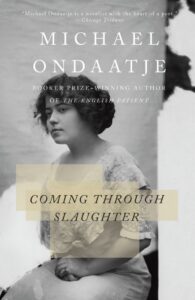
Michael Ondaatje, Coming Through Slaughter
Ondaatje’s Coming Through Slaughter fuses prose, poetry, historical record, and imagined biography to tell the story of Buddy Bolden—the legendary “inventor of jazz”—who lived before recording could capture his sounds and who ultimately ended his days in an asylum after a series of mental breaks.
He combs through historical sources to assemble a plausible biography, while not shying away from invention to animate Bolden’s world. Like Voigt and Finney, Ondaatje invokes recognizable musical pieces as anchors, yet the point of his approach is not to imitate effortlessness but to illuminate how artists live and how audiences receive their work—how the truth of a life can be approached from multiple angles, whether rooted in documents or born from imagination.
Coming Through Slaughter pushes beyond traditional genre boundaries, yet the detail of its scenes—how Bolden’s life feels through music, and how perception shifts between performer and listener—has stayed with me for decades:
“She knew his fingers moving against the flesh of another body as if he were thrusting them into a cornet. She suspected he would be unaware of it, imagining his thoughts wandering elsewhere. Yet she was wrong; he was improving on Cakewalk Babies.”
My appreciation here rests not only on the exactness of the description, but on how Ondaatje uses a single moment to reveal how the performer’s inner world and a companion’s experience of that music can diverge—two readings of the same sound, each true in its own right.
Sometimes writers assume they understand a song’s intention or a musician’s aim—an error I’ve probably made more than once; but as Ondaatje demonstrates so lucidly, even when we share the same notes, our interpretations may diverge dramatically, revealing the layered nature of listening itself.
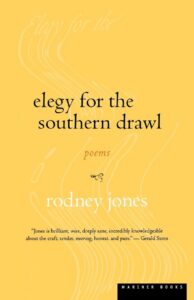
Rodney Jones, Elegy for the Southern Drawl
Jones’s Elegy for the Southern Drawl uses the Southern Drawl itself as the instrument—an approach that binds music to place and speech. Music feels inseparable from geography and language here, and the collection threads musical reference through a broader map of landscape. The book is extraordinarily precise about what it includes—if a subject involves music, it names a tune or a chord; if a description involves landscape, it names the trees or the rivers. The title piece and its peers unfold through palimpsest, layering sound, place, and memory to form a world where each element teaches the next:
Country songs, sorghum, the odor of lard
That clung to coats, sweat and saliva roaring
Out of the varnish of old desks as the days
Heated up in late spring: it embarrassed me.
In the ninth section, music and the life of musicians take center stage with unflinching specificity, grounding the poem in concrete details that illuminate a broader cultural and personal geography:
Some kind of hippie cowboy on the elevator
Going up in the Music City Day’s Inn,
He’s apologizing for his pink, hard-shell
Guitar case jammed in the closing door,
Thanks, and he’s gone, the only white
Man I’ve heard speaking the hoarse,
Barreled-in English of a native of India…
…This is Nashville,
Shrunken world, a hundred twenty miles
North of home
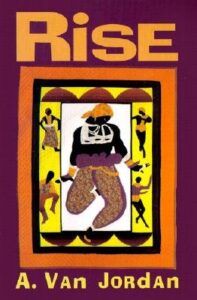
A Van Jordan, Rise
Jones’s use of musical detail sits alongside other means of representing sound and voice, but a particularly telling strand in his work is how music threads through the consciousness of speakers who are not performers themselves. In Rise, for instance, the poems often treat music as a soundtrack that moves in and out of the speaker’s thoughts. The voices may not be musicians, yet music remains a vital companion as the speaker navigates the world.
I’d argue this example matters for its demonstration that one need not be steeped in piano construction or in a public figure’s lineage to weave music into poetry effectively. In “Public Radio Plays Eddie Harris,” Jordan offers enough particularity about Harris and his horn to render Harris’s presence tangible, so readers can grasp Harris’s place within the speaker’s interior life:
…If WPFW FM can’t resurrect me, Lazarus was a liar.
Thank God, they’re playing Eddie Harris.
I have friends who are atheists.
I have ammunition for our next argument:
They play four Eddie Harris tunes in a row!
Faith healers are tuning in.
I’m all but cured when they make the announcement:
Eddie Harris died today.
Thoughts tornado over my bed.
It pirouettes over the city with hips like my mama’s.
Eddie always said there’s no such thing as a wrong note,
Only bad connections to the next.
I put the alarm clock under the sheets.
In the morning it will sound like music.
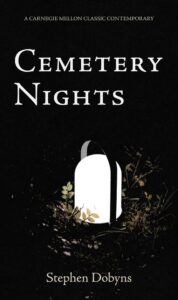
Stephen Dobyns, Cemetery Nights
Dobyns’s Cemetery Nights isn’t primarily about music as a subject, yet the anthology returns time and again to songs and sounds, perhaps most clearly in the poem “Loud Music.”
Where the previous writers weave music into a tapestry of identity and place, Dobyns centers sound itself and the listener’s needs—how the presence of sound can erase the self, or rearrange perception. “Loud Music” foregrounds how volume reshapes the room, the mood, and the self, to reveal what a listener longs for when the world recedes and only noise remains.
My stepdaughter and I circle round and round.
You see, I like the music loud, the speakers
throbbing, jam-packing the room with sound whether
Bach or rock and roll, the volume cranked up so
each bass note is like a hand smacking the gut…
…Loud music does this, it wipes out the ego,
leaving turbulent water and winding road,
a landscape stripped of people and language —
how clear the air becomes, how sharp the colors.
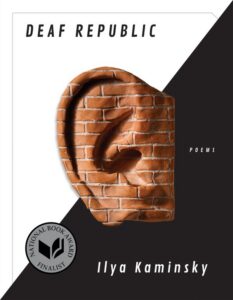
Ilya Kaminsky, Deaf Republic
Kaminsky’s Deaf Republic centers on a population silenced by military occupation, choosing deafness as a form of protest, and thereby examining what happens when listening itself is attacked. The book treats silence as a political act and asks how oppression demands attention, how the oppressed communicate within a regime that forbids hearing, and what silence and sound become in a world where some voices are permitted to speak while others must remain unheard.
The absence of sound is the book’s animating concern, and I’ll quote a few moments to show how silence becomes the focal point:
silence?
it is a stick I beat you with, I beat you with a stick, voice, beat you
until you speak, until you
speak right.
And later, from the Notes, the book’s most telling articulation on silence:
ON SILENCE: The deaf don’t believe in silence. Silence is the invention of the hearing.
__________________________________
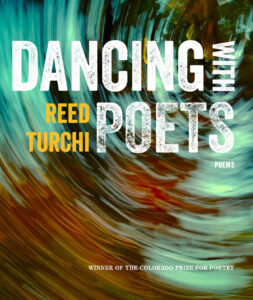
Dancing with Poets by Reed Turchi is available from University Press of Colorado.
