
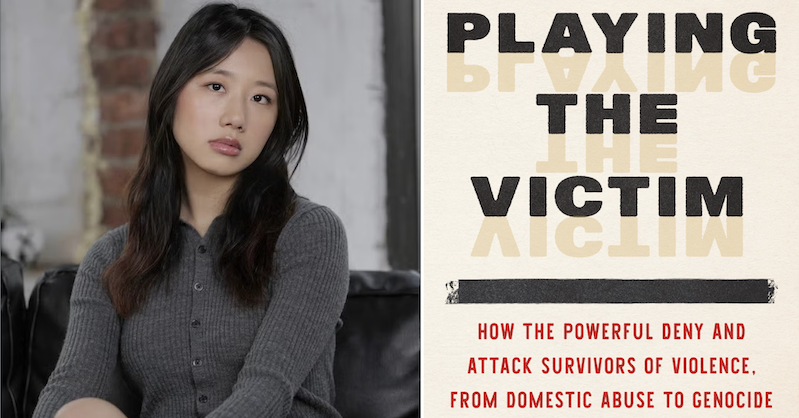
In the spring of 2022, Kylie Cheung was covering urgent topics for Jezebel—stories focusing on sexual violence and intimate-partner abuse. In the background, a high-profile defamation trial played out live on social feeds. As she watched Johnny Depp’s team recast Amber Heard’s resistance to his alleged abuse as evidence of her own aggression, Cheung began to view the trial as a textbook demonstration of DARVO: Deny, Attack, Reverse Victim and Offender—the abuser’s playbook first named by psychologist Jennifer Freyd in 1997.
Playing the Victim: How Empires and Abusers Fake Victimhood to Hold Power—And How We Fight Back (North Atlantic Books) traces that mechanism from intimate relationships to vast power structures. Cheung contends that influential institutions, from the Israeli state to anti-abortion legislators to the U.S. immigration system, sustain control by performing victimhood and portraying the people they subjugate as the aggressors. The book’s central case study is Israel’s actions in Gaza, where Cheung draws on conversations with human rights lawyers, aid workers, clinicians and researchers on sexual violence to document both the assaults and the propaganda used to justify them.
Cheung and I spoke about how a celebrity trial turned into a larger meditation on empire, what it means to cover a genocide as it unfolds, and the personal toll of pursuing these stories.
*
Samaa Khullar: The book starts with your 2022 reporting on Depp v. Heard, and you write that it reshaped your understanding of power and patriarchy. You also confessed at the book’s launch that you regretted initially treating the trial as a frivolous assignment. When did your perspective shift?
Kylie Cheung: While I was tracking the early stages of the trial from the periphery, I felt irritated about having to cover what looked for a moment like celebrity gossip. Yet the moment I witnessed the widespread misogynistic backlash against a woman who was clearly a survivor of sexual and domestic violence, my attention shifted. I started digging deeper into the case and the tactics used against this survivor, and I saw the bigger pattern at work.
SK: You do an excellent job linking an individual abuse case to the way a modern empire preserves its dominance. Could you expand on that connection?
KC: For a long while, imperial powers were typically imagined as legitimizing themselves through displays of brute force. Fascism, for instance, often rests on the image of large, intimidating men projecting strength. Yet many such powers sustain themselves by adopting a victim persona—casting those they subjugate as the real oppressors. That reversal then rationalizes the violence they carry out.
In the Depp–Heard case, Depp’s side floated a notion of mutual abuse. They didn’t outright deny his violence toward Heard; they framed it as mutual aggression, hoping to confuse the public and obscure the dynamics at play. That tactic—misframing power as vulnerability—has become incredibly potent in a society with considerable gaps in understanding domestic abuse and power dynamics. Israel’s actions in Palestine present a stark, even more brutal, instance of the same logic.
There are numerous aspects of this book—particularly regarding Israel and Palestine—that could have been written well before 2023.
SK: How do you approach writing a book about a moving target? When do you stop and place events in context, given there’s always a fresh development on the horizon? With a newspaper article you can trace it, but a book like this demands a broader frame.
KC: I had to stay mindful about grounding the work in a concrete vantage point. As I mentioned at the launch, this has long been true in my reporting on abortion bans, sexual violence and the carceral system: you feel a restless urge to pile on examples. Yet the core argument and the crucial points of critique don’t fundamentally shift. There are many things about Israel and Palestine that could have been written before 2023—the same patterns of genocide and occupation persist.
A notable case from a few months ago, the Palestinian Feminist Collective’s rigorous report documenting the systematic sexual violence associated with Israeli actions, is something I wish I could have integrated into the book. Still, even without that addition, the report builds on what we have long understood: the state executes mass, state-sanctioned sexual violence against Palestinians.
SK: I also want to ask about what didn’t make it into the book. Many readers will wonder about the Cornell rape case—the details of which emerged after the manuscript went to print. It feels highly relevant to your arguments, especially as more of Jane Doe’s alleged attackers speak out, claiming she initiated the encounter or that text messages later show her apologizing. If the lawsuit had been public earlier, where might it have fit within your framework?
KC: There was a substantial chapter on campus sexual assault, and there’s a strong overlap with that material. It ties back to a persistent problem: the public’s deep misunderstanding of trauma responses and the processing of abuse, which tends to privilege the offender’s narrative over the survivor’s.
A concept Dr. Nicole Bedera has studied—weaponized irrelevancy—describes how observers nitpick tiny details about victims while allowing the perpetrator’s various inconsistencies to slide. The standard expectation remains: the only testimony that counts is that of the person who committed the act. When a survivor speaks, the response shifts; as we discussed with Gaza, too many Palestinians describing the technologies of attack are dismissed or dismissed as conspiratorial.
This case also serves as a quintessential example of campus sexual assault. People acknowledge the scope of the problem, yet the magnitude remains hard to grasp. The Title IX offices, meanwhile, show little base knowledge of trauma or victim advocacy. Since #MeToo’s mainstreaming, there’s a fear of appearing biased toward the survivor, which itself yields protections and concessions for the accused that would not normally exist.
Some of Depp’s most ardent supporters were women who had faced sexual violence. The way people respond to trauma can be heartbreakingly misguided and infuriating.
SK: I want to hear more about your argument around the slogan “Believe Israeli women” and how it foregrounds gender to obscure the larger reality of colonization. I recently saw a story of an American woman who, after years of seeking help for abuse on campus, moved to Israel, joined the military, and now promotes hasbara. She was reportedly raped on campus and received no support. It’s plausible, yet it’s painful to watch as she repeats harm against another population. How do we address this hypocrisy?
KC: That observation is striking. Sexual violence is deeply entrenched. It’s difficult not to see that there are many women in similar situations. Even in the Depp case, several supporters were women who had suffered sexual violence. The ways trauma shapes people’s reactions can be wrenching and unjust. It often feels like a projection of relief—people trying to regain control by aligning with someone else’s fight against injustice, even when that alignment collapses under the weight of other harms. Your anecdote about your family illustrates this vividly: from experiences of sexual violence to the everyday realities of moving through checkpoints in Occupied territory, the problem is woven into the fabric of life under occupation.
But what has continued to unsettle me for three years is the October 7 mass-rape narrative. That claim was designed to obscure the very real, enduring sexual violence at the core of the Zionist project. The propagation of this narrative has driven some Israeli men and soldiers to escalate violence as a supposed retaliation—and they have spoken about it openly.
SK: In Chapter 3, you note that anyone who questions the repeatedly debunked New York Times piece, “Screams Without Words,” which alleges a mass rape campaign by Palestinians against Israeli women, “steps into the trap of appearing to be a misogynist and a rape apologist.” As someone who reports on survivor justice and has survived yourself, what was it like to write that line, knowing you would likely face that trap? Were you ever concerned about being labeled a misogynist while researching or drafting this book?
A major reason I felt compelled to write this book is the notable absence of Western feminist condemnation of Israel.
KC: I’m not sure I can phrase it as a single term, but I felt a sense of relief—perhaps even a grim satisfaction—in taking on this project. It’s been utterly appalling and enraging to witness how some progressives handle this topic. Some have tried to strike a compromise, acknowledging Hamas’s abuses on October 7 while insisting that it doesn’t warrant genocide. Kamala Harris, for instance, often courted a similar middle ground, speaking about humanitarian crises without naming genocide and invoking the mass-rape narrative to soften the stance. Whenever that move occurs, it risks being weaponized to justify escalated violence and to cast the colonial power in a less culpable light. My aim in the book is to reject that stance entirely. Invoking the mass-rape narrative serves as a mechanism for allowing the state’s violence to continue, and it’s rooted in racist and Islamophobic stereotypes that stereotype Muslim communities as inherently regressive. If you defend Palestine, you confront that trap head-on.
SK: In the book you discuss “revolutionary violence as self-defense” and describe fear as “a permissible risk for health-insurance executives.” I’m thinking about people currently detained by ICE for their writing and journalists jailed for questioning those in power. Did you fear professional or legal repercussions for voicing these assertions, or do you sense a turning point in public discourse?
KC: I’ve long felt distant from the idea of working within a traditional, strictly objective newsroom. I’ve gravitated toward outlets that encourage a distinctly voiced perspective. A key reason I wrote this book is the noticeable lack of Western feminist condemnation of Israel. On a human level, anyone with a conscience should repudiate the violence taking place, but feminists have to confront how gender-based violence is weaponized in the context of occupation. In 2024, Democrats emphasized defending reproductive rights while the U.S. government supplied weapons to Israel, places where pregnancy is perilous under a genocide. The cognitive dissonance was striking, perhaps even Orwellian. It underscored the need for Western feminist outrage toward Israel and for more feminists willing to declare that “Israel does not have the right to exist.”
SK: What has this long, intense focus on atrocity cost you mentally, and what does it yield once you step back?
KC: I’ve reflected on it a lot. It’s been roughly a decade since I began covering reproductive violence and related harms. Earlier in my career, I felt energized and driven; in recent years, I’ve grown weary, cynical, and exhausted by the sheer scale of it all.
As for what it gives back, I value the sense that my work isn’t merely about witnessing injustice passively. If I can document a story that wasn’t being told, or ensure that someone’s voice is captured in a record, that matters to me. I wanted to place this argument in the record, to insist that DARVO can be applied to state violence. That said, I doubt I’ll write another nonfiction book soon; the process was extraordinarily draining. Yet when confronted with such grave and disturbing events, I fear worse if I didn’t engage with them at all.
_________________________________
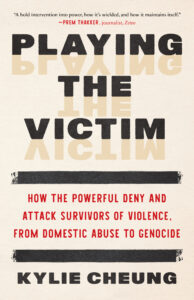
Playing the Victim: How the Powerful Deny and Attack Survivors of Violence, from Domestic Abuse to Genocide by Kylie Cheung is available from North Atlantic Books