
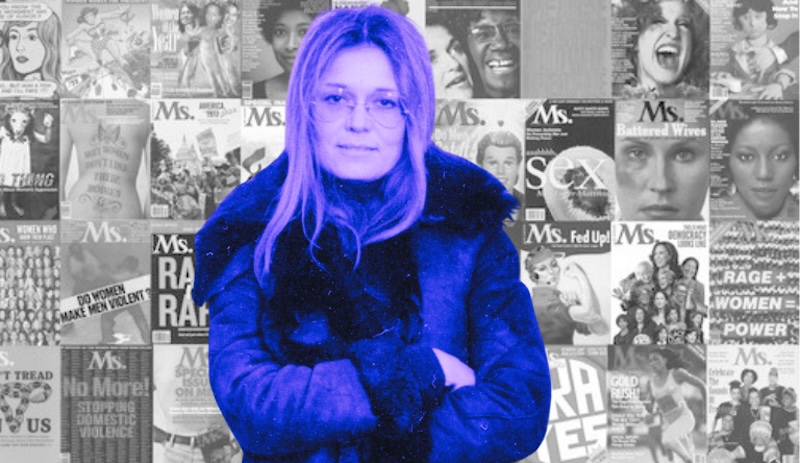
Gloria Steinem’s calendar was packed to capacity. Autumn promised a string of luncheons and interviews, including a high-profile exchange with Katie Couric at 92Y and a prominent slot in The New Yorker Festival. Yet her commitments spilled beyond the schedule: she canceled certain appearances, left interviews unaired, left an essay unpublished, and postponed a forthcoming book. In short, at ninety-two, Gloria Steinem remained very much in motion.
That very vitality shines through in her memoir, An Unexpected Life, released on September 22, where she notes her aim to reach a hundred. Although she was “older than [she] ever imagined,” the thought of death did not dominate her mind. Why would it, when she was “happier than [she] ever imagined” and her days were so full? Part memoir, part manifesto, part consciousness-raising circle, An Unexpected Life gathers essays in which Steinem reflects on her journey, shares her worldview, and casts an eye toward what lies ahead. And as in life, the pages carry a calm, practical certainty—the product of more than six decades spent organizing a movement.
Her story begins long before she became the most recognizable figure of second-wave feminism (a label she would reject), rooted in a bruised childhood in Toledo, Ohio. There were stretches of her youth spent on the road, until her father left when she was ten, leaving her to care for a mother whose mental health deteriorated. Raised with a longing for warm kitchens and the comfort of a conventional family, it is striking that she would later travel across the country for most of her adult life, often living out of a suitcase. Yet perhaps even more influential than those early years was a sojourn in India in her early twenties, an experience that would become the bedrock of her feminism.
Even though mortality did not loom large for Steinem, these pages reveal a sharp awareness of the legacy she would leave behind. “At my age, in this still hierarchical era, people often ask me if I’m ‘passing the torch,’” she wrote in her 1983 work Outrageous Acts and Everyday Rebellionss. “I explain that I’m keeping my torch, thank you very much—and I’m using it to light the torches of others.”
That very effect is evident in An Unexpected Life, a book brimming with hopeful exhilaration about what could be. “Nothing is more thrilling than making the invisible visible. It’s like discovering the end of a ball of yarn,” she writes. “Pull on it, and gradually the whole fabric of patriarchy untangles.” At times, she becomes almost didactic, offering bullet-point lists on how to organize a feminist movement. The text also nods to the critiques of the women’s movement she helped helm. “Insist on multiracial women who represent the movement,” is one such takeaway. “Otherwise, people will have a distorted view.” There is a poignant sense in these essays now that she has passed: a book that serves as both a record of her life and a guide for building a movement. “Whatever my story might be to other people,” Steinem writes, “I hope it creates ripple effects that I myself may never witness.”
A notable ripple concerns her cherished home, an apartment in a brownstone on Manhattan’s Upper East Side. “If time and ingenuity allow,” Steinem writes in the book’s prologue, “I hope to acquire the other floors in this house and leave the entire building as a refuge for diverse women who need a place to stay or simply to gather.”
Steinem first moved into that apartment in 1968, sharing with a roommate. Over the years, the space grew not only in size but in purpose. What began as a single unit eventually became a full floor, then three floors. The living room, a constant gathering place for over fifty years, hosted conversations and circles up until this very year. Meetings in that living room spanned topics—from women’s health to misinformation in the media—a discussion that helped spark the founding of Ms. Magazine in 1971. On September 3, Gloria’s Foundation announced that her brownstone would endure as a feminist sanctuary—a haven for women to convene, collaborate, and find shelter.
*
Lingering behind the scenes of these pages is Steinem’s time in India. The years spent there after graduating from Smith College left an imprint so deep and lasting that they shaped her activism and underpinned her worldview for life. In her final essay, published in The New Yorker following her passing, she wrote that it was there she realized that “white people were a very small minority in the world. In India, I got accustomed to, and began to value, racial diversity.” Gandhi’s nonviolent method and the movement he inspired captivated her, especially when she learned that the peace movement drew from India’s women’s movement. “I think culturally women are drawn to nonviolence,” Steinem wrote in her last essay. “Probably because we are the major victims of violence, we become the major movers of peace.”
There is an odd comfort in having Gloria Steinem insist that it really, truly, believe her, has been worse.
That multiracial outlook threads through her philosophy. Steinem could not imagine a world where sexism existed without racism, and vice versa. The claim, perhaps, also stems from how different that image of the women’s movement is from reality—the movement has long been criticized for alienating Black women, working-class women, and LGBTQ+ women. Many of these women were those who had to work for decades just to survive, let alone pursue careers. From her words, it’s clear she rejected any form of “white feminism.” “Systems of domination—racism and sexism—are rooted together, and must be uprooted together,” she wrote. It remains a forward-looking stance. “To stop racist systems,” she wrote, “women especially must be free.”
*
There is a curious reassurance in hearing Steinem declare that it has really, truly been worse. Surveying a world in which women’s rights are under assault, where there is a strange clinging to traditionalism, and in some places an outright push to erase hard-won gains, doom never defined Gloria Steinem. “My role as an elder is to remind us how far we’ve come,” she wrote. She looks back to the early days of Ms. Magazine, when even a publication grounded in feminist ideals found it hard to mount shows by female photographers. Many of those photographers could scarcely afford studio space and equipment for such experiments. Today, many of the most celebrated magazine photographers are women. Although women still earn around 85 cents to a man’s dollar, the gap had been 55 cents in 1970. “I will always prefer plotting present or future change over living in the past,” Steinem observed. That optimism feels especially apt in the present moment. “We must remember that hope is a form of planning,” she told Vanity Fair on her 92nd birthday, announcing the release of this very book. “If you’re not hopeful, you’ve already given up.”
“The very idea that women could be writers was still rare when I was growing up, as was the belief that women could be complete people, not defined by the presence or absence of men.” As I compose this essay, I find myself in a solitary apartment, typing on a laptop I bought with my own credit card in my own name. My own emergence as a writer, a career path I consciously chose, is far less remarkable today—something I owe to Steinem. Every woman who opted for a career rather than marriage owes Gloria Steinem a debt of gratitude. “This is one of the gifts of age: the reward of recognizing that the flowers of change grew from seeds you once planted or watered or carried from place to place,” she wrote.
Gloria Steinem, in her nineties, felt liberated, she wrote in An Unexpected Life. When the book was announced on her birthday, in that Vanity Fair spread, I saw its publication as a celebration of a life spent fighting the good fight. I did not anticipate that these words would, in effect, become her final message. They’re infused with optimism and a hope that future feminists will carry the banner forward—an act that would be the finest tribute to her legacy. “I count myself lucky that not only have I been free,” she wrote, “but I have seen so many other women who are, too.”