In 1994, after leaving behind the frenzied world of New York City advertising—an accidental career born from a failed attempt to turn a biology degree into artistic renown in the big city—I returned to my home state of Vermont and threw myself into wildlife painting, crisscrossing the United States for six years on the national art-show circuit. I hardly wrote anything beyond birthday notes for my daughters.
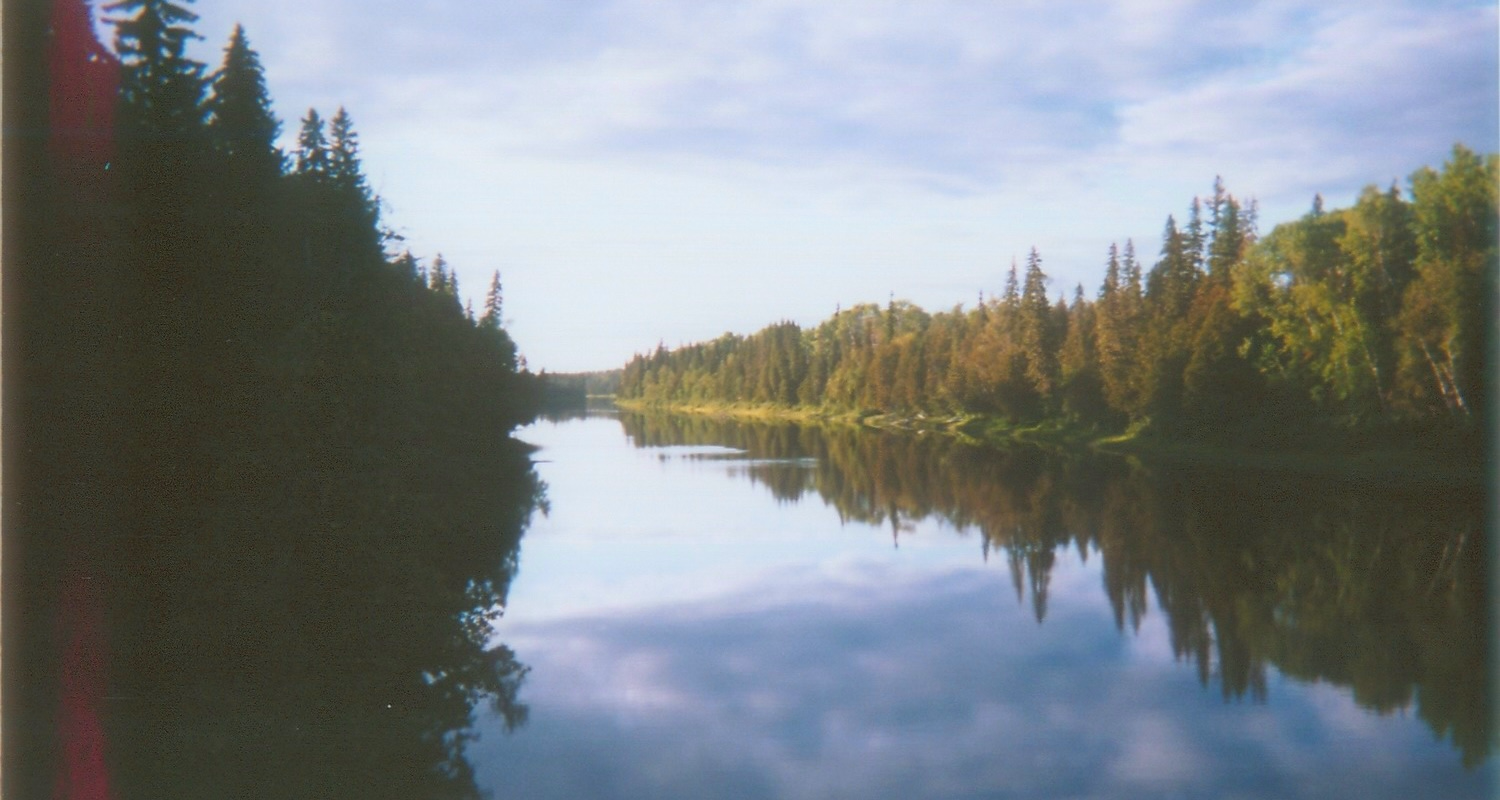
During a show in the western United States in the winter of 2000/2001, it suddenly struck me: I had become as much a teamster as an artist, and I felt detached from what once inspired my brush. I scrapped my late-summer commitments and planned an August/September, 330-mile “source-to-salt” canoe journey on the Missinaibi River, a waterway that runs north toward James Bay (I’d bought my first canoe with money earned from my paper route when I was eleven). This trip wasn’t conceived as an escape, but as work—an expedition for painting and a chance to reconnect with my Muse, in the sense a classical artist might describe it.
That voyage also introduced writing into my creative toolkit. Realizing that disappearing into the wilderness for a month might hardly be noticed, I reached out to an art magazine that liked the artist-on-a-canoe-trip angle and to a canoeing magazine that appreciated the canoeist-on-an-art-trip angle. I wasn’t sure what I would write, but I trusted ideas would arise along the river.
I had assumed I would travel solo with an artist’s itinerary, but at an art show opening in June, John Pitcher, a leading U.S. wildlife painter, asked to come along. On the river, John and I became fast friends and began laying plans for future excursions; however, in Mattice, Ontario, after 130 miles, he had to return, and I pressed on alone.
As soon as Mattice disappeared around a bend, the magnitude of what I was undertaking settled in. I was alone, facing 200 miles of wild river through a roadless wilderness. On one hand, I knew that without help, even a small mishap could spiral into disaster. On the other, the river commanded my full attention.
The wild expanses I have experienced aren’t alien realms, but reminders that the wild is where we all come from.
That first night on my own, I camped at the Kettle Falls portage, and, in a painful blow to my self-image as an adventurer, I was seized by a profound loneliness. I busied myself with setting up camp and starting dinner, yet the melancholy pressed in. Then the westering sun cast a glow along the river’s east bank. Seeking some distraction, I began painting while my supper simmered. I had to work quickly to catch the light, but soon—much to my surprise—the painting began to breathe. A surge of euphoria rose from nowhere and washed away the loneliness in a flood so intense that, for a moment, I wondered if I was all right. The most striking thing was a warm sense of connection, not only to my surroundings but to people in general—not anyone in particular, but everyone. After that evening, I never felt lonely on the river again.
That night, as I dutifully logged the day’s events in the journal the magazines had asked me to maintain, I realized my new assignment was more than a travelogue. The small painting that had triggered one of the strongest emotional responses of my life could not, by itself, describe or explain the inner transformation I had undergone. But writing could.
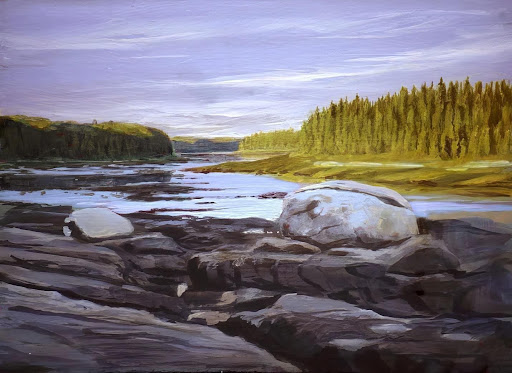 The Way North – Kettle Falls, Missinaibi River. Acrylic field painting, September 4, 2001.
Over the next week, I befriended Canada Jays and sandpipers, chatted with rocks and various bits of gear, all of whom offered their quiet support. Yet an oblivious bull moose nearly took me out by accident, and a large bear appeared ready to consider doing me harm on purpose.
But the river and the forest offered only indifference. There was sound—birds, wind, the current tracing my hull or rushing through rapids—but no discernible voice, and nothing I did seemed to alter the course of events. The timeless vastness of the planet pressed in, a wild Earth utterly unconcerned with humans, and as I reflected on the astonishing diversity of life that “Mother Earth” has produced, sustained, and allowed to pass away through the ages, I realized she is an impassive parent. That felt like a tacit warning and clarified how vain it is to take the world for granted. I also understood then that painting alone would not suffice. I needed to write about it.
That realization was reinforced upon returning home, when I learned, to my surprise, that the wild rivers I had navigated in the Northwoods were all part of the world’s most extensive remaining wilderness and largest land biome: the boreal forest. While this global forest’s southern fringes sit within easy reach of billions, much of it remains vast, remote, and rarely seen except by the scattered Indigenous communities who have inhabited it for millennia. Yet writing about it matters because the boreal forest matters. As Earth’s largest and most intact land biome, it provides environmental services that help keep this planet habitable, second only to the oceans.
Painting has always been my first love, but writing grew from a journaling sideline into a true partner after decades of collaboration with fellow artists, scientists, conservation groups, and Indigenous communities to raise awareness of the boreal forest.
I hope my writing and painting about these landscapes can carry others to the solitude I felt on the Missinaibi River. A universal truth becomes clearer in rarely traveled places. The veneer of human civilization fades, and Earth’s inherently wild nature becomes tangible, offering a perspective that invites us to imagine (or perhaps remember) our world before people and to consider our place in it today. The wild expanses I have experienced aren’t alien places, but reminders that the wild is where we all come from. Ten thousand years ago, we were all wilderness travelers. A quietly profound lesson I have drawn from four decades of canoeing, painting, and now writing about the boreal forest is that, although most people will never see many of these places I’ve been to—and at this stage of my life I may not return—it remains crucial that you can, and there is comfort in knowing that you could. Beyond the edge of the familiar, rivers still flow wild, caribou still migrate across vast horizons, and you can cast off from the shore of a wilderness stream with a month’s supplies aboard and discover what the world you imagine from maps actually looks like—because those places endure.
_____________________________
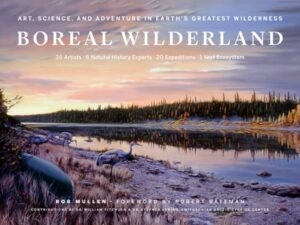
Boreal Wilderland: Art, Science, and Adventure in Earth’s Greatest Wilderness A book by Rob Mullen, available from Page Two Books.