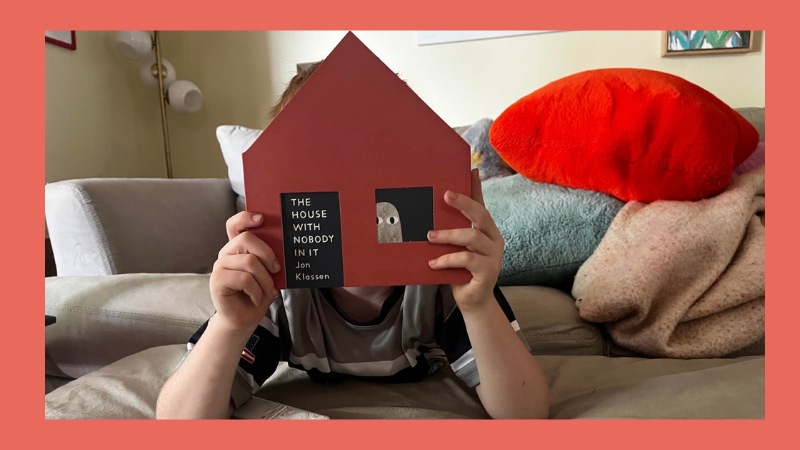
Jon Klassen’s books linger with young readers. Perhaps it’s because they sit with you, eyes wide as you read aloud. His newest release, The House With Nobody In It, is a board book cast as a small house, complete with door cutouts and a playful misalignment between text and image: the narration names objects in each room while insisting there’s “nobody” inside. A ghost peers in from the margins. My own children, who grew up with This Is Not My Hat and the Shapes books, adored it even though they’re now nine and eleven. I’d imagine lots of grown-ups would also relish a well-made board book.
Klassen recently received the Astrid Lindgren Memorial Award, and learned of the honor in a morning phone call that felt almost life-changing (I highly recommend listening to that moment when the full jury calls). His work seems to occupy its own space, allowing a blend of darkness and dry wit that doesn’t always find a home in traditional children’s literature. He kindly answered several of LitHub’s most pressing questions about how fatherhood has affirmed his ideas about childhood, how Sweden views children’s literature, and his overall process. It’s a true treat.
*
Janet Manley: The format of this book is just incredibly satisfying. How did you bring it into being? Did the publisher react with an “oh no, die cuts and doors in every page”? Did you have to imagine an entirely new, house-shaped publishing setup? How significant is it to release a book that also functions as an object?
Jon Klassen: If there was any “oh no” moment from the publisher, they kept it under wraps. From what I’ve seen, board books can accommodate a lot of tricks. I’m not entirely sure how ambitious something like this is, and I’m not sure I want to fully know.
JM: As you move through the book from room to room, the doorway propels you onward — that same forward motion you see in The Very Hungry Caterpillar— was there a specific influence, and how did you map out the three-dimensional aspect of the narrative?
JK: The room-to-room progression drew some inspiration from early video games, such as the earliest iterations of Zelda, or even an older Atari title called Adventure about a fortress. In those games, you have a top-down view of spaces, and you reach the edge of the screen where a door or break in the landscape appears; you choose to go through, and suddenly you’re in a different room or area. I remember, as a kid, being scared by the idea that your on-screen character stands in an open doorway without you knowing what’s next. You don’t see into the next room until you cross into it. And anything INSIDE the next room could see you in the doorway before you see it. This book doesn’t lean on that trick heavily, but the room-to-room movement is definitely part of the concept.
JM: The second rule many people cite in children’s publishing is that readers should be able to identify with a character, a voice they can feel kinship with. In this book the voice feels more elusive. How did you lock in a character or a perspective?
I think having kids really reinforced how meaningful that moment is for me. They’re living real days, as important as mine or anyone’s. I suspected as much, but seeing it firsthand is amazing.
JK: Another anchor for this book, and for a lot of my board-book work lately, is the practice of guided meditation. I don’t claim to be an expert, but we had a few sessions in high school that stayed with me. These books tend to be told in the moment, not after the fact, and I love the immediacy of present-tense narration. The host’s voice is often flat and calm, even when something might be happening that’s exciting. It’s almost like the host is in a kind of trance, and that quiet neutrality is an essential part of the whole experience. There’s also a kind of scholarly texture to the book. If you removed the ghost, you’d have a straightforward object-lesson about what a chair is, which can be oddly educational in its own right. I like the notion that if you can’t see the ghost, the book remains a not-so-entertaining exercise in recognition.
JM: Perhaps the meta-reading was intentional; perhaps not, but the house is empty when the book isn’t being read. Is it a story at all unless a child is turning the pages? Or is it something else entirely?
*i.e., you could count either the ghost or the reader themselves as the wink-wink exception to “this house is empty”
JK: That wasn’t the plan, but I do enjoy the idea that, if there were no ghost on the page, we, the viewers, would still be wandering through the space, unseen, in a sort of strange detachment, moving through walls and reliving the same day. A reader could feel a bit like a ghost inside the book. It ties into the fact that the narrator can’t actually see the ghost. If we can see him, why can’t the narrator? Do ghosts see only other ghosts? What does that say about us?
JM: Did you impose any rules for yourself in writing or illustrating this one?
JK: When it comes to the visuals, it wasn’t so much a strict rule as a new emphasis on the book as a tangible space. The rooms are rendered in solid, click-filled colors; aside from the depicted items inside the rooms, I didn’t create artwork in the usual sense. The cut-out doors and windows, and what they frame, effectively became part of my drawing, which was exhilarating. Letting the physical object do much of the lifting was a real delight.
JM: “Nobody” — is that a nod to Margaret Wise Brown?
JK: Probably. It used to be titled “The Empty House,” but that didn’t fit since the house isn’t truly empty; it contains things. “The House With Nobody In It” is an odd phrase, but it lands the joke more clearly. Still, you can’t ignore the echo of “Goodnight Moon” in that moment. That page feels almost ghostly.
JM: You and your collaborator Mac Barnett often speak about the importance of reconnecting with your childhood when writing or illustrating for kids. Has having your own children changed your approach?
JK: It’s true that both Mac and I rely on memories of childhood as a core driver, though I don’t think that’s the only way to approach this work. Some creators arrive at it differently, and that’s valid too. For us, though, having kids has sharpened my awareness of how fleeting those days are and how carefully children observe the world, even when they’re different from one another. It feels as if this work still comes from the same place, just intensified by real-life experience. I don’t claim I’m writing specifically for them; it’s not about aiming at them alone. It’s comforting to see my kids enjoy the books, but their presence has simply reaffirmed the importance of those early moments I’m trying to capture. It’s amazing to witness how real those days feel.
JM: The repeated use of “let’s” throughout the book strikes me as an instruction children readily follow. Considering how adults and kids might read it differently, are children the ideal audience?
JK: The word “let’s” grows out of working in a board-book format rather than a picture book. With picture books, you never know how a reader will experience the text—someone reading aloud, someone reading alone, etc. Board books are more clearly targeted at younger readers who can’t read yet. The format invites a collective voice—a parental or guiding one—leading more than one person through the pages in a gentle, inclusive way: “Let’s do this. Let’s go over here.” The reader’s agency mirrors the child’s, and though you’re inviting participation, you’re not granting the reader more control. I think kids respond to that tone because they recognize it, and because the misreadings or the voice’s cluelessness can be a kind of playful, cathartic moment for them to experience.
JM: That memorable, unsolicited call from the Astrid Lindgren Memorial Award jury remains a highlight. What did the honor mean to you, and what do the Swedes understand about good literature?
JK: I’m still absorbing it. It’s an enormous honor. The best way I’ve found to process it is to consider past winners whose work I’ve admired for years, and to imagine standing alongside them. It’s humbling and astonishing, but at least it feels grounded in something real rather than a grand national proclamation of greatness.
In Sweden, during the Lund conference and for this award, the sense is that children’s literature is a valid form of expression and communication—no need for grand justifications about why it matters. The staff and everyone connected with the prize treat the significance of children’s books as a given, not something to boast about. They carry complexity, sadness, joy, and everything in between with an almost clinical straightforwardness. It’s incredibly encouraging and inspiring.
JM: And what shape is your house?
JK: I live in a part of Los Angeles where even small quirks aren’t discouraged. Our house has a turret that houses the front door, which is rounded. The rest of the home is a standard peaked-roof stucco place, but it does proudly feature that turret.