
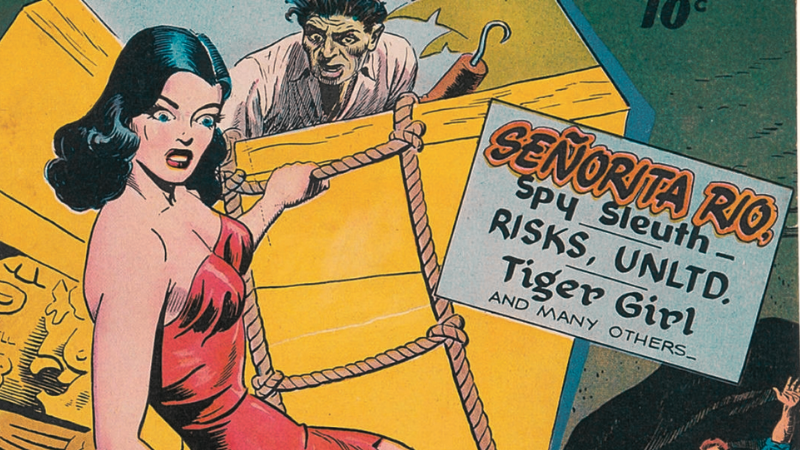
Señorita Rio emerges as a trailblazing figure, marked by a Latinx actress who leaves Hollywood glitter behind to dive into the perilous realm of espionage. The character was imagined by writer Joe Hawkins and artist Nick Viscardi (who also went by Nick “Cardy”) for Fight Comics, a publication of Fiction House. Rita Farrar debuted in Fight Comics #19 in June 1942.
Within the storyline, Farrar is portrayed as a glamorous movie star and stuntwoman whose Hollywood ascent is interrupted by the news that her fiancé, a naval officer named Bill, has perished during the Pearl Harbor assault. Seeking a path to avenge her beloved, she joins the intelligence service, linking two familiar motifs in mid-century fiction about women spies: the righteous patriot and the avenger seeking justice.
Because of her background and linguistic fluency, she is assigned to collect intelligence in South America. The star fakes her own death after the premiere of her film Lady Dance No More, and assuming a covert role, adopts the alias “Señorita Rio” as she pursues the ambition of becoming the “Queen of the Spies.” Señorita Rio actively pursues secrets, yet often must push away suitors; in Fight Comics #20, her Argentinian guide, overwhelmed with emotion, proposes marriage. Señorita Rio declines with the weight of her new life: “my life now is vengeance.” For nearly a decade, through 1950, Señorita Rio wields her marksmanship, fencing prowess, and sharp intellect to combat Axis forces across South America.
Sanjak refuses to fit into the tropes of women spies as femme fatales, patriots, or avenging angels, working exclusively for her own self-interest, and she has a great time doing it.
Although the character was initially sketched by Viscardi, Señorita Rio is most closely associated with Lily Renée, a pioneering female artist and a survivor of war. Born in 1921, Renée escaped Austria on the Kindertransport, eventually settling in Leeds, England, where she worked while awaiting her parents’ escape. At sixteen she was able to join her family in the United States and found work as a comics artist, filling in for many male artists who had been drafted. She contributed to various Señorita Rio installments in Fight Comics from 1944 to 1947, helping to popularize the flamboyant heroine. Renée also used a secret signature, signing her work as “L. Renée,” leading readers to assume the creator was male and directing fan mail to “Mr. Renée.”
For the young artist, illustrating the adventures of the globe-trotting starlet was an ideal assignment. Renée shared a common hatred of the Nazis and a strong impulse to defeat the Axis powers. She also found solace in the adventurous fantasy of the tales. Through Señorita Rio, Renée could combat fascism while highlighting chic fashion. She recalled, “it’s sort of a fantasy. Señorita Rio got clothes that I couldn’t have… She had a leopard coat and she wore these high-end shoes and all this and had adventures and was very daring and sexy and glamorous.”
Although Señorita Rio exited the comic pages in 1950, she was revived later as Rita Rio by AC Comics in 1994. Renée herself continued drawing comics for many years after Rio’s retirement and was inducted into the Will Eisner Hall of Fame in 2007 before passing away in New York in 2022 at the age of 101. Cartoonist and comics historian Trina Robbins even penned a biography of the celebrated artist in graphic-novel form: Lily Renée Escape Artist: From Holocaust Survivor to Comic Book Pioneer.
Not all spies in comics served the United States, nor did all act with noblesse oblige. The trickster figure Sanjak embodies a bold spy and master of disguise who abducts the young heroine April Kane, steals treasure, and hides away on a secret island, only to elude capture. The character is widely credited as the first lesbian figure in comics, first appearing on February 12, 1939, in Milton Caniff’s widely read Terry and the Pirates (1934–73), an action-adventure strip chronicling Terry Lee’s exploits alongside a recurring cast of heroes and villains. Sanjak refuses to conform to conventional depictions of female spies—as femme fatales, patriots, or avenging angels—and pursues her own interests with evident relish.
Sanjak makes a striking entrance in 1939, disguising herself as a French hotel proprietor, “Madame Sud,” abducting Terry’s beloved April Kane, and then seizing a plane loaded with treasure to flee to her island lair. Though the heroes manage to locate Sanjak and rescue April, the villain escapes, resurfacing years later in another disguise, this time posing as a military pilot in a bid to steal plans from the Americans to aid the Axis in World War II.
However, despite her role as a villain, letters sent to Milton Caniff reveal that she was an incredibly popular character.
During the 1930s and 1940s, the concept of lesbian identity was not understood as it is today, and Caniff chose to “code” the character as LGBTQ+ by relying on the era’s stereotypes. Caniff explained: “In those days the word ‘lesbian’ simply wouldn’t have been understood by half your audience, and the other half would have resented it.”
First, Caniff suggested that the name “Sanjak” makes oblique reference to a Greek island near Lesbos. Although such allusions might not be common knowledge to readers, discerning fans would pick up on it. Caniff also drew on the era’s prevailing stereotypes of lesbian fashion, including masculine suits and the monocle, drawing on influences like Le Monocle, a famed Paris gathering place for LGBTQ+ women in the 1930s. Radclyffe Hall, author of The Well of Loneliness (1928), which featured explicit LGBTQ+ content, helped popularize this distinctive look—masculine attire paired with a monocle. In Terry and the Pirates, Sanjak champions this masculine-coded wardrobe and a short hairstyle.
Moreover, she often wears a monocle of her own, using it as a device to hypnotize her victims. In rejecting conventional female fashion and embracing dramatic flair, Sanjak would have felt at home at Le Monocle. Caniff also depicted Sanjak flirting with the naive April, whom she eggs on with a French-sounding “charmeeng A-preel.” Sanjak is notable for a diverse set of skills, including piloting small planes, disguising herself as “Madame Sud” and “Captain Midi,” and executing a range of crafty schemes.
On account of these traits, Sanjak fits within the era’s stereotypical depictions of lesbian characters, and, unfortunately, this portrayal reinforced a link between homosexuality and nefarious intent. From her first appearance through her ill-fated plane crash in January 1944, Sanjak stands as a figure of chaos.
Yet, despite being cast as a villain, correspondence sent to Caniff demonstrates that she enjoyed substantial popularity. A March 1939 letter exclaimed: “I have just discovered your character ‘Sanjak’… She’s the most colorful personality I have met in a comic strip in a long time. Please let us have much more Sanjak in the future.” This praise came at a moment when America was pulling itself out of the Great Depression and standing on the verge of global conflict. A separate April 1939 note from reader T.H.R. argued:
She has a subtly enjoyable cynicism, yet beneath all that cynicism there is a trace of loneliness and even sadness. Perhaps I’m reading too much into it, but please don’t spoil a good intention by making her a pure villain. Even if she is a villain, she is too fascinating to condemn. Your study of her is a revelation, in contrast to the usual goo of pure villainy that one finds in the standard comic strip. She’s a jewel. Let her remain single, fearless, and cynically humorous as she fades from the panel.
Some readers even suggested that Sanjak would make a better romantic partner for April than Terry, as attested by another 1939 letter from a reader who dared the newspaper to publish it. It read: “Dear April, If I were you, I would go for Sanjak and forget Terry. You know Sanjak is fine. I wish she were a real person. I could go for her myself.” Thus, although Sanjak is depicted as a villainous figure, many readers celebrated this original, unapologetic character who seized control of her own fate and challenged conventional gender norms.
__________________________________

Excerpted from Women in Comics by Susan Kirtley, Ph.D and Nhora Lucia Serrano (Black Dog & Leventhal). Copyright © 2026.