
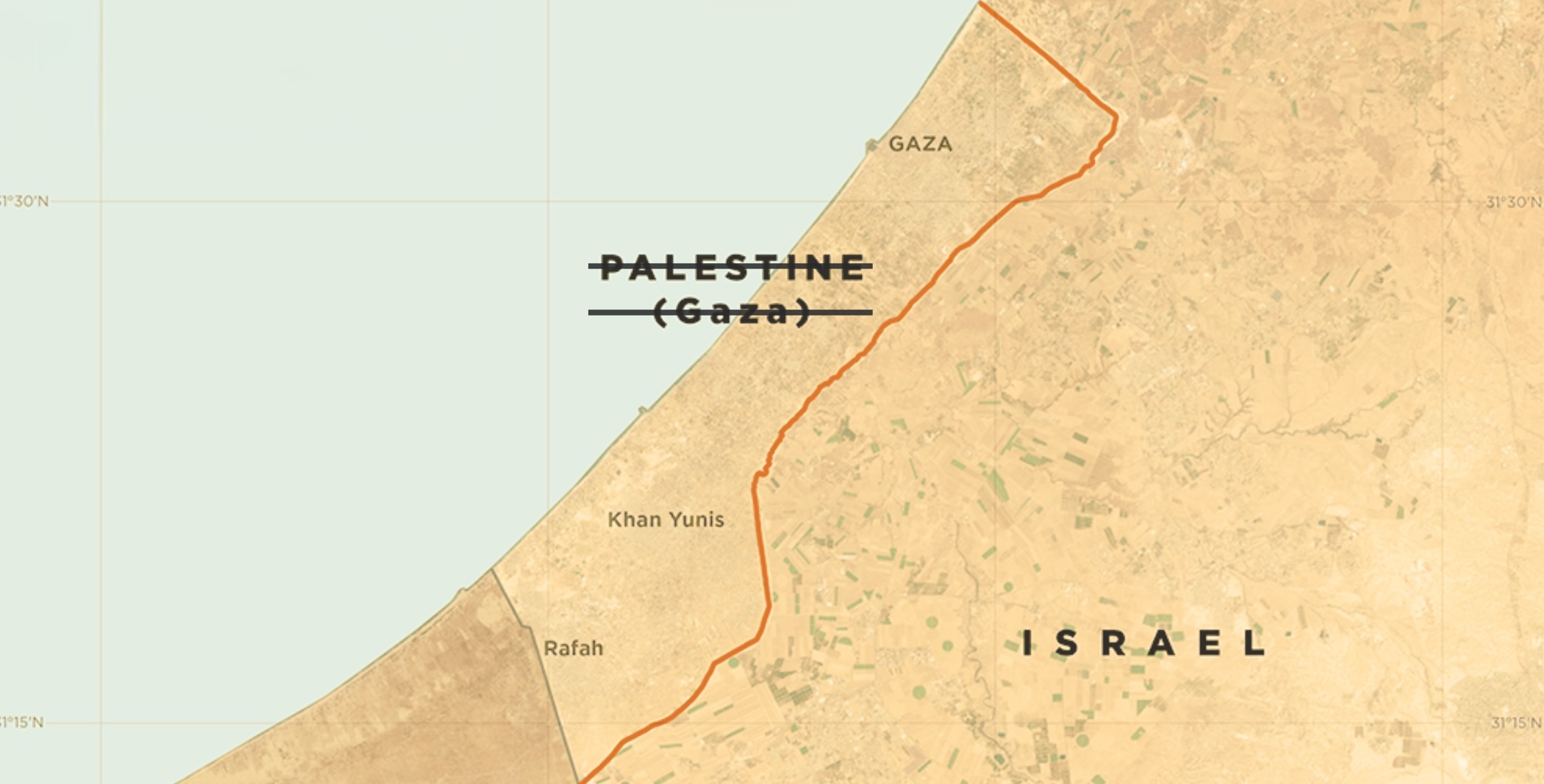
July 2026 was the deadliest month of the last year for Palestinians. The Gaza Health Ministry reported that 152 Palestinians were murdered by Israel, bringing the official death toll in the American-backed Israeli genocide to more than 73,000 people in less than three years. The UN reported in June that 20,000 of those people were children.
Against this backdrop, on August 1 the Atlantic City Press reported that John F. Scarpa, a so-called “major donor” to Stockton University, where I have taught since 2010, had approached Stockton’s president, Joe Bertolino, to complain that the university’s master’s program page on Holocaust and Genocide Studies contained “misinformation.” He quoted the page’s assertion that “Israel’s ongoing genocide in Gaza since October 2023 has killed, according to official figures, more than 70,000 Palestinians, including over 20,000 children, leaving almost the entire population of 2.3 million people forcibly displaced.”
Scarpa—who built his wealth in the cell phone and cable TV sectors—argued that the Gaza crisis represents “a matter of significant legal, political, and scholarly dispute,” and that the page’s language about Israel’s genocide “appears to reflect the personal views of one individual who has previously expressed similar positions and… should not be given a platform to spread opinion as fact.” This remark was clearly aimed at my colleague Raz Segal, a prominent Holocaust and genocide scholar who has endured public harassment since describing the Gaza crisis as “a textbook case of genocide” in late October 2023. As a consequence of Scarpa’s letter, Stockton’s University Relations and Marketing office would reportedly be “reviewing the webpage and the concerns raised, including how content across different areas of the university is presented, attributed and reviewed.” The following day, Stockton removed Raz’s words from its website.
*
I assumed the writing of this would be straightforward, but the task has proven more challenging than I expected. I initially wrote that “leadership at Stockton removed Raz’s words from its website,” but for stylistic reasons I converted it to “Stockton,” as though a cluster of modern buildings in the Pine Barrens of southern New Jersey could edit themselves. This is the perennial dilemma of describing an institution, yet I want readers to understand who bears responsibility for erasing the record of mass murder—President Bertolino, Provost Palladino, and the people in charge.
For two years we have watched as places like Harvard, Columbia, and Cornell caved to the Biden and Trump administrations’ mafia-style demands.
Provost Palladino sent a boilerplate note to those of us who had written outraged responses to the removal of Raz’s words. The message framed the issue in terms of “academic freedom,” insisting that public-facing materials such as the university website fall outside its purview. It argued that academic freedom applies only to scholarship and the classroom, and, moreover, that the university’s ongoing website redesign—though the master’s program in Holocaust and Genocide Studies had not initially been part of it—made this a prudent moment to excise “personal statements” from the site.
I wrote “he concluded,” but the truth is that when a university administrator sends you a note, you can never be sure who composed it. A whole chain of assistants could have drafted it, and, from what I can tell, the president (or someone acting for him) appears to rely on AI to craft or significantly edit messages sent to staff and faculty. In short, I do not want to put words into the provost’s mouth, even if he signed the email. The core matter is the language itself—the erasure and the way it shapes perception. Scarpa’s letter to President Bertolino (which I suspect he authored; it is riddled with errors) reminded Raz Segal “that official university communications should reflect scholarly objectivity….”
Objectivity is billed as the cornerstone of higher education, the signal of one’s adherence to market rationality. If you lean too closely toward an issue, you may be accused of missing the broader view, even when the very thing in front of you is exploding. “Show me the data,” is a refrain I’ve heard from countless university officials, yet those same numbers appear to vanish when the tally reaches about 73,000 dead Palestinians. While the local debate raged, I listened to Ghassan Abu-Sittah, the British-Palestinian physician, speak about liberatory medicine. Asked how to cultivate awareness when academic institutions bend to a colonial cadence, he replied that “people are subjective.” “Capitalism operates by objectifying the subject,” he noted, and colonial wounds seek to reduce the subjective to an object through violence and erasure.
He meant this in the most literal sense—Palestinian, Lebanese, and Iranian bodies designated for destruction by American-made bombs—but the truth is that consciousness can be mangled as well. Every account I write about Gaza comes with a weight of urgency and shame, driven by the constant reminder that language is all I have. Our bodies remain physically safe, but our capacity to think freely is susceptible to the capitalist gaze that Scarpa demands and that Stockton chose to accommodate. If we name our sorrow for Gaza, we place ourselves in the category of subjects that higher education ostensibly resists suppressing. Yet if we restrict our narration to supposedly objective facts, those facts are curtailed by the university’s collective power, this place we once regarded as our academic home.
In Stockton, an abusive counterpoint to Raz Segal’s critique surfaced when a racist colleague confronted anthropologist and pro-Palestine activist Maura Finkelstein during a Stockton event in fall 2024, demanding to challenge the figures she cited about Gaza’s death toll—statistics she did not author, drawn from a Lancet article. The numbers were not hers to claim, yet insisting on voicing them during a brutal genocide, in that moment, stripped them of their authority and undermined the academic freedom and integrity this institution claims to defend. We could call ourselves homeless, at least in a figurative sense, since Raz Segal’s statement—that 2.3 million Gazans have been forcibly displaced and are living amid tents amid the rubble, freezing and starving—has been erased from Stockton’s site, and all I can do is write about it.
Stockton’s readiness to yield to Scarpa’s demands makes an undeniable conclusion clear: the institution’s power rests with authoritarian control rather than genuine academic authority. For years we have observed prestigious universities such as Harvard, Columbia, and Cornell capitulate to what many describe as mafia-like pressure from the federal administrations, and Stockton’s recent actions reveal that it is no exception. We know better now, and we will fight back using every fact, word, and act of solidarity at our disposal. I remain convinced we will prevail, though I would stand firm even in the likelihood of defeat, from my comparatively safe perch in America where language and livelihood can be endangered, but life itself remains secure in this struggle.
And Free Palestine.