
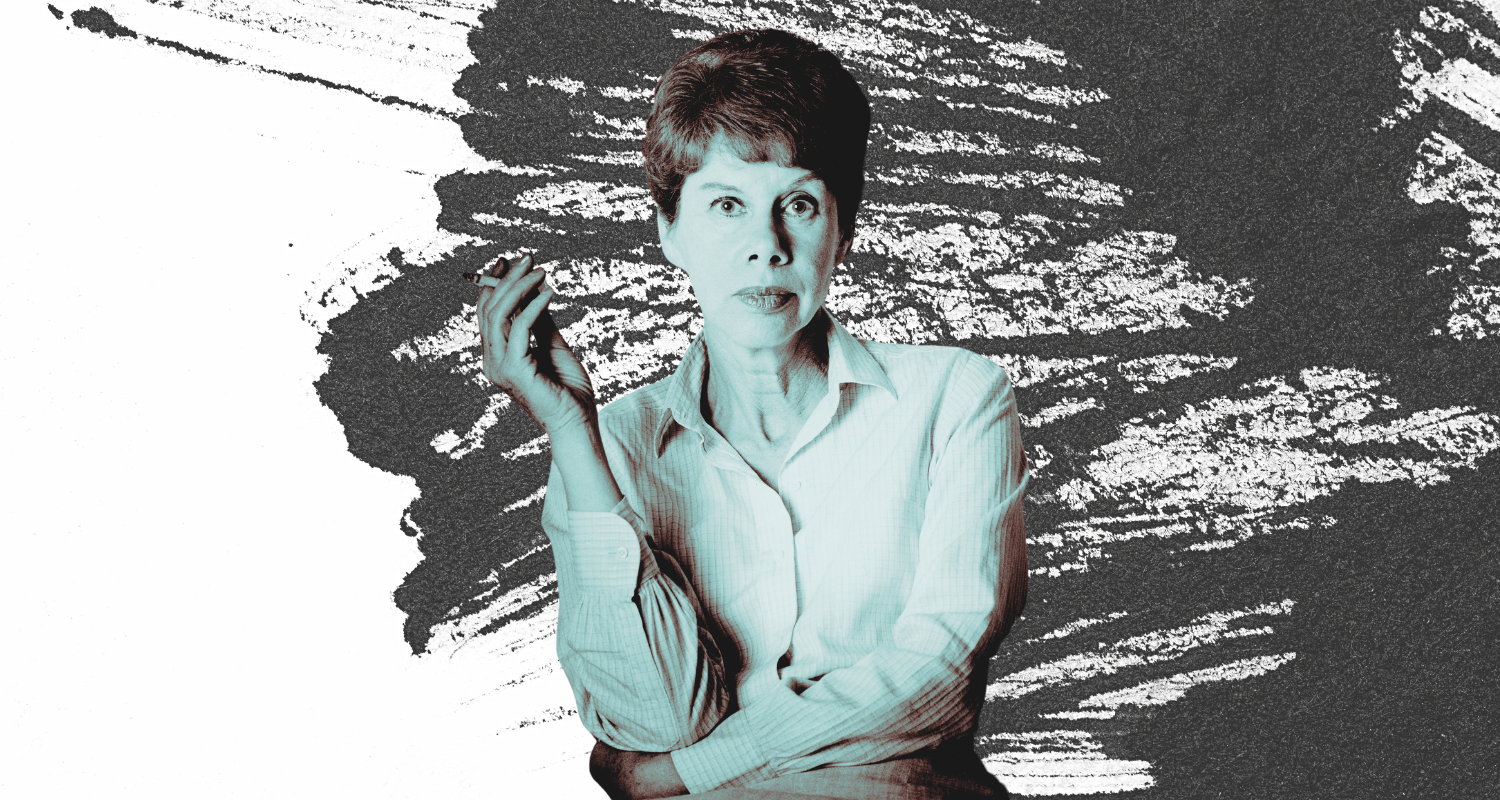
Brookner was fifty-two, though the calendar hinted that she would soon feel ten years younger. She had a novel in hand. She had secured an agent. It wouldn’t be long before a publisher followed. She remained a teacher, a vocation she would retain for several years more, yet she was reorganizing the contours of her life. What brought about this shift? In a conversation with Anna Whitworth, she explained that she was drafting a novel on her venerable old typewriter in her Courtauld study, using the summer lull to fill what she called the “empty quarter.” Whitworth, aware of her friend’s bouts of depression, suspected that fiction might be the way she wrestled with it. Brookner herself asserted this repeatedly in interviews from the early 1980s onward. She framed the process as the deliberate construction of a narrative, a form of strategy rather than a chance turn. (This plan didn’t include a temporary detour—when, soon after the publication of David, she wrote to Chatto asking to write a Life of Mme de Staël, a project requiring residence in Switzerland. They declined, deeming it not commercial enough.) She consistently claimed that her first novel began out of sadness, desperation and ennui, to the point of feeling “endangered.” She was “unhappy” and “alone,” asking how she could deserve such a fate. There was a “gap,” a missing structure in her life, a pressing need to “fill the time.”
Specificities remained scarce, of course, but the fact that she reached her fifties without a family, the fallout of the Blunt scandal, her unspoken feelings for MacLehose, the conclusion of her work on David, and her growing sense of estrangement from the way art history was taught all fed into her sense of being “endangered.” By the mid-1980s she had sharpened these experiences into a tightly wound, compelling narrative:
I began writing [fiction] because I felt a terrible sense of powerlessness: I seemed to drift, invisible and obscure, and I rebelled against that. I wanted to be the maker of my condition, not its subject. I wished to shape rather than be shaped, to ordain rather than be ordained, to determine rather than be determined.
She spoke of a difficult childhood, the sorrow of her parents, the burden of caring for them and their eventual losses, her own loneliness and childlessness. She described the first novel as a “reckoning.” It emerged from the impulse to exorcise a painful memory. It stemmed from “boredom and the wish to reassess my life, which seemed to be plodding along in predictable channels.” “I could have collapsed into self-pity, but that would have been a waste of time, and I’ve always drawn nourishment from fiction.” At times she linked her emotions to her professional life: “I think I was growing stale as a teacher, and retirement loomed.” “There aren’t many opportunities to take risks in art history.”
However empathic, incisive or evasive Brookner could be about psychoanalysis, her novels plunge her, and her readers, into the realms of repression, trauma, and dream.
She began as an “idle experiment.” Fiction had never been her plan, though she had long admired writers of fiction and wondered if she might be capable of it.
I didn’t think I could. I wrote a single page, the first one, and no one seemed to think it was wrong. No angel with a flaming sword appeared to tell me not to proceed. So I penned another page, and another, and by the end of the summer I had a story. That was all I wanted to do—tell a story.
And once she began, she moved swiftly. She wrote with speed and purpose. “There were no secret notebooks, not a scrap, not a single sentence… no drafts… no false starts: there simply isn’t the time.” The pattern stayed constant: a novel would be completed in roughly three months—first because the summer break dictated the pace, later shifting to the winter months, but never taking much longer. She knew the ending from the start. She would chart the outline in her mind while walking, then transcribe it verbatim into a notebook as if it were “encoded in the unconscious.” She worked on unlined A4 pads from Ryman or in “Europa” ring-bound notebooks, the covers bright and the pages densely filled with writing, sometimes switching from the novel to a current review she was preparing. She would either type the pages herself or employ a typist (one who could decipher her rather difficult handwriting). While drafting David in 1979, she told MacLehose it had been “resplendently typed by Rosalind, a fierce girl with red hair whose spelling is slightly better than mine.” Later, in 1996, she described a quick, efficient new typist to the Cape editor Tom Maschler. One of her first Cape editors, a young English graduate, was struck by how nearly flawless the submission was. Once she had marked it, she would visit Brookner’s flat to go through the comments with her. Brookner treated her with courtesy but stood firm on stylistic matters: she knew what she wanted. Not much was altered, and their collaboration moved briskly toward completion.
The result of this workflow was remarkably polished. Hilary Mantel, among many admirers, captured it succinctly: “When her first novel appeared in 1981, she seemed to be fully formed, as if she had hatched from a marble egg.”
The expression “encoded in the unconscious” hints at psychoanalytic readings, yet she was candid about experiencing “quite long periods of depression,” even as she claimed that depression could fuel creativity. So people asked whether writing fiction served as therapy. Her answer was consistent: “If it were therapy I wish it had worked. It doesn’t work that way, which is why I have to keep on doing it.” She explicitly rejected psychoanalysis: “No, and I wouldn’t do it now, it would take too long,” she told a 1985 interviewer, and again, in 2009: “She has always admired Freud, but she has resisted any temptation to undergo psychoanalysis. ‘It wasn’t within my scope. And one doesn’t know how intelligent the interrogator would be.’” Yet elsewhere, she described finishing her first novel as akin to concluding an analysis: “When it was over, it was over, like leaving a psychoanalytic session; you moved on.” More than once she spoke of that novel as “a small exercise in self-analysis. The paradox of self-analysis is that it leads nowhere. It is an art form in itself.” The parallel between writing and analysis recurred: “In a sense, what I’m doing is neutralizing my experience. Freud suggested that the drama of transformation is to turn powerful feelings into weaker ones.”
Her stance on psychoanalysis remained nuanced: she would speak of “we Freudian analysts” in a 1983 review of Norman Bryson’s work, or praise Anthony Clare’s 1984 interview collection, In the Psychiatrist’s Chair, where she compared some interview subjects to “characters in fiction whom the writer has not fully resolved.” She once recounted, to an ex-student, a dry, incredulous anecdote about a friend (likely Lisl Klein) whose family had perished in the Holocaust; as the analyst was listening, he began to cry, and the friend apologized for discussing such horrors, only for the analyst to say, “No, it’s not that; my dog has just died.” Yet, however sympathetic, scathing or evasive Brookner could be about psychoanalysis, her novels nonetheless carried readers into the depths of repression, trauma and dream-worlds.
She preferred to portray fiction-writing not as therapy or autobiography, but as a peculiar process of remembering. Proud of a “superb” memory, she found that things she did not know she remembered began to surface once she began to write. Writing became a way to uncover elements “I didn’t know were there, that had lain in the unconscious for a very long time.” Consequently, she could not have produced these novels at thirty: time had to pass for those memories to emerge. Writing, she said with a strange, almost lyrical precision, was “an effort to remember something that has not yet happened.”
She preferred to describe fiction-writing, not as therapy or autobiography, but as a peculiar process of remembering.
Were these novels, then, autobiographical? This question echoed in interviews. Early on, she denied it. She insisted she was not her protagonist, “not at all.” Beyond the Parisian room she described, everything else in her first novel was “totally invented.” Over time, she softened. In 1985 she allowed, “A lot of me must be in them. Yes—aspirations, longings, desires, sadnesses, too. I don’t think I am concealing as much as that.” In 1987, in a Paris Review interview with Shusha Guppy, she admitted, “It was.” She did not mean that her novels were straightforward romans-à-clef that mapped neatly onto her actual life, but rather that the emotional sources were intensely personal. This long, tantalizing dance of self-revelation and self-disguise began with the title, and with the audacious first sentence, of A Start in Life: “Dr Weiss, at forty, knew that her life had been ruined by literature.”
In 1980, Brookner’s entry in Who’s Who described her as a Reader at the Courtauld Institute, born in 1928. By 1981, the year A Start in Life appeared, it listed her as “Professor” Anita Brookner, then-Reader at the Courtauld, born in 1938. The deliberate relocation toward a fresh start in life thus became a chosen identity, a decision that would later prove costly.
Finding a publisher for her next novel did not come easily. MacLehose read it and took it to Collins’ editor-in-chief, the urbane biographer Philip Ziegler, who dismissed it as unsuitable for the Collins list—impossible to sell. If she felt disappointed, she did not show it—MacLehose believed she would place it somewhere else. Mark Hamilton then assumed the task and circulated it to a couple more houses, including Jonathan Cape. Cape—at the time steered by Tom Maschler and Graham Greene, with Liz Calder as its other principal editor—was building a distinctive list (alongside Salman Rushdie and Julian Barnes) but still needed Maschler’s approval. Calder received a notably downbeat note from Hamilton, which read:
Dear Liz, I wonder if Anita Brookner’s novel A Start in Life might be something for you? The writer is a lecturer at the Courtauld Institute and has written several books on late 18th century art… I will be intrigued to hear what you think of this novel.
Calder, intrigued, passed it to one of Cape’s freelance readers for a first impression. Nicola Beauman—later the founder of Persephone Books—was vehemently opposed to it, calling it “a book about very grey people in a very grey place.” Calder revised her assessment and sent it to another Cape reader, Sally Sampson, who responded with enthusiasm. Calder then faced Maschler’s typical contrariness, but she managed to persuade him. He did not anticipate bestseller status, yet he recognized that the prose was extraordinary: “you knew this was a writer and would go on being so.” The contract awarded Brookner a modest advance of £750, with 10 percent royalties and a print run of 1,500 copies. She grumbled slightly about the cover photograph, which she felt made her look “like a faithful hound.” In the United States, Simon & Schuster published it with the title The Debut, a decision Calder did not contest, even though Brookner herself did not protest either.
They began—and continued—their collaboration with lunch at L’Étoile on Charlotte Street. A routine quickly formed. When Calder arrived, Brookner was already seated, waiting quietly. They would converse more about Calder’s latest news than about the book itself. When they first met, Calder’s life was in upheaval; she had just embarked on her own fresh start in her forties, with the person who would become her long-term partner. She told Brookner that she had fallen in love. Brookner’s reply: “Well, it’s all there is, Liz.” When Brookner was later asked if she would keep writing about love, her answer was simple: “What else is there? Everything else is merely literature.”
______________________________

From Anita Brookner: Art and Life by Hermione Lee. Copyright © 2026. Available from Alfred A. Knopf, an imprint of Knopf Doubleday Publishing Group, a division of Penguin Random House, LLC.
