Late in 2023 I was invited to translate Roberta Recchia’s debut novel All That is Left of Life. The manuscript was still a few months away from its Italian publication, and Recchia hadn’t yet entered the consciousness of many readers, so receiving the manuscript felt like a secret access pass. I agreed to read it during the holidays out of curiosity.
Set in and around Rome in the 1980s, All That is Left of Life unfolds as a chorus of voices tracing three generations of the Ansaldo family as they confront the consequences of Betta’s murder at the age of sixteen. It is the height of summer when Betta and her cousin Miriam slip away to attend a beach bonfire, yet only Miriam returns. Marisa and Stelvio, Betta’s parents, are swept into the emotional storm of their seemingly inexplicable loss, while Miriam carries the heaviest burden, concealing her own presence on the beach that night from everyone.
As the memory of the violence becomes harder to bear, she seeks oblivion in drugs and soon slides into addiction. It is only when she reaches rock bottom that she crosses paths with Leo, a small-time drug dealer who becomes her unlikely savior. The narrative spans three decades and brings to life a cast of unforgettable figures, and the book’s reception in Italy has been extraordinary: more than 200,000 copies have sold domestically to date, and it remains on the bestseller list more than two years after its initial release.
All That is Left of Life offers a masterful examination of how people respond to grief and trauma, ultimately tracing paths to healing even when healing seems beyond reach.
One of my most vivid recollections from engaging with All That is Left of Life isn’t a translation trick at all, but my very first encounter with the book. I was seated in the middle seat, flanked by strangers, on a Christmas flight back to Italy, filled with the mix of anticipation and tension that the season always stirs. There I found myself crying over Marisa’s sorrow. I was only about a quarter of the way in (readers who know the passage will recognize it), yet I knew instantly that translating the novel was something I wanted to do. I finished it the next day, and I did my best to hold back from writing to the commissioning editor on Christmas Day to declare that I was in.
All That is Left of Life is a virtuoso study of how different people respond to grief and trauma, ultimately finding ways to overcome what feels like it should be impossible to overcome. The excerpt on Lit Hub, which follows immediately after Marisa’s pietà-like moment that still brings me to tears, stands as a superb example of Roberta Recchia’s craft: in under a thousand words, we witness reactions to the murder from Betta’s closest family, the police, and the town as a whole. New characters emerge, many details are introduced, yet the narration never loses its focus; every sentence adds to the characters’ mounting sense of powerlessness in the face of such a tragic death. This was one of the main challenges I faced—translations tend to expand, but for me it was crucial to preserve the tautness of Recchia’s propulsion.
This was my second full-length translation, and it taught me many essential lessons about my own process. Through working on it, I learned that the first draft is really a stage of discovery about the challenges each book will present, and that the solutions emerge only after numerous drafts, as the English tone and voice of the novel crystallize into a coherent whole.
Readers might assume that once all the words are on the page, the translation is essentially finished and that one or two passes suffice. That may be true for some translators—we all work differently, after all—but for me, a first draft serves as a moment to slow down and really immerse myself in the book, which is especially important for a fast-moving page-turner like All That is Left of Life, where savoring the subtler nuances can be missed in the push to know what happens next.
Translations “physiologically” tend to expand, but for me it was very important to keep the tautness of Recchia’s propulsive storytelling intact.
When I finished the first draft, I realized I could trust the novel’s inexorable momentum to translate well into English, and that the real work lay in the finer details: word-for-word repetitions from one chapter to the next that knit the characters into being, the small gestures or expressions that reveal the emotional terrain of the protagonists, and the social-class cues in dialogue that expose the speakers’ implicit biases. By focusing on these elements, and through many rereads and revisions, I came to cherish some minor scenes perhaps as much as the central plot: Stelvio and Marisa in the dairy, Leo in the library, Marisa’s envy of Maria Grazia. On an initial read, All That Is Left of Life can shred the heart with its sweeping emotions, but its true grace lies in balancing grand, chorus-like moments with smaller, more intimate ones.
All That is Left of Life came out in Italy while I was still deeply immersed in its inner workings, and watching early readers respond to it was exhilarating and simultaneously filled me with a sense of responsibility toward a work that would soon prove to be a major success. Roberta Recchia has earned a loyal following: booksellers recommend it, book clubs embrace it, social media buzzes, and word-of-mouth remains strong. Recchia’s second novel, Io che ti ho voluto così bene (I, who loved you so much), appeared in Italy last year. I won’t say too much about it, but readers who loved All That is Left of Life will be intrigued to see that it revisits some of the same events from the perspectives of a different set of characters. I’m thrilled that readers in North America can now experience one of Italy’s most notable publishing successes of recent years, and I’m honored to have served as the intermediary.
_______________________________
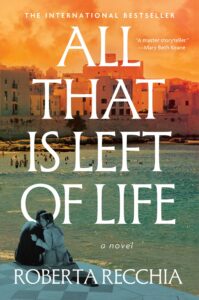
All That Is Left of Life by Roberta Recchia, translated by Antonella Lettieri, is available from Scribner, an imprint of Simon & Schuster.