
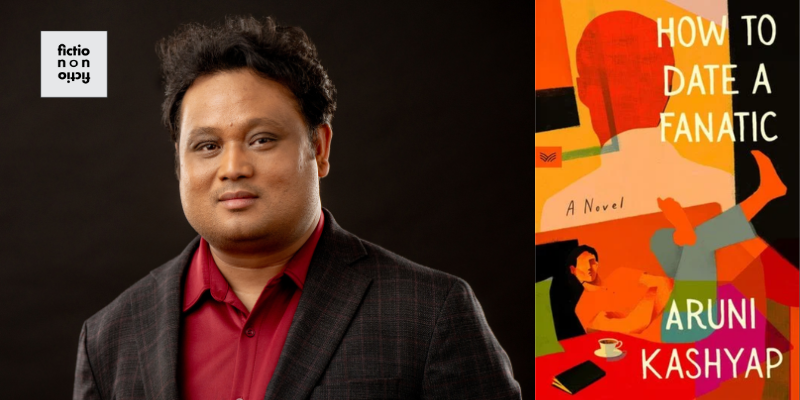
Novelist Aruni Kashyap sits down with co-hosts V.V. Ganeshananthan and Jennifer Maritza McCauley to explore the striking rise of a youth-driven movement in India. Kashyap, creator of a forthcoming novel, How to Date a Fanatic, which follows young queer scholars navigating campus protests in the mid-2010s, explains how the Indian Chief Justice’s description of unemployed youth as “cockroaches and parasites” helped spark a wildly popular satirical collective. He recounts the origins of the Cockroach Janta Party or Cockroach People’s Party, which now claims millions of followers and has made its policy goals widely known. Kashyap reflects on those goals, places campus politics within India’s broader historical arc, and considers how a humorous organization can drive substantive change. He also looks back on his own experiences with student protests in the country where he grew up and taught. Kashyap ponders the challenges of narrating political violence, affection, and queer life in India. He also performs a reading from How to Date a Fanatic.
To hear the full episode, subscribe via iTunes, Google Play, Stitcher, Spotify, or your preferred podcast app (remember to include the slashes when you search). You can also listen by streaming from the player below. Video versions of our conversations are available on the Fiction/Non/Fiction Instagram account, the Fiction/Non/Fiction YouTube channel, and our show site: https://www.fnfpodcast.net/ This podcast is produced by V.V. Ganeshananthan and Christian Barter.
Aruni Kashyap
How to Date a Fanatic • How to Date a Fanatic excerpt from LitHub • The Way You Want to Be Loved • The House with a Thousand Stories How to Tell the Story of an Insurgency
Others
The rise of the Cockroaches – The Hindu
EXCERPT FROM A CONVERSATION WITH ARUNI KASHYAP
Jennifer Maritza McCauley: We’re going to discuss your exciting new novel, but first I want to set the stage with some current headlines from India and sketch the political landscape a bit. In mid-May, the country’s chief justice drew attention by likening jobless youths to cockroaches and parasites. Soon after, a student in Boston posted on X, “What if all the cockroaches came together?” Why did the judge’s remarks provoke such anger, and how did that single post evolve into a nationwide movement?
Aruni Kashyap: There are several long-standing pressures at play since the Modi administration took office in 2014. The short version is that youth unemployment hovers above 40 percent, and many other sources of disillusionment grip young people. The cohort that backed the 2014 government is now in their early thirties or late twenties, and many of the promises—visions of India as a global power or a “ Vishakaru,” in the sense of a world-capable leader—have not materialized.
There’s also a deep economic downturn. Foreign direct investment into India has been falling, yet this is scarcely reflected in the media. Much of the press is effectively under state influence, controlled by large corporate groups that cheerlead for the government.
Frustration among young people runs high, and in parallel Modi sought to launch a “Digital India” program in his first term. The aim was to accelerate economic growth and consumer culture, enabling more sales. What emerged, instead, was a booming online ecosystem of content creators, capitalizing on India’s expanding digital market as the rupee weakens against major currencies. A large swath of creators began using online outlets to vent their discontent.
This online surge spread rapidly, aided by satire and humor. It is this combination—playfulness, invention, and critique—that made the movement so compelling. People grew tired of the Hindu–Muslim antagonism that dominated public discourse, the notion that dissent from the government equated with treachery or ties to Pakistan. A new generation refused to accept such binaries, and I admire them for that.
V.V. Ganeshananthan: It was a spectacle to behold. It evoked memories of uprisings like the Arab Spring or Sri Lankan protests that helped topple a president in 2022. Initially, it felt like a joke, yet the Boston-based poster behind it is not merely a student but a former political communications strategist as well.
Although the Cockroach Janta Party has no official registration, its online following has swelled to around 22 million. At first, some observers dismissed the movement as a trivial curiosity—“just young people, what are they up to?”—but it quickly expanded its reach and influence. The movement’s impact became visible when the Education Minister resigned, a notable win for the movement’s advocates. How did a satirical group manage to achieve such consequences?
AK: Its appeal lay in its lighthearted approach and sharp satire. The Cockroach Janta Party found traction for several reasons. One key factor was the 2014 rise of a campaign that exploited communal tensions. When that tactic began to falter in several states, where Muslim populations are relatively small, the government shifted its strategy to pit Hindu groups against one another at regional levels—creating divisions within Hindu communities, as well as within Muslim communities, along tribal, ethnic, and linguistic lines.
These fractures became targets for the Cockroach Janta Party. They adopted a cockroach motif—the imagery of a tiny, ubiquitous infiltrator—that aligned with the moment when the Chief Justice’s label made everyone feel like they could be a “cockroach” in the gutters. The idea that anyone could be considered an outcast or an underclass member helped dissolve rigid identities: you might be Hindu, Muslim, upper caste, or Dalit, and still claim the label “cockroach” as a universal badge of grievance and protest.
Even infrastructure challenges in metropolises like Mumbai underscored the movement’s logic. A city renowned for its wealth could still suffer devastating floods after a mere hour of rain, while grand plans for “smart cities” produced photographs of waterlogged streets rather than practical solutions. The satirical campaign reframed these failures as a shared, everyday problem that anyone could confront if they demanded accountability.
Another element of their appeal was the redefining of patriotism. Questioning the government wasn’t seen as unpatriotic; rather, it became a demand for jobs, accountability, health care, and dignity. The Cockroach Janta Party’s supporters argued that true patriotism involves asking tough questions and seeking better governance rather than bowing to a narrow, exclusionary definition of loyalty.
One of the earliest working titles for my novel—a lingering candidate—was The Love Story of an Anti-National. The phrase “anti-national” circulated widely in the 2014–2015 period, often used against women, journalists, LGBTQ+ people, or Dalits who challenged the state. The working title eventually evolved into the here-and-now concept of the Cockroach movement, shaped by the same climate of online mobilization and mass participation.
Its fortune was bound up with social media’s reach, which the movement leveraged so effectively that momentum swung rapidly. For a long stretch, we expected little to change in terms of leadership or accountability; the Modi administration has shown a pattern of disregarding mass protests. Then the tide shifted when filmmakers, actors, and other public figures began praising the youth’s efforts. It was remarkable to see celebrated stars—once famously restrained and supportive of the government—start endorsing the protesters, with veterans like Shabana Azmi among them.
Transcribed by Otter.ai. Condensed and edited by Vianna O’Hara. Photograph of Aruni Kashyap by Jason Thrasher.