
“Where’s the water of disappeared rivers?”
–Etel Adnan, Sea and Fog
*“the morning couldn’t find space
to bring its light
across to the other side
on the riverbank stones
one by one
open their eyes”
–Phoebe Giannisi, “Stones,” translated by Brian Sneeden
*
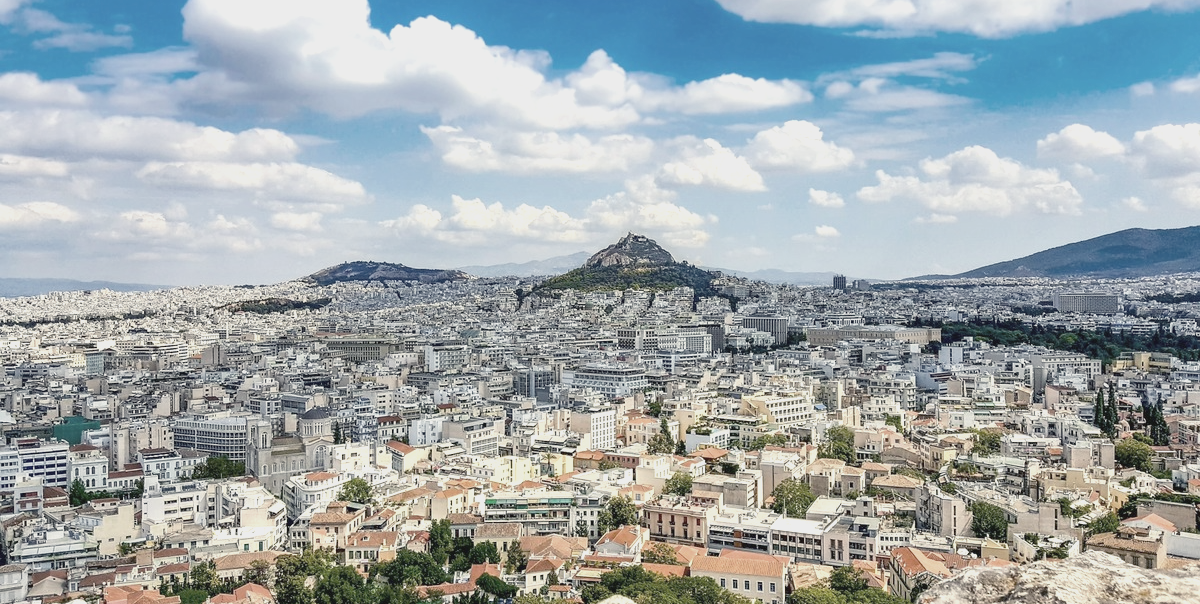
You might not think of Athens as a city of rivers, but embedded and buried in its topography and story are three that carved the landscape. The Kifissos springs up at the foot of Mount Parnitha and empties into the Faliron Bay, still partly exposed. From the southwest slope of Lykavittos, in what is now the center of Athens, comes the Eridanos, which collects the waters flowing from the hills, passing just below the Church of Kapnikarea—in whose square I often go to listen to rebetika—creating a hidden well inside the church. It flows through the Ancient Agora, to the Sacred Gate of Kerameikos, diving underground and dumping into the third, the Ilissos, home of the Muses and the eponymous river god whom we might find in the British Museum, lounging in midair.
Heraclitus famously wrote that the river is never the same, we can never place our foot in the same river twice. “Just as the river where I step / is not the same, and is, / so I am as I am not.” And “The river / where you set / your foot just now / is gone— / those waters / giving way to this, / now this.”
The river is made of its own memory, as are we.
The Athenian rivers are classical and modern; the story they tell depends upon which moment of time. These rivers have not dried up but rather have been buried in concrete, and though Athens is no stranger to its present being dug up and overturned to showcase the past, this burial was a reversal.
Once considered sacred, the Ilissos marked the southern border of Athens. Its banks, once lined with sycamore trees, now feature the Hilton (which had been under renovation for years, and finally reopened, with rates fit for kings) and the National Gallery (which I am standing outside, this particular November, ten minutes before opening, until I notice it’s closed for the day). Once dredged for sand and gravel to make up the roads, the river was prone to flooding. The river is mostly buried now, and if the Ilissos tunnel were to collapse, it could flood the entire city center. For a while, there seemed to be a plan to daylight the river from the Agia Foteini church all the way to the National Museum of Contemporary Art, a little over a kilometer away. A greenbelt, a flood protection project, and a way to provide a pedestrian path to the beautiful contemporary art museum with other sites of the city.
The Ilissos River was completely covered by the 1960s. It was a gradual hiding, beginning in the late nineteenth century after public health fears/pandemic fears had turned it into a conduit, or the “sewer of the city.” But the fear of a collapsing tram line between Neo Kosmos and Syntagma is what might finally have it unearthed, the water exposed so it might offer some reflection. On one of the surviving Ottoman maps of Athens, it’s indicated by a dotted line, a marking that also indicated what is believed to have been a plan of underground tunnels below the citadel.
The last days we spend with someone are not about their last breath. They’re a way to re-narrativize the life that preceded them.
Along with this planned daylighting, a new park is proposed to run south from the Kalimarmaro Stadium for a little over a kilometer. The tramlines would be rerouted, and a new pedestrian route would connect the National Gardens with Hadrian’s Arch. It’s not just an aesthetic choice, or one to unearth a glorious past, but a practical one: whereas it was once cemented over for fear of plague, it will be unearthed because of the danger of collapse, a collapse that could flood the city.
I’m in Athens now, walking along, my first time in the city since the start of the pandemic, two months after my father’s death. Imagining these waters running below the city feels oneiric and strange. I imagine them rising through the concrete, refusing to be contained.
*
My father always said that if one was going to die, one should do so right before winter; if they were going to go that year, they should go before the cold. He made it through August and died on the first of September. I have always associated August with sadness, so that he died on the first of September felt like a triumph of his spirit, a small consolation. Kalo mina, Greeks greet each other with each turn of the calendar page. Good month.
The beloved Greek composer Mikis Theodorakis died the day after my father—September 2, 2021—and Greece declared three days of national mourning. Theodorakis’s body was laid to rest for people to pay their final respects, in the Metropolitan Cathedral of Athens, where I’d light a candle for my father two months later; as for my father’s ashes, I met his wife at his grave in Michigan, the state in where he’d lived since coming to the States in 1966, to lay his urn into the ground. As I grieved in private for my father, Greece as a nation together mourned the loss of the beloved composer, whose songs my father and I listened to and sang those last forty days of his life, most of them spent in a hospital.
Years before all this, my father seemed to be compiling a playlist of Greek songs he wanted at his funeral. He sent these songs to me over email, often taking care to note that his actual death wouldn’t be for another forty years. If you know Greek Orthodox funerals, you know they definitely don’t include pop-music playlists—so I know he imagined an American, Protestant, nondenominational affair, and though I am not religious this somehow, inexplicably, hurt. But Greek music was one of the few ways we could connect, so I was happy for them.
The summer leading up to his death, my father’s dementia seemed to be rapidly progressing, and the last time I saw him before he went into the hospital, the Monday after Father’s Day, we’d had dessert on his back porch. My father was having trouble paying attention, mostly staring at his phone—and he disappeared into his house and returned with his computer, playing the Mikis Theodorakis song “Old Streets”—also on the funeral playlist, though I am not sure by then he would have remembered that. His neighbors were out too, and I could feel them glancing over. My father didn’t seem bothered by this, as he sang along, and I joined him too. My pre-dementia father would have never done such a thing. I mean, what would people think?
There’s a long Greek tradition of setting modern Greek poetry to song, and the words my father sang came from the poet Manolis Anagnostakis.
The lyrics go like this: “Old streets I have loved and hated endlessly.” And: “I wander along, deep in the night without recognizing anyone. Not a one. And no one recognizes me.”
These old streets I have loved and hated endlessly is a line that seems to sum up my father’s relationship to Athens, to Greece, to that place he left when he was twenty-one years old. A song about a man walking through the city, not recognizing a face, not being recognized, and not recognizing himself.
*
I leave Ann Arbor for Athens on the Day of the Dead.
My taxi driver from the Athens airport looks like Sotiria Bellou, the beloved rebetika singer who died in August 1997, the last time I was in Greece with my father. Sotiria Bellou has picked me up from the airport, I think.
“Are you here for vacation or work?” she asks.
“Neither,” I say. I haven’t contacted friends or family; it feels necessary to spend some time alone. “My father died,” I tell her. “I’m here for”—I pause. What am I here for?
“The forty?” She asks, meaning the memorial that takes place forty days after a death.
My father’s memorial service had been in Michigan, weeks after his death, but there was no forty-day commemoration.
“Yes, the forty,” I say.
What is time, anyway.
*
If my father had the nostalgia of the exile, he hid it well. In many ways, the exile has no other choice. Or, it was a particular kind of controlled nostalgia. He was, as Svetlyana Boym notes of first-wave immigrants, “often notoriously unsentimental, leaving the search for roots to their children and grandchildren…Somehow the deeper the loss, the harder it was to engage in public mourning.” Looking back, like Lot’s wife, she notes, can paralyze you forever; looking back, like Orpheus, can cause harm to those you love.
But who doesn’t look back?
The way I see it, my father wanted to be, first and foremost, an American. He rarely returned to Greece. I’ve been going annually for more than twenty years but most of what I know of Greece I know without him. I’ve asked him if he might come, particularly over the past decade before he died, when our relationship began to feel less fraught, but the entire experience for him was too painful, too disorienting, simply too much.
These old streets that I have loved and hated endlessly.
But this is another story entirely, full of its own complications of immigration and homelands and politics, a story of a difficult and fractured relationship with a parent, a story of a debilitating disease. I’m not writing about my father’s failings or absences; I’m not writing about childhood at all. But there are many ways of acknowledging what has been disappeared from the map.
*
My first morning in Athens, at the hotel pool, an older woman watches me dip my toes into the icy water. It’s rare to find an outdoor heated pool in Greece, and it’s November, after all.
She sits nearby on the patio where guests, in warmer weather, enjoy their coffee, but she’s alone. I’m not sure if she’s a hotel guest, or on a coffee break, because she acts like she runs the place. “The sea is the same, you know,” she says, shrugging. As if she worries I might complain, write a Tripadvisor review, The pool was not heated.
“Jump in, swim around, you’ll feel good,” she says. “Make sure you keep moving.”
I suspect she’s the type who’s been taking cold plunges in the sea for the past fifty years.
I look around the pool, the patio, inside the windows of the hotel. Two men in suits discuss something over coffee near the window. Otherwise it’s empty. I glance at my towel, draped over the chaise. I don’t know what possesses me, but I jump in and nearly feel my heartbeat stop. I swim to the other side and lift myself out.
Then, for some reason, I do it again.
Do I feel good? I’m not sure. Well, anyway. Here I am. I’m here now.
I return to my room and have a coffee on my balcony—I have a literary preoccupation with balconies. Usually, I don’t stay so close to all the ancient Athenian sites, but this time, my balcony has a view of the Acropolis, which I will visit later for the first time in more than fifteen years.
When Virginia Woolf returned to Athens for a second time at the age of fifty, one year older than I am this November, she writes that atop the Acropolis, her own ghost met her, “the girl of 23, with all her life to come.” Having just lost her beloved Lytton Strachey, Woolf came to Greece to be with friends, to mourn, “muddled headed.”
I wonder, what does her twenty-three-year-old self encounter in her older self? In my father’s things I found a photo of him atop the Acropolis, in front of the Parthenon, dressed in a chambray shirt, light-colored jeans, and a fanny pack. He looks so proud. It’s 1992. I was with him on this trip but I have only a scant recollection of this visit. What does my nineteen-year-old self encounter in the one who’s here now?
For me, to walk through Athens is to wade through memories, both real and imagined. On the flight to Athens, I reread “Street Hauntings,” Woolf’s famous essay about walking through London, and because I know Athens through moving through it on foot, it has rooted itself in my imagination. One of my favorite moments is this:
Is the true self this which stands on the pavement in January, or that which bends over the balcony in June? Am I here, or am I there? Or is the true self neither this nor that, neither here nor there, but something so varied and wandering that we give the rein to its wishes and let it take its way unimpeded that we are indeed ourselves?
Something so varied and wandering.
Old streets I have loved and hated endlessly.
Something so varied and wandering.
Is not the same, and is, so I am as I am not.
Am I here, or am I there?
As I walk through Athens that November, these lines run through and merge in my mind, as though they belong together. The Rings of Saturn begins with Sebald’s setting off to walk the county of Suffolk, and, as Daniel Mendelsohn writes, recognizes the failure of narrative to reconstitute the past. Even as it haunts us. Sebald wrote that while he was ill, all the wonderful walking he’d done in Suffolk shrank to “a single, insensate spot,” and I’d felt this way about Athens, those two years away during the pandemic. The vastness I’ve always felt in this city, the openness, had disappeared. Athens became the Athens of my imagination, the Athens that hung above my desk as a map, the Athens on Instagram, with its requisite graffiti and street art and plates of food posted by tourists, and photos of the protests and the parties and the glowing faces, posted by friends and family who live there.
What a relief it is to walk through it again.
I know it’s not possible to reconstitute the past, but maybe it’s possible to repair it.
*
“Athens won me straightway,” writes Marguerite Yourcenar in Memoirs of Hadrian, “…the somewhat awkward student, a brooding but ardent youth, had his first taste of that subtle air, those swift conversations, the strolls in the long golden evenings, and that incomparable ease in which both discussions and pleasure are there pursued.”
Athens won me straightaway too; its long golden evenings are my favorite. Yet when I imagine Athens from outside its limits I think of my comings and goings. A July morning, watching the city from the back seat of the taxi, each time I leave it. And the joy of those sweet, jet-lagged, late-afternoon arrivals, usually in May.
This year, time is upside-down, and I arrived at the start of November.
Kalo mina, everyone.
Because I do not live here, I know my perspective is always through the gaze of impermanence—even when I’m here for months at a time I am always aware of the moment I’ll leave. Though I try to resist a certain kind of simple, restorative nostalgia I admit I’m prone to its rosy-toned hues. The Western gaze on Athens always includes the cliché of the “Greek light,” but I live in gray southeastern Michigan, and it’s one of the first things I delight in each time I arrive. Our experiences in a place are as subjective as our memories of them. Shaped by all the interactions that came before. What sorts of things overshadow this landscape, what do I superimpose upon it, what is inextricable?
A few days into my stay, I walk to the First Cemetery. It’s not a place I visit regularly, but years ago, when I was taking language classes nearby, I’d sometimes walk through afterward. At the church near the cemetery’s entrance there’s a funeral, and the chants of the priests fill the square. I walk past them, reeling. The magpies, who have been following me through the city, are there too: I’d seen them on Filopappou the day before. I greet them, to ward off bad luck. I know that they grieve too.
Sparrows flit about and I’m reminded of the sparrows in Mrs. Dalloway, singing in “voices prolonged and piercing in Greek words, from trees in the meadow of life beyond a river where the dead walk, how there is no death.” I ask the caretaker in the small front office where I might find Sotiria Bellou’s grave, and he explains to me where it is, but I’m terrible at following verbal directions and it takes me over an hour to find it. The entrance to the cemetery feels grand and museum-like but as you wander through, it feels like something else: more villagey, a little bit random, a little too private, as if you shouldn’t really be there at all. Someone has left a copy of the communist newspaper Rizospastis, folded up neatly near Bellou’s tombstone, which is engraved with the lyrics of one of her most beloved songs.
You don’t say a word. You guard your secrets, and your documents.
When I leave, hours later, a group of men in black suits carries a coffin out of a church, and I walk through the neighborhood of Mets, filled with marble tomb makers and flower shops and “mourning cafes,” where people might gather after a funeral. On Anapafseos Street, the “place of rest,” or a euphemism for grave, I rest and take a drink of water in front of a marble workshop. Outside it, a marble topless lady greets me, extending an olive branch with her one arm.
“Wherever I travel Greece wounds me,” the poet George Seferis famously wrote.
But I prefer the counter from the poet Michalis Ganas, an Athenian speaking to an exile: “Greece, you know, is not only a wound.”
*
“It takes us an entire lifetime to unravel the mysteries of our own lives,” Jenny Erpenbeck writes. “Layer upon layer of knowledge accumulates upon the past, revealing it anew each time as a past that we certainly lived through, but couldn’t even begin to understand.”
“Today” in this essay is many days, retrospective and prospective, the edges of days bleeding into one another. Today, I’m walking through Athens in November; today I’m in the Ann Arbor hospital with my father, and fires are breaking out all over the island of Evia. While he recovers from surgery to stop a brain bleed, and from the stroke that follows, Greece burns. Six days in and 150 fires. His older sister, Vassia, who I think never got over the loss of their little sister, sends frantic messages, and with them a view from her home on Kythnos, where the sunset was beautiful and beset by dark clouds. They’re not clouds, she writes. Black smoke from the fires. I cannot bear to show my father the pictures. He’d long divorced himself from the news, it seemed, and I didn’t want to introduce any more distress.
“Fires are proliferating, indeed,” writes Etel Adnan in Shifting the Silence. This is what I’m reading in the hospital, days before those fires raged. At the top of my heart and at the top of my voice I told my brother, my mother, my friends: He’s getting better every day.
And some days this—he’s getting better—was not a lie. Those days in the hospital, each small bit of progress felt like a triumph. But from the bottom of my heart and the deep rasp in my voice, scrolling through the images of a burning landscape, I’d tell only my husband, I think my father is dying.
Near the end of my trip to Athens, I learn that Etel Adnan has died. “I know what’s left in me, under these clouds, this wind, this cold, this wintry weather: the need to be in Greece,” writes Adnan. “Will I die without returning to Delphi, to Athens?” I wonder if she had made it back.
There’s a distance between grieving and mourning, the potential of a wave just before it crests and breaks.
Adnan continues: “I remember Maria Farandouri in the lobby of the hotel which sits at the foot of the Acropolis, I remember her singing Theodorakis. And the Mediterranean has colors that the Atlantic, at least around here, hasn’t even imagined. Are older people on death row? Don’t tell them that.”
*
When my father was in the hospital, he and I listened to Sotiria Bellou, and he began to sob. The song “Don’t Cry,” also on his playlist, seemed to unearth several types of grief: for his own life, maybe also a life he left behind, and for the life of his little sister, Eleni, who died in 2006. Bellou was Eleni’s favorite singer—and it was Eleni who introduced me to her music. My father deeply loved Eleni, of this I have no doubt, but their relationship had been strained most of their adult life: differing politics, for one, though that’s a very uncomplicated way of putting it.
The nurse happened to come in at that moment.
“I’m crying because, because,” he said to the nurse. “I’m crying because—she, because my daughter, because—”
“It’s okay to cry,” I tell him.
And I also tell him, “Dad. Please don’t cry.”
Those days in the hospital, and in the months leading up to his surgery, it was difficult for him to finish a sentence. After the nurse left, he said to me: “Lipamai poli pou se…lipamai para poli.” I’m sorry that I [something] to you. The object (you, well, me) comes before the verb, so I cannot translate. It’s his only gesture to a past that’s been clouded over, nearly erased. Months later, after he’s gone, I’ll dream this again, my father trying to utter an apology that catches in his throat.
Still, the afternoons we listened to music were much better than those we did not. He watched live concert videos with great interest. His breathing, which would often become fast, as though he were gasping for air, would slow down. I know he’d seen all these artists perform, in Athens, and I wondered what sort of time meld was happening in his injured brain. The brain injury did nothing to damage the lyrics, though: he knew them all.
I was there, he said proudly, about one of the performances, but I know he was not. It was a performance from 2019, at the Kalimarmaro stadium in Athens, many years after his last visit.
In another concert, Mikis Theodorakis comes on stage with his son, and my father cries again.
“These guys are all dead now,” he said.
“No,” I said, “Mikis is still alive.”
He looked at me strangely, exasperated. “Honey,” he said. “He will die very soon.”
*
Six days before my father would die, on my name day, he was discharged from the hospital, only to go to a memory care facility, where he managed to stay only a few nights before falling once more, returning to yet another hospital, where he would die a few days later. When I told him it was my name day, he cried because he hadn’t remembered. I didn’t mean to make him cry. I told him I was only a minor saint, laughing—no one wished me Happy Name Day the way they did the Constantines and the Elenis and the Marias and the Georges. But this only made him cry harder.
“No, no,” he said. “You’re a big saint.”
Some days, my father couldn’t speak much at all; other days he shouted, without volume control. Often he was baffled at his state.
“But I’m only seventy-six,” he’d say
“I know, Dad. You’re a palikari.”
“Palikari,” he’d repeat, amused, proud as a palikari.
“Palikari!” he’d shout later, apropos of nothing.
Sometimes the questions were utterly bizarre.
“What’s the name, what’s the name of the”—what follows is something so strange I won’t repeat it here.
“I don’t know, Dad.”
I played him a Manos Hatzidakis song: What’s the name, what’s the name of the river? Ilissos, Ilissos.
“What,” he asked his nurse, “are you going to do about.”
“About?”
“About.” He looked at me, then around the room. The nurse had arrived to help him use the bathroom, a tall, strapping guy with tattoos and infinite patience.
“What are you going to do about the misery of the world?”
“I don’t know about that, Dad. But I think he can help you use the bathroom.”
Other days he wanted nothing. No listening, he said, so I obliged. But this didn’t stop him from singing. When he was feeling a bit better, I was allowed to wheel him around the ward floor. He’d sing Delfini, delfinaki, a song about a guy waiting for the boat to arrive with his love, with no self-consciousness. I’d join him, and together we’d serenade the ward like a couple of joyful drunks at the taverna.
Each night when I returned home, I was heartbroken.
Some days, when I left, he’d already be in bed: a tent-like, inhumane contraption that was supposed to keep him safe. After I said goodnight I could hear his voice bellowing to me from down the hall, nearly deranged. I would be numb until I got home, where I opened a beer and sat on my back porch, trying to translate to my husband even a fragment. When I tried to sleep at night, it was this voice I heard, bellowing my name.
*
One day, in the hospital, I told my father I was going to visit Athens soon. It was August, and I’d planned to go at the end of the month.
“Oh?” He seemed happy, lucid. “Make sure you go visit your sister.”
“You mean your sister, my aunt,” I said. Gently.
“Right,” he said.
Another day, about ten days after his surgery, my father was groggy and confused. He was not able to eat yet on his own. He sat in his chair and allowed me to feed him a few bites of food, some raspberry sherbet, a chocolate shake. “No, no,” he said, after only several bites. “Stop asking me questions.” He was quiet and closed his eyes. “Eleni?” he called out. His voice was both plaintive and natural, and he called to her again—the first as if looking for her and the second as though asking her a question.
I was quiet, I didn’t respond; wherever he was, I thought it would be right to leave him there a moment. A nurse had walked into the room and was at the sink, washing her hands. Soon he opened his eyes, focused on me. How strange it must have felt, to come out of a reverie and see everyone around you, masked. I know my eyes are the same as Eleni’s. Did he see her in them?
“It’s me,” I said. “Natalie.”
“It’s me,” he echoed. I sat down next to him on edge of the bed. “Hi, loulouthi,” he said, as if I’d just arrived.
Eleni?
*
What sorts of conversations might he have had with his late younger sister, Eleni, those strange, long afternoons? What did my father see in those moments, what moments of time?
“My favorite time is in time’s other side, its other identity, the kind that collapses and sometimes reappears, and sometimes doesn’t,” writes Etel Adnan. “Those days have gone to where days go, in their own cemeteries. Today I see eternity everywhere. I had yesterday an empty glass of champagne on the table, and it looked both infinite and eternal…”
In Athens, I hear his voice: Don’t forget to call your sister. Meaning his sister, my aunt Vassia, but for all I know he’s talking about Eleni.
But I don’t call anyone at all. Somehow the thought of social interaction, not just because of the pandemic, feels too much. My grief proliferates, billows behind me like the sweater I’ve tied around my shoulders, except by the time I make it back to my place I’ve lost the sweater. The grief I cannot shed the way I’ve shed so many things in Athens. Journals and bottles of wine and sweaters and books, an extra bathing suit, a pair of shorts, left behind in taxi cabs and at friends’ places and in a small storage space on an island. Scattered across the city, the country, perhaps in hopes that some of them might take root. Then again, I prefer the rhizome to the root, “a network spreading either in the ground or in the air, with no predatory rootstock taking over permanently.”
*
“Where shall I start? Where can I end?”
How can I translate any of this, the sequence of those forty days, into language, into meaning, into anything but the present moment? Yet after my father is gone I will see those days as a gift, in that something was exchanged. The last days we spend with someone are not about their last breath. They’re a way to re-narrativize the life that preceded them.
I was surprised when I would tell my father that everything would be okay, ola tha pane kala, and he would believe me. “That’s what I need to hear,” he’d say. “I am sorry that this is happening to you,” I added, and he looked up, his eyes momentarily clear, alert.
*
Today in Athens I see eternity everywhere. May their memory be eternal, we say to the bereaved. May you have an abundant life. Or: Life to you, so you remember them. Or, more simply: Life to you. Since my father died, I have not been able to stop thinking about the link that Svetlyana Boym notes between nostalgia and public mourning. That to mourn publicly was a sort of witness, a sort of freedom: one that was sometimes given and sometimes claimed and sometimes completely denied. That mourning, by definition, was public. As Didion writes: “Grief was passive. Grief happened. Mourning, the act of dealing with grief, required attention.” There’s a distance between grieving and mourning, the potential of a wave just before it crests and breaks.
*
The week before my father’s memorial, Athens began to flood. The underground rivers that had been cemented in began to rise, and the infrastructure of Athens, that is, its government, struggled to contain them, just like they did the fires. A few years later, it will flood again, and again, and again.
In the end, I wasn’t permitted, or invited, to play any of my father’s requested songs at the memorial service, so the list remains in my email, or scribbled in notebooks. Beyond that, I don’t know what to say of the service, which took place seven weeks after his death, in the clubhouse of the neighborhood community where he lived in Michigan. It was not the sort of service I had ever imagined; its mood felt more like the affable retirement party of an acquaintance’s parent, but everyone was in black, and the retiree himself was not there. At the last minute, my brother and his family could not attend because my niece had COVID; it was the fall of 2021, after all, fears of infection were very high all around. And because of these fears, at least that’s how it was presented to me, my father’s wife and her family wanted to keep the service small. Understandable. But small meant nobody from my father’s former life, not his ex-wife, my mother; not his cousins whom he’d grown up with in Athens and now lived in the same metro Detroit area; not any of his friends who’d know those songs on his playlist. “Your father never mentioned anything like it to me,” my father’s widow said. I try to offer her grace now, because I can imagine what all those songs, what all those friends from his past, might unearth. So I read a eulogy and left.
*
A death not properly mourned in ancient Greece was seen as a silent death, a bad death; it is “unscreamed.” In Antigone, the Messenger hopes that Eurydice will keep her grief inside the home, that she will not engage in public mourning. But the chorus is more wise: There can be grave danger in mute grief.
*
It’s November in Athens, and I’m walking through the city, grieving the loss of my father.
But I have not yet mourned him.
A lament requires a listener. A call and response. I suppose that’s what I’m doing as I write these words to you.
When I walk through Athens, I become part of its story, I resist beginnings and endings or the somewhat natural desire to bring a story to its close. A walk from point A to point B rarely goes as planned: there’s always a digression, or, for me, a wrong turn. Walking as in-between, I think. Walking as mourning. (Roland Barthes calls it limping). Moving through.
*
“Exile brings you overnight where it would normally take a lifetime to go,” Joseph Brodsky writes. Dementia, it seemed to me, was exile in reverse, bringing my father overnight to where it had taken a lifetime to flee. Though my father never spoke Greek to me when I was growing up—and I only learned the language in my thirties, in graduate school—toward the end he seemed to revert back to his first language.
We’re buried in the earth and the earth is full of underground rivers that take us not into dust but back into the sea.
Those last forty days my father was alive was its own quarantine—the literal meaning of the word, after all, is forty days—often the forty days of mourning after a death, or rest after a birth. A new mother might be wished kala saranta in Greece (“good forty”), referring to those first forty days of the infant’s life, where the mother and child are expected to stay inside, out of the public eye. To quarantine is to grieve—or to wait something out. A period of forty days where the world outside the hospital and the rhythms of my visits seemed to be the only thing in focus.
Everything else faded away: emails unanswered, obligations shirked. I saw him nearly every day, which was very unusual, and I wondered if my father and I had always wanted to make space for each other but didn’t know how. I didn’t see at the time that these days were not a quarantine but a way that I helped carry him over to the other side.
Greek music became a way to create a shared language outside our other shared languages, both of which had failed us. Annie Ernaux writes of the love between herself and her father as “fractured,” and this seems to me a perfect way to describe the love for a parent whom you both knew very well and ultimately not at all. Something fragile and cracked, but still whole.
*
After my father died, also among his things—many of which I still have not been able to parse—were several pictures. In a small, leatherbound English-Greek and Greek-English dictionary was a photo of his parents walking by the seashore in Loutraki, a place not far from Corinth, known for its therapeutic, healing springs. They’re walking along the quay, a narrow strip of beach below them. To their other side, a row of cafés and shops. Whereas the others in the background are in bathing suits, my grandparents, walking along the promenade, are fully dressed. My grandmother carries a small clutch and she’s wearing pearls, a dark shift dress, and flat sandals. My grandfather is in a suit, spectator brogues, his hair combed back. He carries a newspaper and he’s turning to her, as if they’re discussing something or arguing about where to sit, where to go next.
The back of the photo reads, in Greek script: “Your young parents at Loutraki on their 25th anniversary, so you remember us this way.”
My father did not like clutter and as such did not save many knickknacks and mementoes. “Our artifacts tell more about ourselves than our confessions,” Joseph Brodsky writes, yet I was left with very little. So the things that remained seem all the more significant. I will never know exactly why, besides political difference, my father’s relationship with his parents was so fraught—was his departure a result of it, or its cause? I know the choice to emigrate, of course, is not so straightforward. But of all the things he left behind, this was the one that touched me the most.
What is nostalgia, really, but regret?
*
For years I’ve been trying to obtain Greek citizenship, which, if one of your parents was born in Greece, can be, ostensibly, a straightforward process. I began my quest for citizenship several times: once in 2014, when I was at the Greek consulate in Chicago to apply for residency papers, before spending a year there; and again in 2016, and again in 2018. This last try took a span of several years and hundreds of emails, interrupted by the pandemic, and involved a lot of absurdist conversations negotiating Greek bureaucracy, which made me better understand the Greek penchant for the surreal.
When I first told my father I was applying for Greek citizenship, he seemed nearly alarmed. “But I came here, to the United States, and you were born American. Why would you want to give that up?” I explained to him that Greece and the United States both recognized dual citizenship—if you were patient enough to wade through the process—and that I was not getting rid of my US passport. Then, a year or so before he died, with dementia already taxing his brain, he said: “I hope you will ask me for what you need.”
Before the beginning of his cognitive decline, I’d ask my father if he knew where his family papers were registered (in the town where he was born, Kyparissia, say, or in the suburb of Athens where he had spent most of his young life). I’d asked if he had an old birth certificate or old Greek passport or ID. “No, no, I’m sorry,” he always said. “I don’t have any of these things.”
I took his word as truth. When I found not one but two old passports amid his things after he was gone, as well as several old Greek IDs, I felt that familiar pit in my stomach, the knot in my chest. You guard your documents. That there were so many things my father did not want me to have, and I’ll never understand why.
*
In her essay “Portrait of a Friend,” Natalia Ginzburg writes of the death of her friend Cesare Pavese, who died “on an ordinary, stiflingly hot day in August.” Turin, the city in which she was a child, and the city where her friend lived, comes to resemble him. She closes the essay with his words, which have stayed with me since I first read them, years ago: “The voices of the dead / Are like the breaking of that sea.”
When I walk through Athens, I listen for them.
*
Two days before I leave Athens, I walk to the top of Lykavittos Hill, and in the small church of Agios Georgios that crowns the top, I light one more candle for my father.
I hear the tinny, muffled sound of voices from below and realize it’s coming from the loudspeaker in Exarcheia. The big protest, which commemorates the Polytechnic Uprising, when in 1973 students took over the university in protest to the oppressive military junta that had seized power in a coup, and, supported by the US, ruled for seven years. This uprising of students at the Athens Polytechnic University and their famous pirate-radio broadcasts are commonly understood to be the beginning of the end of the junta. On November 17, tanks smashed through the gates, injuring and killing students.
Though the commemoration and national holiday will take place the following day, on November 17, the campus events have already begun.
The day is cool and the sun peeks through the clouds. The melancholy light suits my mood. The prickly pear are ripe and orangey red, and the green of the fragrant pines reminds me how much I also love Athens in winter.
I descend into Exarcheia to the campus of the Polytechnic, where big groups of people—mostly students, journalists, but also some who seem like professors, neighborhood residents, Athenians of all walks of life—have assembled. Parents with children and groups of friends mill about, and leftist student organizations chat with passersby, handing out pamphlets. I wander the grounds awhile, listening, and before I leave, I lay a carnation on the famed Polytechnic gate, busted down by a tank in 1973.
*
In that final hospital, those last few days of my father’s life, one of his nurses was Greek, from Napflio, a city about two hours away from my father’s birthplace. She’d asked him, loudly, in Greek, where he was from: “Apo pou eisai, Yiorgo?”
“Kyparissia!” he bellowed.
Once my father began to receive hospice care, she offered me and my brother reassurance that it was the right thing to do, that her family had done the same for her father, months earlier. She hadn’t been able to return to Greece when her father was dying; COVID had kept her in the States. That she spoke to my father in Greek, called him not George but Yiorgos, that she knew his home town, calmed me.
The next morning, I woke early for a swim, and as the sun rose over the pool, blinding me, I could feel it in my chest that my father was slipping away. I swam the last lap when a terrible cramp in my calf nearly took my breath away, and I thought to myself, my father is dead. My brother and my husband and I went to the hospital to see him and I was hit with the knowledge that this was not my father, and the man he was I would never see again.
*
There’s not enough land, not enough cemetery space in Greece to bury everyone and keep them there, so if you follow tradition, a few years after a death you dig up the bones of your loved ones, an inverse burial that’s both an unearthing and a putting to rest. If a funeral is a closure, an exhumation might be a second ending, or a new beginning.
For many years, I taught in a summer program on a Greek island, and one afternoon some students came across what they did not know to be an ossuary—they were terrified to find what amounted to a shed full of bones, lined up, and the story they told surrounding it—a woman who lets out a scream, a café with no patrons, an eerie sense to the town, as if they’d entered another dimension—revealed a discomfort so many of us feel, a queasiness and unease around death. My first experience with a Greek ossuary happened nearly the same way, the same sense of the uncanny, the same sense that I had walked right into something I was not supposed to see, the same odd feeling that something so private was so accessible, so public. I turned the corner, looking for one thing, and there was another. I understood why they were so unnerved; when they told me the story I felt a sense of déjà vu. The matter-of-factness of death, the performance of lament, the stages of a funeral—the funeral, the forty-day memorial, the exhumation of the body—make death not into a one-time event but a narrative.
A greater awareness of the body, of cycles, the way revolutions are both beginnings and ends.
*
“If we opened people up,” says Agnès Varda, “we’d find landscapes.”
From the top of Lykavittos that day I could have split right open, looking out over the landscapes of Athens from all angles and frames. After I lit those candles and before I descended, I took in this beautiful city, its streets and its stones, its balconies, its conversations, its tenderness, its belligerence, its lives, its fires, its mountains, its sparkling Aegean in the distance.
We’re buried in the earth and the earth is full of underground rivers that take us not into dust but back into the sea.
*
“Anyone who could understand how an end becomes a beginning, how a beginning in turn becomes an end again, would surely also understand that fundamental thing, the principal of transformation: how something unknown can emerge from what we thought we knew; how one thing can be swallowed up by another,” writes Jenny Erpenbeck.
That November, I leave Athens as I always do: in the middle of the night. In the cab, my driver is kind and talkative, but not overly so. It’s three in the morning, after all, and I don’t know if for him it’s late or early. Athens feels empty but twinkling, and as we merge onto the national road, he asks about my family, my origins. “Yes, Athens,” he says, “but from where, what is your family’s origin?” I recall the way my father would shout it when the nurse asked where he was from, proud as a palikari. I tell the driver: Kyparissia.
“A beautiful place,” he says. “On the sea.”
“I’ll be back in spring,” I say.
“Tou xronou,” he says. Next year.
“Tou xronou,” I say.
Life to you.
____________________________
“The Breaking of That Sea” by Natalie Bakopoulos appears in the latest issue of New England Review.