
All is recollection save for the slender membrane of now. Every present thought, every present feeling, collides with a league of their familial ghosts. And if our lives in this moment seem flimsy, that is because they are. We dwell on that slim edge of experience while the waters of all that has been foam and swell.
I can remember that occasion on the Carter farm as if actors were performing it on a stage before me. I can recall the odor of the bonfire, the taste of the beck when we submerged beneath its surface. I can remember Billy and Kimberley and their brothers, and the potatoes and the bales of hay. These memories hold many facets, like a precious gem turning slowly between a jeweller’s fingers. I recall my own part, yet I can also picture myself as Joe Palmer, or as Billy Fletcher, or as any of the others. I can perceive the scene as if through their eyes, as if we constitute a single whole. And most of all, I remember the event as Eve—brave Eve—diving beneath the water to rescue Joe Palmer. Imagining myself as her. Living in her. And the same applies to Billy Fletcher’s expulsion, and the speech Mr Henton delivered on that stage, though it all feels unreal, as if my mind has drafted an elaborate echo of a humbler truth. I can sense the breath of every person in that hall. I can feel the policeman’s hand at the back of little Billy Fletcher’s neck, guiding him into the car to be driven away.
I told Sita I’d been thinking about Billy. It was 2017 and I was back in York, working in the bar of the independent cinema and trying to write another novel. After Billy had been expelled from school, he disappeared from our lives almost entirely, though there were moments of return when we would see him or hear of him or wonder where he was or how he lived. But now, eighteen years on, he was back, haunting my thoughts alongside the others like an unwelcome specter. Sita asked about his significance, and I told her there was none. “He was simply a boy at my school who was a bit wild and who did some reckless things.” I recounted the story we had heard about him breaking into the Carters’ farm, partly because it was so sensational and I enjoyed retelling it. A couple of years after his expulsion, he reappeared at his former foster home. First, he stole a moped from the town centre and rode it all the way out there, along winding roads and muddy tracks, cutting across a field belonging to a neighbor, ruining some crops. Then he hot-wired one of their cars—a Volvo estate—and sped along the A64, with police in pursuit. One of the officers was the father of a girl in our year, and we all went to his house after school to hear about it. He described Billy Fletcher gripping the steering wheel with two slender hands. The boy hadn’t properly closed the boot, so debris kept spilling out: shopping bags, dog toys, and electrical cables. The car’s hazard lights blinked the entire time. Eventually the police caught him, arrested him, and sent him to a juvenile detention center. I don’t know how he fared there. And I don’t know where he lived after his release.
The first time I met with Sita, she asked about my earliest memory; my elemental impression of consciousness. Her consulting room was dimly lit and smelled of incense. I’d originally learned her name, as far as I could recall, from one of the men who now maintains he has no idea who I am, and when I mentioned this in my initial email, she seemed delighted—after all, he is a figure of consequence, and it made sense that she would have been pleased to have him on her radar. Now that I’m gradually accepting that I never actually met him, I’m left to suppose that I must have spotted her name somewhere—perhaps while researching psychoanalysts to help my younger brother, Jos—and something in my memory must have bubbled up.
I placed my hands on my knees, studied the ceiling and tried to answer her question. “My dad rowing a boat,” I said. “I stood on the beach, watching. He was out on the waves. It was rough. I remember it being rough. And I was afraid for him.”
I tried to locate the moment in time and place. I guessed I was perhaps three years old, but she reminded me that truth wasn’t the point, and I studied the floor and the soft rug with its knotted vine-leaves.
We return to the image often. She asks about the fear I felt in that moment, and I find it hard to respond. We scrutinize the motif of the turbulent sea and why I stood on the shore alone. One week it stands for the deep unconscious with my tiny self adrift. The next week it appears as a cracked mirror.
In recent years, memory has given me trouble. It began a couple of years ago, or perhaps I only started noticing it then. There was no forgetting so much as an excess of memory; a fogging of certainty that gathered gradually, and the breakdown happened as much in the sudden dispersal of that fog as in its thickest point.
It wasn’t a disease of forgetfulness. I didn’t lack memories; I had too many. They arrived like birds in a Hitchcock movie: one, then two, then an entire flock. Recollections of three distinct events, each fabricating itself. A psychic concoction. The details were astonishing not just in quantity but in quality. The layers of evidence; the breadth. Each memory carried familiar touchstones, or material that my mind could lean on. Some came from real life—my own verifiable experiences—and others from my family’s history, weaving together with the marvelous so deftly that I could forgive myself for losing control. The people I remembered felt as real as anyone I have met. Yet—so I’m told—I never met any of them. They were phantoms, arriving with messages. Recollections of their own. Fabulous tales becoming mine.
Eric proposed that I seek help from a psychiatrist. At first I declined, but eventually I agreed to try. I was careful with what I shared, mindful of the absurdity even as I lived it. Yet he and I had always been so close—so close in our mental movements—that the words came. We spoke on the phone, him in New York City, me in the other York, in the house I shared with a woman named Elizabeth who worked for an environmental charity and regarded me as a complete wreck because I drank, had casual sex, and didn’t recycle. Eric expressed worry, his voice quiet but firm. I resisted, then gave in. He promised to check in the next day, and the next. And so he did. Sometimes he messaged, sometimes he rang.
I was guarded in what I told my GP. Knowing something of the psychiatric process (having lived through my brother’s illness) I made sure to give just enough to secure a referral, not so much that I would be admitted to a ward. Although urged on by my distant friend, I believed I could stay in control, as if my words could be curated. In front of me, the GP wrote a letter to a psychiatrist named Dr Raymond Hoggett, preserving my exact wording, thereby sharpening my sense of agency. I told Eric I had an appointment, and I went to speak to Amelia at her house one evening after she’d settled Romy into bed. I couldn’t understand why she was so worried. It amazed me that neither she nor Eric—so intelligent—could grasp the logic behind what I was telling them. It all fit together so neatly, after all. Why could they not see it?
Dr Hoggett’s office lay in a hospital across town, a building of long corridors, low ceilings, washing stations, and works of art that felt both innocent and unsettled. He was handsome, Irish, in his forties. In a different setting, I might have pursued something with him, brought him home for the night, and endured Elizabeth’s sharp gaze the next morning as I sent him away. But, as I say, that would be a different context.
He sat at his desk, turning toward and away from a bright computer screen, listening and speaking. He was affable and lively, and, in general, not at all what I had expected. I kept back again, hesitant to reveal too much, partly from concern for his response, partly because I still believed. It seemed pointless to reveal the full story. Like Eric and Amelia, he appeared to think the whole thing had something to do with “trauma.” With the bereavement we’d endured. I agreed that trauma existed, but not in the way they supposed.
Dr Hoggett prescribed Sertraline, which I’d taken before, along with a mix of Olanzapine and Aripiprazole, both of which were new to me. They are antipsychotics, though, as I explained to him, it wasn’t exactly like the illness I’d seen in my brother Jos. There were no hallucinations. No voices, at least not in the present moment. Only memories. He told me he’d never encountered a presentation quite like mine, which,
I’ll admit, made me feel both special and unhinged. I have always enjoyed standing out from the crowd, but this fondness is usually accompanied by a fluttering panic, as if being different might lead either to untold riches or to being singled out and shot.
He explained that the waiting list for psychotherapy was long and asked whether I could pay for my own treatment. I told him I couldn’t, but that I would figure it out. And thus, that is how I met Sita.
“Why do you think you’re here, Mary?” she asked.
As I paid for the service, I resolved to make the most of it. I drew in a deep breath and replied. “Basically, I have all these memories, and I need to determine whether they are true. And I hoped you might help with that. They appeared after the event—as flashbacks, you’d say. But they’re so lucid. They’re so tangible, so detailed, it’s hard to believe they didn’t happen. Yet everyone around me insists they didn’t, that they couldn’t have happened. And I understand that. I see why they’d think so. But you should at least hear me out. Broadly speaking, the flashbacks involve three distinct events—literary happenings in London that were so shocking that I forgot what happened right after. I forgot the people I met and the things that were said. I forgot how I got home, all of it. And then, later, I began to remember them. The people. And I began to remember what they said to me.”
I trailed off. A layer of sweat had formed at the back of my neck. Perhaps the room’s warmth explained it, but when I thought about these events, a transparent terror would descend, and perhaps that accounts for some of the moisture as well.
After a while, Sita asked the question. She seldom spoke so directly. “What is it that these figures said to you?”
“They told me that my Jewish granddad assassinated Adolf Hitler.”
__________________________________
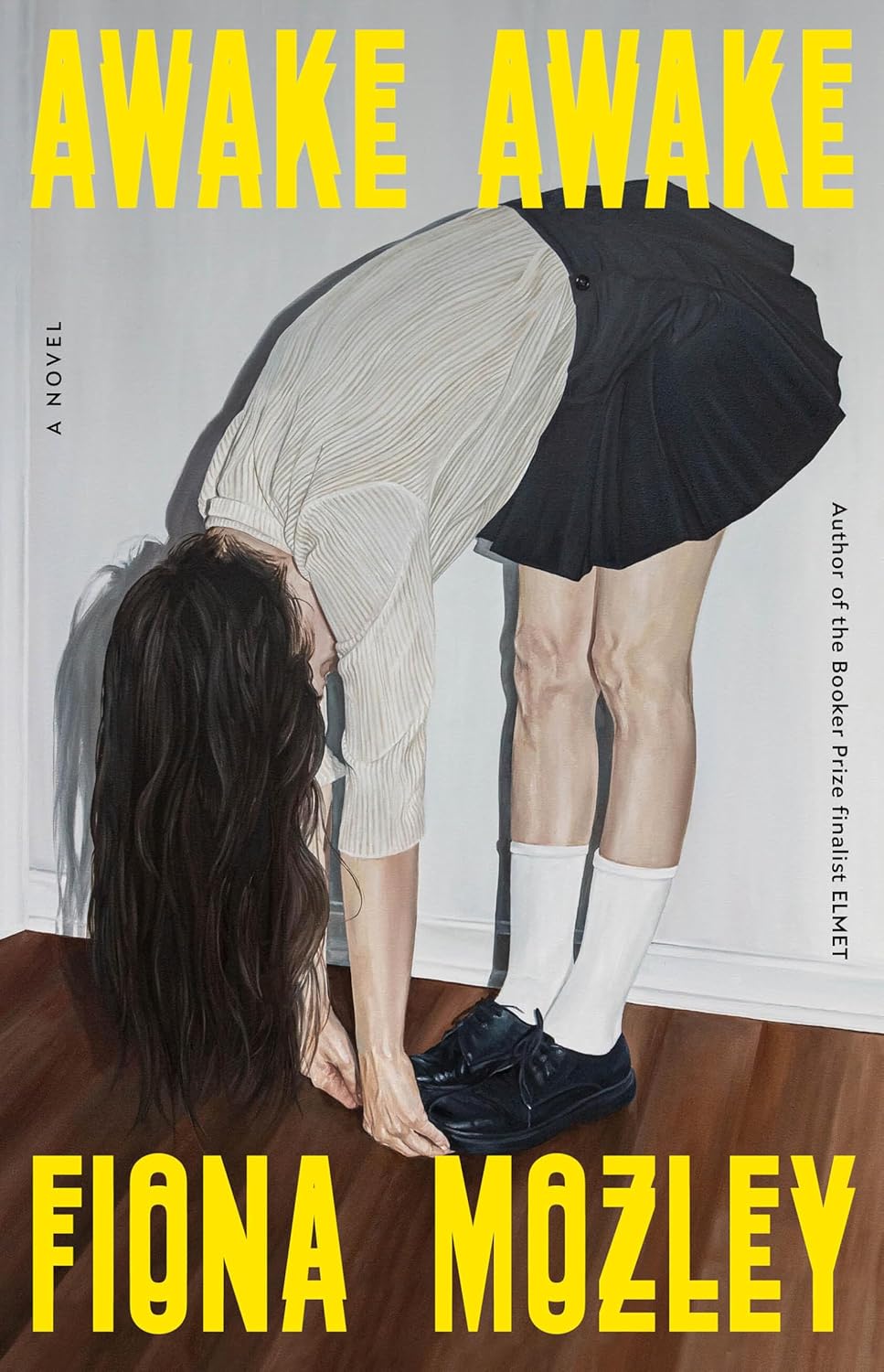
From Awake Awake by Fiona Mozley. Used with permission of the publisher, Algonquin Books. Copyright © 2026 by Fiona Mozley.