
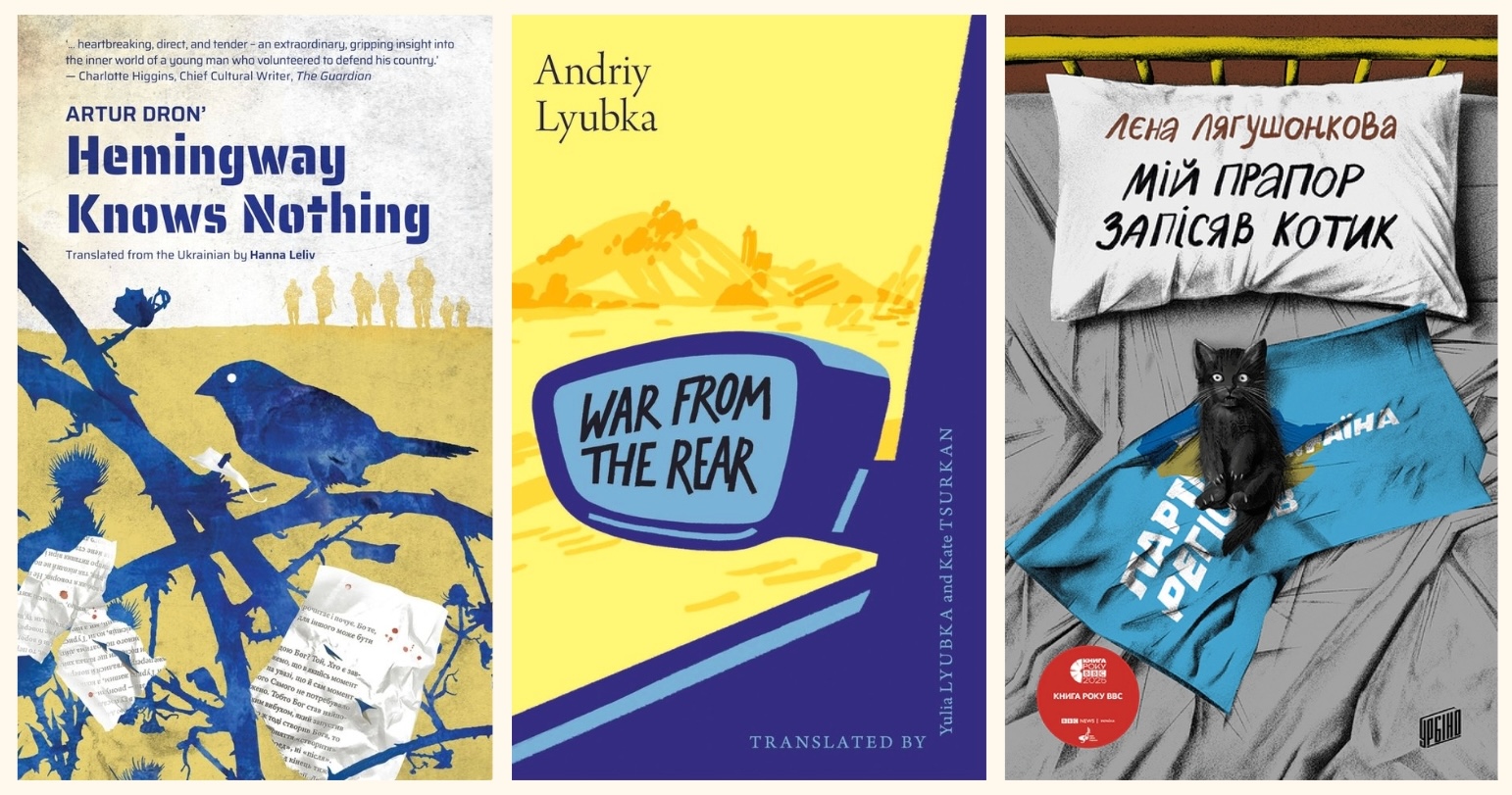
Since the start of the full-scale invasion of Ukraine, nonfiction and autofiction have emerged as leading strands in contemporary Ukrainian literature, alongside poetry. Several factors contribute to this shift. Primarily, memoir-like and autofictional forms underscore the immediacy of events and, according to some voices, safeguard authenticity from being compromised. Additionally, the autobiographical angle enables quicker publication, whereas fictionalizing reality would demand longer periods of research and analysis. In wartime, writing has become a method of witnessing and recording life. The three writers examined here—Artur Dron, Andriy Lyubka, and Lena Lyagushonkova—each cultivate a distinct voice and depict a slice of life shaped, in one way or another, by the enduring Russian aggression and colonial aims.
What binds these authors is their self-positioning as witnesses and their use of autobiographically informed viewpoints. Dron centers his pages on a soldier’s life; Lyubka—who, since the publication of his book, has also joined the Armed Forces—relates various experiences of a volunteer assisting the army and procuring supplies, primarily vehicles; and Lyagushonkova, whose genre leans closest to fiction, concentrates on a personal history that remains inseparable from the broader political landscape of Ukraine’s industrial east, Russification, totalitarianism, and the legacy of Soviet corruption that persists in today’s Russia.
Andriy Lyubka’s collection of brief essays War From the Rear: A Ukrainian Aid Volunteer’s Story has been translated by Kate Tsurkan and is available in English from Academic Studies Press. Artur Dron’s book, Hemingway Knows Nothing, a compilation of essays and personal testimonies, is set to appear in an English edition from Jantar Publishers in the United Kingdom, while Lena Lyagushonkova’s autofiction probably belongs to a category that faces translation challenges: to immerse readers in the authentic Luhansk of the 1990s and early 2000s, she crafts a distinctive sociolect that interweaves literary Ukrainian with slang—a blend of Ukrainian and Russian known as surzhyk (linguistically, a creole)—and a substantial amount of culture-specific obscenities that are essential for reconstructing the broader reality.
*
When the full-scale invasion began, Artur Dron, then a young poet in his early twenties, voluntarily enlisted in the Armed Forces. His book offers a visceral, gripping portrayal of life at point zero—being wounded and losing friends. The title, which evokes Ernest Hemingway, signals the polemical edge found in some of the essays. For decades, the works of Ernest Hemingway and Erich Maria Remarque have been regarded as benchmarks of war and veteran literature. Since the invasion began, literary discussions have asked: “Who will be our Hemingway to chronicle this war?”
For contemporary Ukrainians, war is neither an adventure nor a political game in which they function as pawns.
Dron argues that the conflicts these writers participated in differed markedly from the current war in Ukraine, and their epistemic landscape cannot serve as a universal blueprint here. For Hemingway, war was a foreign affair, an event he joined in search of meaningful adventure. For Remarque, war was a forced undertaking imposed on a new generation by corrupt politicians.
For Ukrainians today, war is neither an adventure nor a political game where they are someone’s pawns. It is a conscious choice to defend their land, lives, political autonomy, and beliefs. Dron demonstrates that a Ukrainian soldier possesses agency and political will. The volume quickly gained acclaim and earned the Yury Shevelyov Prize for nonfiction from PEN Ukraine in 2025. Beyond its philosophical reflections, the collection includes moving personal accounts of camaraderie, faith and religion, loss, and hope.
*
Andriy Lyubka’s latest work centers on his experiences as a volunteer. From the onset of the full-scale invasion, he and his colleagues have been tirelessly raising funds, acquiring resources, and transporting used vehicles to the front lines. To date, the team has secured more than four hundred cars. Lyubka describes the narrative as “the war from the rear”—not a soldier’s war, but that of volunteers and the families of those defending the country. The book presents road diaries and short essays detailing the group’s wartime experiences across Ukraine.
Lyubka’s engaging storytelling technique is meticulous, lyrical, occasionally witty, and thus deeply piercing. He evokes the scent of unexpectedly fine coffee brewed at a roadside gas station in Ukraine’s eastern regions, while also addressing hope and heartbreak, soldiers who lost their lives before the volunteers could deliver the vehicles needed for evacuation, as well as guilt, regret, bad weather, hard work, and the complexities of time management. This offers an honest glimpse into life in Ukraine over the past four years.
*
Lena Lyagushonkova’s novel, A Cat Peed on My Flag («Мій прапор запісяв котик», Урбіно, 2025), follows a coming-of-age story in Luhansk during the 1990s and early 2000s. Luhansk, this terra incognita within an independent Ukraine, is depicted in almost carnival-like terms, yet this carnival is infused with absurdity and sometimes cruelty. As the heroine notes, to someone from Western Europe or even Western Ukraine, Luhansk and Donetsk might appear the same: distant eastern cities, heavily Russified, intricate, and incomprehensible.
In reality, the two differ greatly: Donetsk became the terrain of oligarchs, “Rihanna concerts,” and money, whereas Luhansk belonged to miners, poverty, and thwarted ambitions. Lyagushonkova devised a highly original self-description language, blending moments of code-switching into Russian, coarse slang, miners’ jargon, and philosophical terms with ease.
Growing up female in a place shaped by Soviet policies of ethnic mixing, material scarcity, and pervasive oppression offers a poignant focal point that illuminates totalitarian epistemic violence rooted in gender inequality. The book’s humor is sharp and merciless, reminiscent of stand-up comedy, even as the realities described are far from funny.
On the surface, it might seem unrelated to the current war, yet this impression is misleading: Lyagushonkova provides a broader framework and offers a candid portrayal of the industrial east that bore the brunt of Russian pre-war propaganda and, to some extent, corroborated Russian political mythology. The work is highly relevant to the war and to understanding its roots. Critics have labeled the novel postcolonial and feminist. In 2025 it was awarded the BBC Ukraine Book of the Year Award in fiction.
Autobiographical approaches appear across the works of the three authors discussed here in various forms, both in fiction and nonfiction. Dron presents a conceptual examination of the war in its epistemic dimension. Lyubka concentrates on detailing daily life in Ukraine and the volunteering movement, a cornerstone of the Ukrainian resistance. Lyagushonkova offers a personal account of growing up in Luhansk, contributing to a deeper understanding of the Ukrainian industrial east, parts of which were annexed as early as 2014.
