
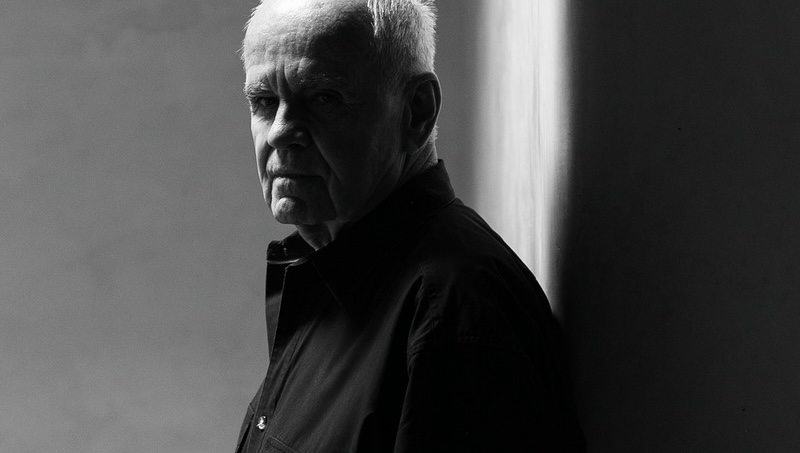
Tuesday, August 12. My photo assistant Chika and I arrive at the Santa Fe Institute, Cormac’s home away from home, and load equipment into the library. Cormac is early, chatting up the kitchen staff. We introduce ourselves. Cormac is perhaps 5’6” tall, and I’m 6’2”, but his beaming “pleased to meet you” makes the greater impression on everyone in the room as he shakes our hands. Before we proceed to the library, I note the daylight coming through a side window. Cormac understands and obliges. He is as kind and accommodating in person as I hoped he’d be when we first spoke three Tuesdays before.
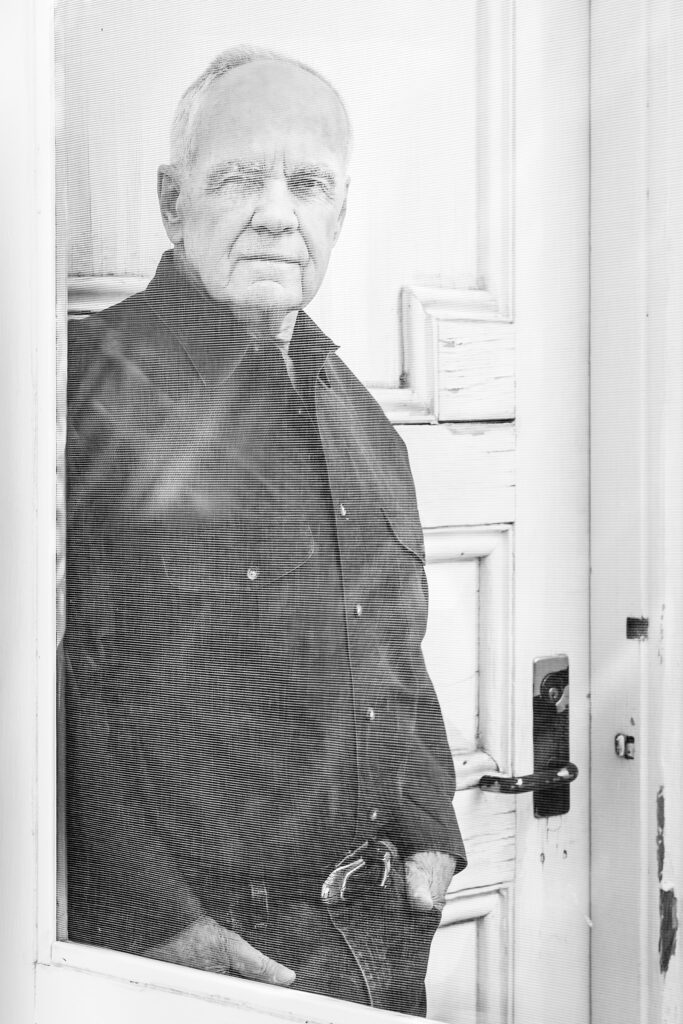 Cormac McCarthy Photograph © Beowulf Sheehan www.beowulfsheehan.com
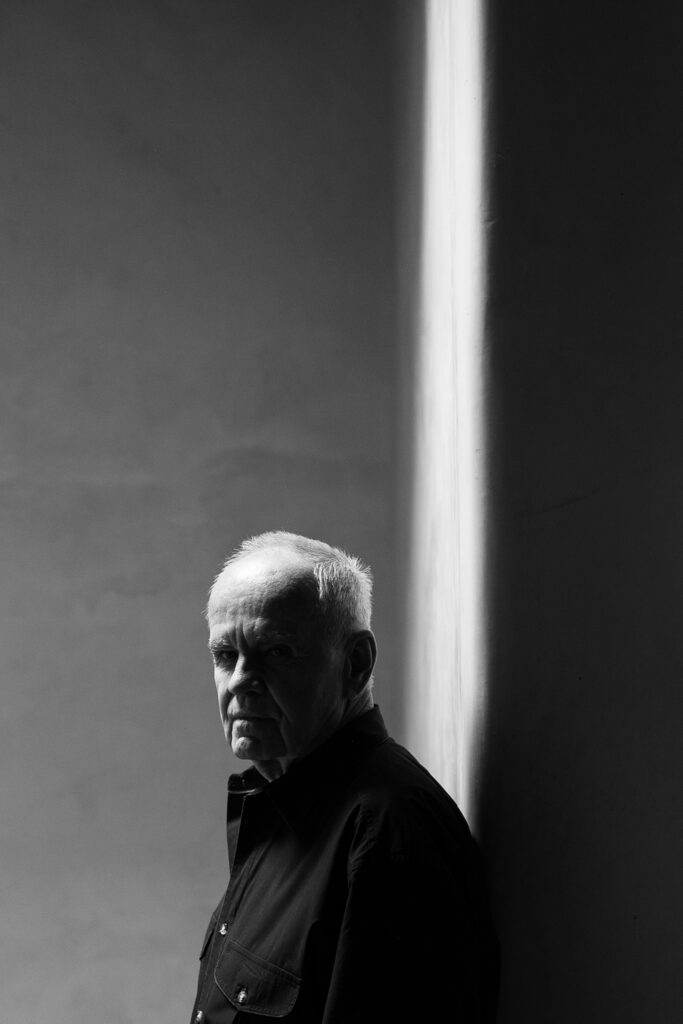
The sun sits with a hard, grainy edge. In an adjacent courtyard, I remark on the drama I see in the interplay of light and shadow, and I ask Cormac if he’d be willing to be part of that moment. He agrees. Our conversation circles the Institute—why he’s here, what drives him to science. “My friends are here. We love the same things. We argue.” When asked what draws him to science, he replies, “It’s fun.” And what brought him to Santa Fe? “It’s home.” We move through the library, working in different alcoves, while a balcony overlooks a nearly unbounded sky. I invite Cormac to step to the balcony’s rim and absorb the sense of “home.”
At our prior Institute location, beside a long adobe wall separated from the entrance, he opens up further: “Do you know the story of my typewriter?” I hadn’t heard it before, so he tells Chika and me that he donated his Olivetti Lettera 32 to a fundraiser auction for the Santa Fe Institute. It sold for $250,000. A friend later scoured eBay to buy him a replacement for only a few dollars. A proud smile settles on Cormac’s face. That smile might not have appeared had I not agreed to this shoot.
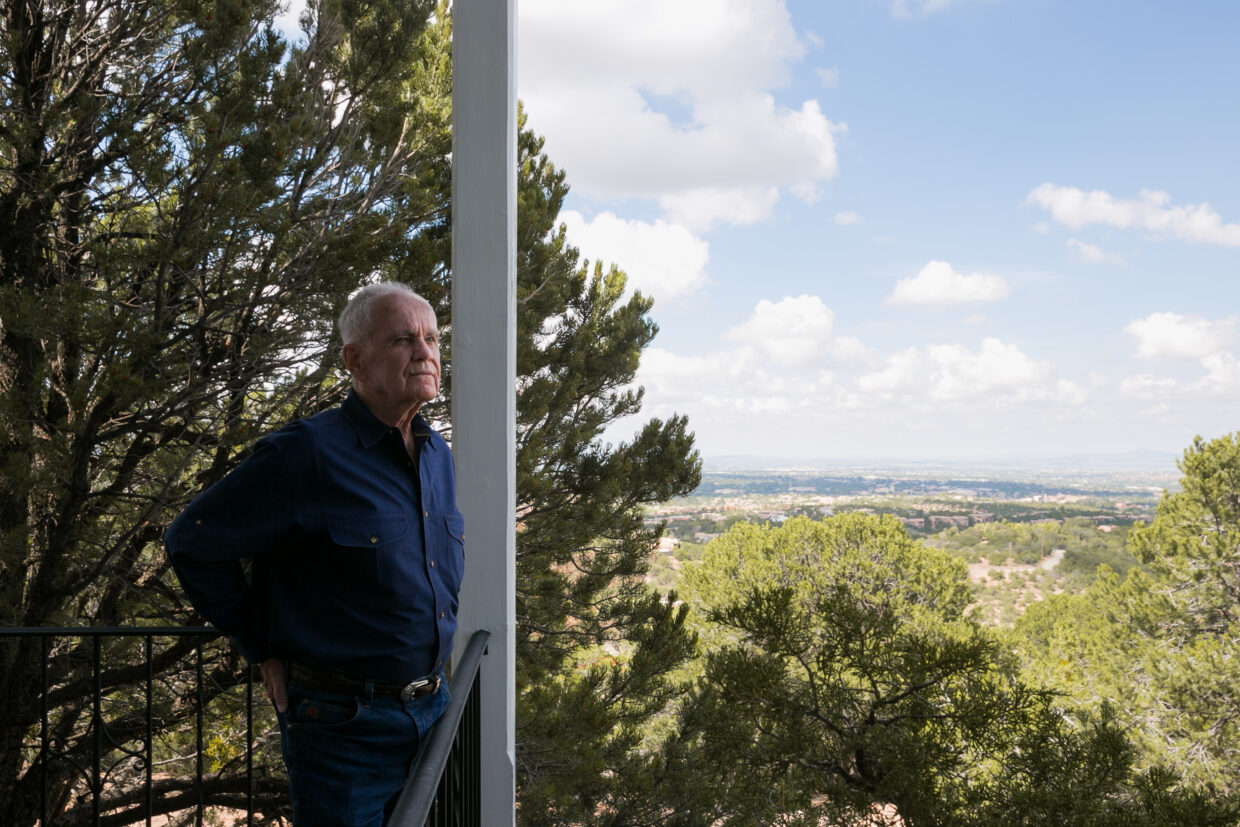 Cormac McCarthy Photograph © Beowulf Sheehan www.beowulfsheehan.com
“Do you want to come to my house and make more pictures?”
I’m eager at the prospect. We gather our gear as Cormac retreats to join his friends.
*
Cormac’s pickup is weathered, rust-streaked, dented, conspicuously easy to spot in a crowd. We trail him through traffic lights and intersections, out to a zone where the city gives way to open space. Off to the right, a two-story adobe house—roughly four thousand square feet—rises into view, with a cluster of vehicles stretched under tarps across a dusty yard. Following his lead, I ask about the cars he’s collected. Pointing to one, he quips, “That’s a Corvette Stingray. I drove it back after I’d partied with Johnny Carson in Fort Lauderdale,” and he lets out a quiet, self-mocking laugh. It feels like a memory pulled from my own hometown.
 Cormac McCarthy Photograph © Beowulf Sheehan www.beowulfsheehan.com
Inside, in the center of his grand living room, sits a pristine billiards table—a nod to the stories of his early years earning a living at the game. I don’t press about the table, and he doesn’t offer explanations. Instead, he guides Chika and me upstairs. The stairwell’s plaster and paint glow with a mood that could pass for an Irving Penn backdrop. I photograph him along the stair, the sun flooding through a skylight and sculpting the space around him, reshaping the lines of his face. At the top, he asks how the house feels so far, already aware of our reactions. I ask him to stand tall like the columns nearby. After a handful of frames, he invites us into his bedroom, but first he wants to show us his son’s room.
____________________________
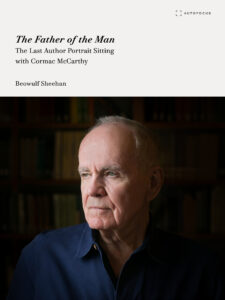
From The Father of the Man: The Last Author Portrait Sitting with Cormac McCarthy by Beowulf Sheehan. Copyright © 2026. Available from Autofocus Books.