
Gripping the worn steering wheel of my old pickup truck, I steer southwest out of Fairbanks, Alaska, a ritual I have kept up at least once a year for a quarter of a century. My field vehicle strains to maintain a steady pace as the road climbs and winds around gentle knolls. The elevation offers sweeping views of the wetlands that fence in the Tanana River, one of the Yukon’s largest tributaries.
The river lies in the distance like a dark brown serpent, its banks alive with patterns and colors. Deciduous trees the color of fresh green apples line the shore, then punctuate the expansive conifer forests that stretch up into the hills. The woods are thick with spruce, their needles a deep, musty green veiled in shade. Old river channels and oxbows are etched into the floodplain in curves and rounded shapes, calligraphy the river has scratched as it shifted course over thousands of years.
From my vantage point above, I can see not only the river’s current route, but also the marks ancient flows have left on the surrounding sweep of land. Old channels linger as soft depressions across the floodplain, now filled with bog vegetation in muted shades of yellow, green, and brown—living traces of water long since gone.
How many times have my feet carried me to the top of this slope, so steep that the bottom disappears from view?
While small, scattered wetlands are common across Alaska, broad river floodplains are particularly plentiful. The Yukon Flats, Minto Flats, and Tanana Flats form vast lowland systems—tracts of boggy terrain that sometimes stretch for hundreds of kilometers across saturated earth. These places are wild and rugged, and reaching them often requires taking to the air by helicopter or float-plane, touching down on a river, lake, or hidden pond. In winter, some wetlands become more accessible as thick, spongelike layers of organic-rich peat freeze solid and become strong enough to support snow machines on their icy surfaces.
Leaving the truck at a dusty, circular parking area, I walk toward the viewing point known by the Fairbanks research community as “the Bluff.” How many times have my feet carried me to the top of this slope, so steep that the bottom disappears from view? The Bluff offers a gorgeous view of a section of the Tanana River and the surrounding boglands, ranging from permafrost forests to wet fens to bogs.
There are signs of old fires that burned through the area over forty years ago—although the vegetation has changed over time, the burned areas are still distinct. The occasional charred stump juts above the undergrowth like forgotten relics, and where flames once swept through the forest decades ago, patches of tall shrubs lay adrift in a sea of denser forest. The Tanana River in the background is flowing high, and most of the area between the river and the Bluff sparkles as sun rays glisten on the thousands of small pools and ponds that fill every dip and crevice in the land surface.
One rarely discerns the quiet, elusive beauty of boglands from above. Their subtlety often escapes such a view, lacking the dramatic contrast or defined edges that come with elevation, and stretching too wide and far to be taken in at once. Bogs tend to keep their secrets low to the ground, where colors shift by inches and boundaries blur in gradients of tiny mounds of moss and sedges emerging from pools. That’s what makes the Bluff such a rare and remarkable vantage point. From this elevated perch, I can take in the full, living tapestry of the wetland beneath me, the soft, feathered transitions where one type of bog blends almost imperceptibly into another.
From here, patterns begin to reveal themselves—how the different hues and textures of peat and vegetation not only respond to water, but also quietly control its flow. Bogs act like living sponges: absorbing snowmelt and rainfall, slowing runoff, and releasing water gradually back into the surrounding floodplain and river systems. Even slight changes in elevation or the thickness of peat shape the path of water as it journeys across the landscape, spreading it out, storing it in pools, or filtering and hiding it in deep layers of peat.
At first glance, the surface appears solid, but stepping onto a quaking bog feels like walking on a vast, trembling waterbed.
Off to my right, far on the horizon, the Alaska Range looms as tall, jagged, and glacier-capped peaks even in the heart of summer. Denali rises above them all, a monument standing guard over the low, water-rich world of the wetlands below. These mountains are more than a backdrop; they are the beating heart and driving force of water movement in this region. Meltwater from the mountain’s glaciers and thawing permafrost flows down through ancient channels, fueling the great rivers and soaking into these sprawling boglands. From this high point, the connection is clear to see: The peaks shape the floodplain, and the bogs in those flats govern the water that moves through them—quietly, steadily, but with surprising force.
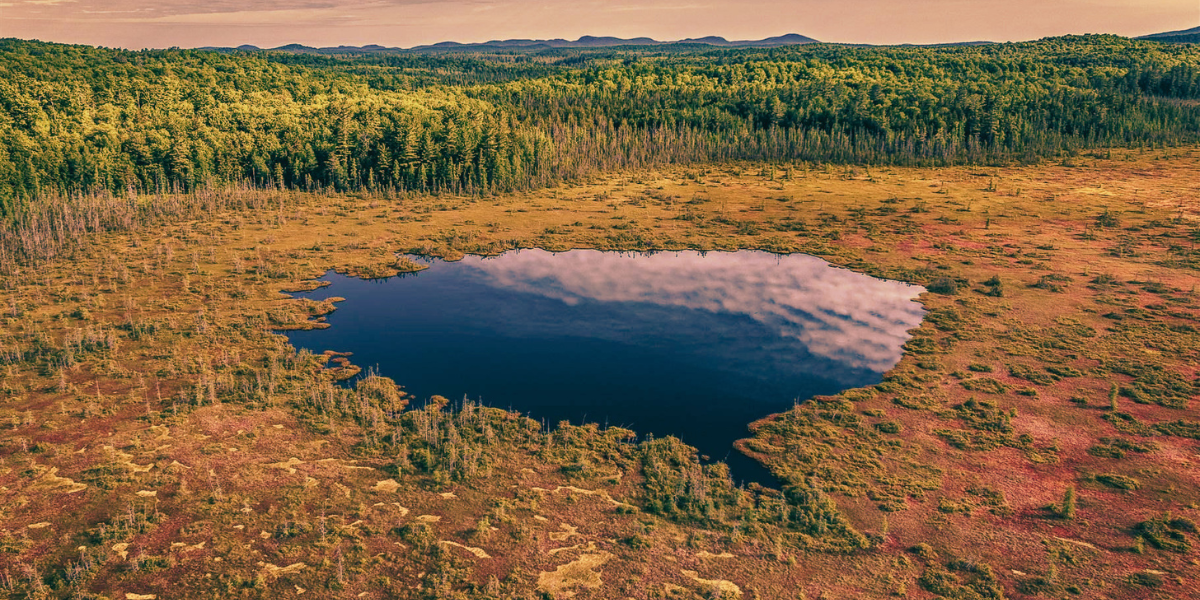
Buffering the space between forest and river, boglands refuse to be defined as either land or water. Neither liquid nor solid, the soft peat layers formed in bogs and fens set them apart from all other ecosystems. In a few small depressions farthest from the river, auburn-brown vegetation and peat have stretched into thick floating mats across open water, forming what’s known as a quaking bog.
At first glance, the surface appears solid, but stepping onto a quaking bog feels like walking on a vast, trembling waterbed. Each step sends a ripple through the spongy, thin mat, a slow undulating motion beneath your feet that surprises the senses, disorienting yet simultaneously strangely delightful. Children, college students, seasoned professionals—everyone reacts the same way. First with hesitation, a tentative step followed by a pause; then wide-eyed amusement as they bounce and sway across the surface as it yields under their weight. In their quiet, playful way, quaking bogs connect us, breaking through age and experience with the simple wonder of motion.
But it is not all joy and magic. Some have misjudged the strength of the surface mat, stepping in the wrong place or breaking through into the cold water below. Accounts of injuries, even fatalities, are reminders that beneath the mystery of a bog’s soft ground lies real danger. For the elusive beauty of bogs cloaks underlying danger.
In addition to the quaking bog, the view from the Bluff reveals a wide variety of peatland types: fens thick with willow shrubs, bogs where gnarled, ancient trees stand, and open fens circling broad pools of water. Each is shaped by its own relationship to water: Some can withstand regular flooding, while others, like the quaking bog, stay afloat by building a dense, buoyant mat of vegetation over open water. Though I can cross this landscape on foot—albeit slowly, and often in chest waders—I have seen many ATVs and snow machines sink deep into the soft ground and stall out.
Too aquatic for roads, yet too terrestrial for boats, boglands remain some of the most remote and difficult landscapes to access. As a result, they have long been seen as unproductive ground: Land drowned in water, resistant to development or use. And it’s true: The very essence of a bog is shaped by stagnant flooding. If the soils were not saturated, microbial decomposition would happen too quickly, breaking down organic matter before the thick layers of peat, the signature of boglands, had a chance to form.
But this delicate balance between water and peat is far more than a biological barrier; it is a quiet force that shapes entire landscapes. As a bog slowly forms, spreading its sodden layers outward like an unfurling, living quilt, it begins to hold water—absorbing rainfall and snowmelt, and slowing its journey downslope toward streams, lakes, and rivers. In doing so, it not only reshapes water flow; it also creates the very conditions needed for peat to build up, setting the stage for even more bogland to grow.
When I tell people that I study bogs, or peat, they often laugh. How odd, I’ve heard a million times.
Looking out across the flats, I can see small depressions dotted with tufts of fen vegetation holding pockets of water that shimmer deep blue, their smooth surfaces reflecting the sky above. These wetlands, connected to the river, act as natural reservoirs that absorb and hold water, especially when the river swells with meltwater or heavy rain. Scattered like sponges across the floodplain, they help reduce the speed and peak of floodwaters that would otherwise move quickly down the Tanana River, into the larger Yukon River system, and ultimately toward the Bering Sea. By holding water on the land, these peatlands not only reduce the risk of flooding downstream, but also buffer the landscape against drought, keeping soils moist and supporting nearby forests through dry spells.
From above, it becomes clear: These wetlands are not isolated features, but a connected, living network—dark water and soft ground woven into a single web teeming with life. Without them, this vast flatland would be laid bare to extremes. Water levels would surge and vanish with unsettling speed. But instead, the land breathes with the water, its rhythm steadied by the bogs that quietly hold the balance of the whole system.
When I tell people that I study bogs, or peat, they often laugh. How odd, I’ve heard a million times. Their skepticism at first blush is understandable. Throughout much of modern history, we have not known how to value these unique places. During the agricultural and industrial revolutions, bogs were an aberration. Not quite land and not quite water, too wet to yield bounty, too dangerous to navigate, too wild to fit into our concept of beauty, bogs were obstacles to human prosperity. To drain and clear a bog was to improve the world, with no recognition of any harm or loss.
Our very language perpetuates the idea of bogs as unvalued and unwanted. A “quagmire” refers to a complex, typically hazardous, situation. “Don’t get bogged down” is a warning not to get stuck in details that stand in the way of progress. Bogs are metaphors for situations that interfere with you and your goals. A “bog standard” describes something that is basic and unrefined. When, historically, the British used the term “bog trotters” to describe rural Irish people, the—intentionally offensive—implication was that the Irish were poor, uneducated, and uncivilized. Ancient myths and modern cinema depict bogs as sinister locales, dangerous to cross, and fatal to get trapped in.
It is true that standing in the middle of an expansive bog, with nothing but undulating waves of thick moss and gnarled spruce trees surrounding you as far as the eye can see, can be an unsettling experience. Boglands form from the overwhelming triumph of death: the laying down over thousands of years of organic matter as peat. This accumulation of thick layers of peat—soil rich in partially decomposed organic matter—is what makes a bogland a bogland, whether it is then more specifically considered a bog, a fen, a marsh, or a swamp.
Indeed, death can lurk in these layers. The waterlogged soil can often seem like a trap, eager to draw you down with one misplaced step. The Elling Woman, the Tollund Man, the Grauballe Man: These are just some of the names we have given to so-called bog bodies, individuals immortalized in peat with their injuries, shaved heads, and preserved final meals of gruel. These bog bodies tell stories of a time when humans were sacrificed to the gods in bogs, as otherworldly margins between the human and divine realms, or when social outcasts met a cruel, violent end for failing to conform to societal standards.
But bogs store much more than the physical overabundance of dead biomass. Peat’s remarkable preservative powers make bogs the keepers of memories, secrets, and dreams; they record information and protect remnants of the past. In bogs, history is sequestered and suspended in time, but can be revealed at any moment, just as layers of peat can be uncovered. These ancient systems are silent observers of history, capturing thousands of years’ worth of stories in depths of peat that patiently await discovery.
What’s more, even as they are defined by death, bogs are also springboards for unusual and unlikely life-forms that extend our understanding of biology—from acid-flinging mosses to amphibian-eating plants. Bogs are full of such paradoxes. They are strong enough to preserve comprehensive patterns of change over thousands of years of Earth’s history, yet they are extremely fragile in the face of climate warming. Despite their reputation as dangerous places, throughout history, they have offered safety to those needing refuge. They are the underdog ecosystems that have helped win wars.
Refusing easy labels and spanning so many thresholds—between land and water, life and death, past and present, safety and danger—bogs can be both beautiful and petrifying because of their transitional nature. But these magical, convention-defying places are also one of our greatest allies in the fight against climate change. Not only do boglands manipulate water as it flows from mountains to sea, protecting neighboring forests with moisture even during intense drought; for thousands of years, they have cooled our global climate by absorbing carbon from the atmosphere.
Boglands have taken millennia to form—and yet without swift protection, we could lose them in mere decades.
Although peatlands occupy only 3 percent of the world’s land area (an estimated 4 million square kilometers, or 1.5 million square miles), they store roughly 30 percent of the planet’s soil carbon. This far exceeds the carbon stored in the world’s forest biomass, despite forests covering a much larger area. Yet the planet continues to lose several thousand square kilometers (hundreds of thousands of hectares) of peatlands every year due to drainage, agriculture, and other human land uses. As one of the most effective natural sinks for carbon, peatlands could accelerate climate change if disturbed.
Already, drained and degraded peatlands are estimated to contribute about 5 percent of annual global anthropogenic greenhouse gas emissions. These emissions will only grow unless we fundamentally and radically rethink how we value these landscapes.
Boglands have taken millennia to form—and yet without swift protection, we could lose them in mere decades. To preserve peatlands is not just to protect carbon—it is to safeguard ecosystems that steadily shape the planet’s climate, preserve deep records of human and natural history, and challenge us to see resilience and beauty in the slow, strange work of wet ground.
__________________________________

From Bogland. Reproduced with the publisher’s permission, W. W. Norton and Company. © 2026 by Merritt R. Turetsky
