
As a youngster, fear came easily to me. We dwelled on the edge of a murky, bubbling, swampy woodscape; after dark, my mother would sing “The Unquiet Grave,” a traditional ballad in which a living beloved begs a departed one to answer. He does, in a way that unsettles the room. Yet I grew into a skeptic, fully aware that the sharpest dangers often come not from the hereafter but from the living. Consequently, I gravitated toward fiction, dedicating myself to crafting believable tales about believable people facing believable predicaments.
So it happened that, embracing a realist stance, I began drafting The Spirits (W.W. Norton, 2026), a narrative about Sister Whitby, a twenty‑one‑year‑old farm girl who carries guilt for her father’s violent death. (In its early form, Spirits is almost literally the drink she’s been consuming.) The setting is Christmas Eve, marking the ninth anniversary of that stormy night, a moment that each Whitby kin remembers in a distinct way and without ever naming aloud. Yet I encountered a snag: even though I had erected this pivotal moment, I remained unsure of what actually happened. Sister Whitby’s memories are blurred, and her father is gone.
Yes, redemption figures into the plot. Yes, the graveyard sits just beyond the doorstep. Yes, I nicknamed the project a Michigan‑seasonal Carol, but I refused to let any specter intrude upon the page. For so long I had treated the supernatural as implausible, and I told myself that the scene could unfold without any otherworldly interference. But the more time I spent with my characters, the more they grew haunted—and there was no denying that their father’s ghost hovered in the room. What was a realist writer to do? To discover a way forward, I began to catalogue a selection of literary phantoms.
*
Hamlet’s father’s apparition, a domineering patriarch, arrives at the outset and sets the gears of action turning. He is surprisingly transparent in what he demands of Prince Hamlet: to “Revenge his foul and most unnatural murder,” presumably by removing Uncle Claudius, who has seized the throne and his wife. We can question whether the ghost is “real” or merely Hamlet’s conscience made flesh. The truth is that Shakespeare never required a verdict—the tale works beautifully whether the specter is a supernatural presence or a psychological conscience made flesh in the castle’s halls.
Beyond frightening Hamlet and pointing toward blood, the ghost reveals precisely how the murder occurred. Not every story, though, benefits from such explicit revelation. I chose to let ambiguity about events become a core instrument of the narrative: the family’s task that evening is to reconstruct what actually happened on that shadowed, desire‑driven night. The truth is unveiled gradually, by and through the family, and the reader discovers it alongside them—and often in spite of them.
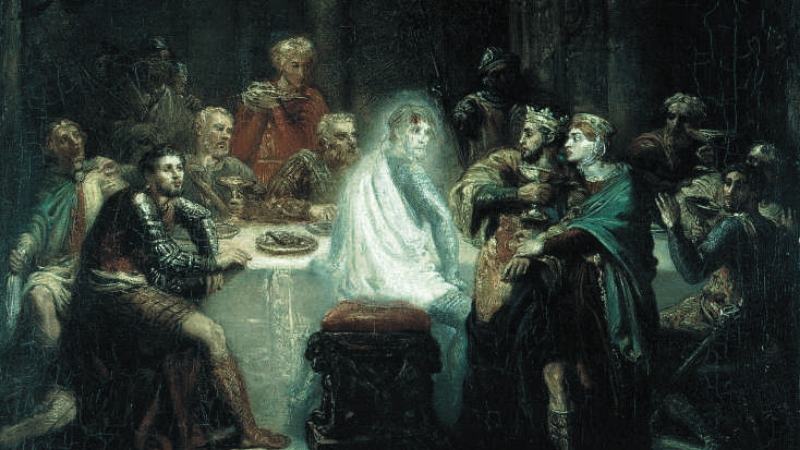
Banquo’s ghost: In Shakespeare’s Macbeth, only the man who has ordered the murder can see the specter of the victim. The banquet—meant to celebrate power—turns into a scene of disintegration as this morally upright ghost interrupts the festivities. Banquo’s haunting incurs no active role; simply by existing, the spirit unsettles Macbeth and exposes the hollowness of his triumph. The haunting demonstrates the uncanny potency of a well-placed ghost.
Marley’s ghost: It struck me with the force of a sledgehammer that, since my tale unfolds on Christmas Eve, A Christmas Carol already looms in the room. Dickens’s first specter, the sorrowful former business owner Jacob Marley, is dreary yet morally recalibrated by death—he is candid and speaks the truth. The subsequent spirits likewise speak with candor, laying bare the moral of Scrooge’s life and guiding him toward transformation. The tale argues, in no uncertain terms, that wealth without mercy should be renounced and reconfigured toward communal care.
In my own cautionary tale, Sister requires redemption as urgently as Scrooge does; the events of the past have left her bitter, parsimonious, and curiously hard to endure. In The Spirits, I needed a lighter touch, yet I could not permit a sugary epiphany that would send readers storming to the hearth with a “bah, humbug.” Imagine if Sister awoke and proclaimed: “I am as light as a feather, as joyful as an angel, as merry as a schoolgirl, as buoyant as a drunken reveler, a merry Christmas to all!” I recognized that such an abrupt change would alienate readers and derail the very mood I sought to sustain.
Beloved: I have consistently found Toni Morrison’s daughter to be the most formidable ghost in literature—a spirit wronged by both her mother and the system of slavery. Beloved returns as an insatiable force, demanding ever more sustenance and attention from Sethe. This specter acts as a blunt instrument of vengeance, neither tempered by age nor softened by death; she reclaims the loved one with a tenacity that unsettles the living and unsettles Sethe in equal measure. Sethe faces an impossible dilemma: she must learn to metabolize her guilt and coexist with the haunting if she is to endure it.
The Tell‑Tale Heart: We never lay eyes on a ghost in Poe’s tale, yet the rhythmic pounding on the floorboards that spurs the unnamed narrator toward confession clearly arrives from the beyond. It feels tailor‑made for a ghost to orchestrate guilt and compel truth. And, like many great masters of the eerie, Poe never clarifies the source of the sound, letting the mystery persist.
Lincoln in the Bardo: Writers often present an afterlife that is orderly and morally legible, where the past is finally clarified. George Saunders rejects this trope. His Bardo is a jumble of souls who drift, lament, and misunderstand their own deaths; some are too confused to realize they have passed on, especially those who departed with little time to reflect. Such unsettled, wandering beings would hardly be trusted to guide anyone toward a safe resolution.
The Unquiet Grave: Finally, I revisited the folksong my mother used to hum—a tune that still gives me gooseflesh. In the ballad, a young woman sits on her beloved’s grave for an entire year, pleading to see him again. The twist comes when the ghost finally materializes and instructs the despairing lover to move on—go on with a life of her own and stop haunting him. There is a sly reversal here: sometimes the living are the ones who haunt the dead. I take that message to heart. After the otherworldly turbulence that rocks the people in The Spirits, this skeptical writer returns to the living world to craft a coherent, plausible resolution for the holiday tale!
__________________________________

The Spirits by Bonnie Jo Campbell is available from W. W. Norton and Company.
