In time he will say that The Waves by Virginia Woolf has stood as the most formative novel of his life; yet at twenty he would not name it, nor any book, and would deem such a claim flashy, awkward, vague, and conventional. The novel invites, shelters, and guards, then relentlessly presses on him through years of recollection, gnawing at the boundaries of imagination.
On November 28, 1928, Woolf wrote in her diary about The Waves. She claimed the work had emerged or materialized while she was completing To the Lighthouse at Rodmell in Sussex: she gazed out toward the marshes and was struck by the image of “a fin in a waste of water.” Or perhaps The Waves arrived a couple of years earlier, when she pondered what it would be like to conceive and craft a certain life: “Yet I am now and then haunted by the semi-mystical, profoundly deep life of a woman, which shall all be told on a single occasion; and time shall be entirely erased; the future shall somehow bloom out of the past. One incident—say the fall of a flower—might hold it. My theory being that the actual event hardly exists—nor does time either.” Or might the origin of The Waves, published in 1931, lie much further back, in the pages of The Voyage Out, where Terence Hewet longs to write a novel about silence, “the things people don’t say. But the difficulty is immense.” It is also hard to say where a book begins, or if it begins at all, and whether it has not been washing over you from the start.
It is tempting to call this novel Woolf’s most abstract—at first glance recall the fragmentary essence of Cubism—or, as the dust jackets of at least three of the six copies he will own declare, the most poetic. In her earliest draft, which Woolf finished on April 20, 1930, poetry and abstraction had not yet illuminated everything, clarifying and complicating it at once. In this initial version she called the work The Moths; she herself remained too present, too clearly in the act of working out—and even theorizing—how the book should be. The turning point lay in handing the novel over to its characters, who sometimes barely exist as characters, barely separable from one another, and entrusting it to a narrator who speaks from nowhere and mentions nothing about the six voices (and one non-speaker) that comprise the cast of The Waves. We begin with this voice, a plain past tense that he will repeatedly misremember as a stubborn present: “The sun had not yet risen. The sea was indistinguishable from the sky, except that the sea bore a slight crease as if fabric had wrinkles in it. Gradually as the sky brightened a dark line appeared on the horizon dividing sea from sky, and the grey cloth became crossed with thick strokes moving beneath the surface, following one another, pursuing one another, endlessly.”
The Waves does not instruct but confirms that everything is also something else.
Repeatedly, but only nine times throughout the novel, the waves return, along with the light and shore, while this voice attends, observes, and continues to fashion further images that translate each element of the scene into a gleaming stand-in: “the sky cleared as if the white sediment there had sunk, or as if a woman’s arm rested beneath the horizon had lifted a lamp, and broad strips of white, green, and yellow stretched across the sky like the blades of a fan. Then she raised her lamp higher, and the air seemed to become fibrous, tearing away from the green surface, flickering and flame-like in red and yellow fibers as if the bonfire’s smoke roared forth.”
The Waves does not instruct but confirms that everything is also something else. He has learned this lesson by heart, within his bones, initially from Roland Barthes, who argues that meanings proliferate the more oblique they are. He has not yet linked this stance, taste, or doctrine to metaphor in the RB sense: a term often reduced by schooling to a dull distinction from simile. Instead, RB’s habit is a form of bravado, a refusal of how things are, and how they ought to be. It’s not that the veil of appearance—consumer advertising, common sense, literature itself, or photography—gets ripped away, as Dennis Potter’s review once suggested in the margins of B’s copy of Mythologies. It is something else: unwarranted meanings on the periphery—per RB, connotations. The world of things, bodies, texts, and sensations becomes a network of connections and diversions, all spread across the surface of signification.
Depths are obscuring, Sontag argues in her essay on RB. Turning one thing into another, revealing that this is in fact that, is the task he imagines for himself as reader, student, critic, theorist. And as a writer? A difference between RB and VW, between thought and poetry: in The Waves, metaphorical becoming, the mundane and secular transubstantiation, occurs anew in nearly every sentence, whereas RB seems to pursue a figure more thoroughly, but it remains a single event within his prose, not the very texture of the writing. Transformation is how VW’s writing progresses: like and like and like. It is one reason—rhythm being another—she could not simply separate prose from poetry, so she told Vita Sackville-West that prose and poetry should be distinguished by their use of metaphor.
The Waves stands above all as a book of images. These images can feel strangely fixed, ingrained, or imprinted, especially when they detach from one character’s monologue only to reappear in another’s, as if these six, perhaps seven, can read one another’s minds. (A collective telepathy regarding imagery is a power, or a curse, in Shakespearean tragedy.) A fin in a sea of waters, Woolf’s conception from Rodmell. An orientalist vision of women bearing red jars on their heads, camels stationed by the Nile. Childhood scenes framed by greenery: a grand house where gardeners sweep a lawn with massive brooms. The most minute details, pictures conjured from next to nothing: the glistening metal of fish scales, a chain of silver bubbles rising from a pan’s bottom, white ships that resemble petals floating in a basin, the silver and glass (the persistence of things) above with six or seven faces bobbing up in turn, like petals—image upon image upon image.
Later, the book will feel like a kind of test, both in his own mind and in the minds of various (male) writers and critics.
Alongside this imagery, there is a profusion of metaphor, metonymy, and simile: a wealth of substitutions that conjure one thing out of another, proving that things can be subtly or strangely other than themselves. This is also that. The narrator of the interludes is the novel’s first founder of comparisons: a devotee of like and as if. “The wave paused, and then moved again, sighing like a sleeper whose breath comes and goes.” The horizon’s dark bar becomes clearer, as if sediment had settled in an old wine bottle and made the glass green. Bernard, the craftsman of phrases, becomes the book’s second devotee of metaphor, and thus the first to beguile the others with the potential—and perils—of figurative language. Neville, the future poet, says: “Bernard keeps talking. Up they bubble—images. ‘Like a camel’… ‘a vulture.’ The camel is a vulture; the vulture is a camel; for Bernard he is a loose wire, enticing yet precarious. “Yes, when he talks and crafts his foolish comparisons, a lightness comes over us; one feels liberated; I have escaped.” Yet metaphor’s flight is also a snare, and Rhoda, for one, desires to break free: “‘Like’ and ‘like’ and ‘like’—but what is the thing that lies beneath the semblance of the thing?”
He does not yet know it, but Woolf’s extravagant metaphorical strain—the sense that any object, body, or view could instantly translate into any other—is a quality that spans her entire œuvre, both essays and fiction, and will one day exert a consuming pull on him: hours of astonishment and learning, years of envy and aspiration. At the same time, there is no ambition to master all of Woolf, no drive toward expertise or exhaustion, and there remains a nagging fear that the wrong text could ruin her entire body of work or that of any other author he loves. What if the same intensity of image cannot be found elsewhere in her output—what then? Decades later, having avoided it for years, he will encounter in Orlando the line, “Trees were withered hags, and sheep were grey boulders. Everything, in fact, was something else.” Woolf’s own love of metaphor—her suspicion and mockery of it too.
The remarkable unity of voice among the six narrators in The Waves, their tendency to imitate, repeat, or rhyme with one another—how, if at all, does he grasp this? As a pure, overarching aesthetic pattern, as a plane of recurrence and recollection, it captivates him. It becomes a spellbinding fascination, bordering on tedium, unlike anything he has encountered, so that he wonders if he could simply open the book to any page and begin reading. He never does this in practice; instead, when he rereads the novel in his fifties, he begins again from the first page, finishes, then starts again. After a certain point, he deems he will be reading The Waves for the remainder of his life.
He keeps this to himself and does not discuss it with his father. One of the peculiarities of Woolf’s portrayal of childhood—youthful growth and entry into adulthood—is that parents are almost absent, as if they inhabit a separate, parallel realm that intermittently intersects the lives of Woolf’s figures—like the drone-like grown-ups in Charlie Brown cartoons. The Waves is the only Woolf novel his father owns, but is it the only one he has read? The son never asks. Later, the book will feel like a test of sorts, both in his own thinking and in the minds of various (male) writers and critics, some of whom deem The Waves unbearably extreme among Woolf’s work. You’ve read The Waves? You’re a better man than I am! Translation: You’ve fallen for this obvious sham, this pretentious and failed experiment? What is wrong with you? The temptation is to read this hostility as a distinctly English trait—an artifact of late modernism’s awkwardness, even decades after Woolf’s time.
Yet then he encounters a starker verdict from an older American writer. “Unreadable, makes no sense.” Thirty-five years after first reading The Waves, he teaches Woolf’s essay “On Being Ill” (1929) when one of his students proclaims that The Waves stands as Woolf’s greatest novel, far stranger than the others, and a significant portion of the class agrees. What is it they perceive, or hear, that the wisdom of elders resists? Is it formal audacity? A democracy of voices? A freshness and peculiarity of figural language? Or perhaps the youthful energy of a novel in which, even near death, its characters seem to stay young?
Somewhere in his reading he notices that Woolf lost her mother early—Julia Stephen passed away in 1895 when her daughter was thirteen—but he pays it little heed. He has not yet begun to wonder whether his own mother’s death could bear on him or signify anything beyond embarrassment, a past to be escaped as soon as life will permit. Then he learns that Woolf’s father died when she was twenty-two.
In 1989—he is reading The Waves in the back garden of his home, which has just shifted from the green overgrowth of late spring study time to the scorched feel of peak season. As he reads, perhaps for the first time, he also experiences the sunlit excess of time, a nostalgia for a period now past. He had never conceived that childhood, his own kind, might be a serious subject for writing. The opening pages of The Waves glow with green light; the garden becomes a space of languor and surprise, sudden kisses, bright animal eyes, solitary daydreams and jealousy. The mood the novel evokes in B is unlike anything he has felt before, not even from a book; Wilde’s and Huysmans’s lush inventories now seem naive and childish, RB’s verbal play remains intellectually distant from his body, while Woolf (in this version) makes him feel both thrilled and lulled, absorbed and exhausted by a singular concentration that often borders on drowsiness, sinking in and out of himself, toward and away from the page. He cannot swim, yet he feels utterly immersed in this book. He has read challenging novels since his adolescence—though not yet in the university context—and has explored deliberately avowed, abstract poets (in his father’s cool blue Faber collection of Emily Dickinson) outside of school. He cannot claim that Woolf’s novel engages him as deeply as he has been engaged by other authors demanded by college study: certain Jacobean revenge tragedies, Keats’s odes, A Tale of a Tub by Swift, Poe’s “The Purloined Letter,” the Anglo-Saxon Wife’s Lament. These and others awaken his intellectual vigilance and formal inquiry to a degree that becomes a lifelong discipline, though he never experiences it as a formal program. No single work has accomplished this transformation in him: during the course of reading The Waves, he sinks into a reverie or stupor, with a portion of his awareness unsure how to feel. Is this an extraordinary depth of literary experience to surrender to, or a kind of aesthetic enchantment that verges on kitsch? Has he misread all this beauty, embracing it wholeheartedly when he should be alert to formal experiment, the dissolution of character, the diminishment of plot, and the stern challenges of Modernism? And what about its sociological angle? Why dwell on these sad, gilded English lives from a bygone century (or more) and yield to a sensibility that feels so distant from his own time and place, so un-Englishly awkward? He senses the novel as wholly new while also astonishingly old-fashioned.
It becomes clear to him that this is the first novel he has read that makes him seriously contemplate the very form of a human life.
____________________________
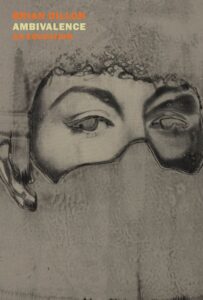
From Ambivalence: An Education by Brian Dillon. Copyright © 2026. Available from New York Review Books.