
This first appeared in Lit Hub’s Craft of Writing newsletter—sign up here.
This summer, an old, failing air conditioner abruptly halted a stretch of seasons in which the house never quite cooled to a satisfying degree and the electric bill kept climbing in surprising increments. The technician broke the news: the system would need to be entirely replaced, the attic re-insulated, and the ducts for an extension that had never been tied into the central cooling would need to be installed. To fit those ducts from the crawl space up to the attic, I found myself hauling coats, boxes, and bags from the hall closet into the guest room and sorting through papers untouched since the pandemic years.
Staring up from beneath layers of overdue invoices and teaching plans, I uncovered the earliest notes for the project that would eventually become my fourth book of poetry. The manuscript, titled Broken Houses, treats the home as both a tangible structure and a symbol—a shelter and a source of unease. Like many families, I carried constant worries about money, fearing that one calamity could extinguish our place in the world. And, as so many Americans know too well, we did lose our house—at least most of its belongings—when a natural disaster of epic scale struck. Writing the collection became a way to reckon with my own ties to home, to money, and to social class, while weaving broader tales of erasure and dispossession.
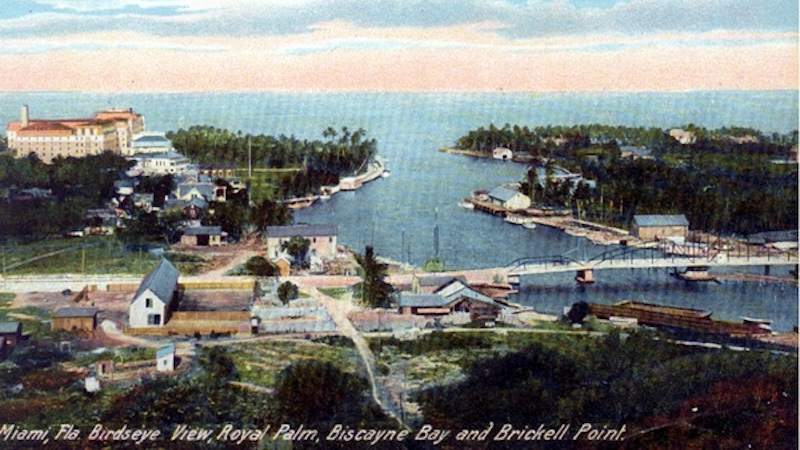
As I turned the pages of early research and notes brimming with potential poem ideas and tentative titles, I was taken aback to discover that the focus was less on houses themselves and more on how my hometown had come to be built. Although the poems that would finally populate Broken Houses mostly unfold in Miami—the city where my father and I grew up—the initial concept revolved squarely around the founding of the city itself. The legal pads and scattered sticky notes dated from around 2019, during a phase when the project carried the tentative title Magic Cities. I had hoped to lean into Miami’s early booster’s nickname and to evoke the magical spaces of childhood, imagining poems that would borrow the rhetoric of historical documents and promotional ads to illuminate the gulf between the city’s poorest residents and its wealthiest. (If that sounds like material one might draft for a tenure file or grant proposal, you’re not wrong; those were indeed ideas stirring my curiosity.)
There was, however, one trouble: the poems wouldn’t cooperate. The more I immersed myself in the writings of Florida naturalist Charles Torrey Simpson or traced the actual filming spots of Miami Vice, the more I delved into the Miami Memoirs of early mayor John Sewell and the promotional pages of the East Coast Homeseeker, a newspaper produced by Henry Flagler’s railroad to spur real estate expansion, the more my notebooks multiplied while finished drafts stubbornly remained thin, if not nonexistent.
Meanwhile, each trip back to South Florida to visit the family brought me to the sites of early settlements, prompting fresh observations and even more lists along the way.
“I’m guided through the hammock on Deering’s estate, and the naturalist describes ‘tourist trees’—the kind whose bark peels like sunburnt visitors—the very script of every South Florida tour,” a notebook page records, “and the group dwindles as the path proves long and the mosquitoes bite, even in January.” Also: “berries that ease constipation, berries that ease diarrhea.”
Elsewhere I write, “I’m trying to imagine what this looked like when my family first arrived here—”
That line becomes the throughline joining the two versions of the project. My family. Both the original plan and the completed book emerged from my later realization that my paternal forebears were among Miami’s earliest settlers. In a city that never stops reinventing itself, I had always felt transient and alien. Discovering that my father’s line lay buried in the historic city cemetery, alongside pioneers whose names later graced schools and parks, puzzled me even more. And discovering that my great-great-grandfather had served as the first streets superintendent and sat on Miami’s 1906 city council, only to see two generations later his descendants living in trailers and involved in bank robberies, left me with a question: what had gone wrong in his family, and could examining the city at large illuminate the answer?
I sometimes tell my students that the poems we fail to finish show us how to complete the ones we do finish.
Reviewing those early notes, I’m embarrassed by how many hours I spent learning about the Florida pineapple industry and the dredge—the topics that appear in the notebooks but never in the book—yet I eventually recognized that the project wasn’t moving forward as I had expected. I worried that centering the narrative on Miami’s settlement risked echoing a white, official chronicle of the city, and I wondered whether, having moved away and lacking prospects to return, I might be overstepping in telling any version of history, whether published or private.
What if I paused to consider those who were left out—the marginalized, the dispossessed—instead of the pioneers and politicians? What if I admitted that the smooth surface of middle-class respectability was a fragile cover, concealing a frightened child inside who feared losing the roof over her head?
Rather than combing public archives, I turned to private ones, beginning with a family history book my grandmother had compiled for her children. It contained many omissions, contradictions, and even outright untruths, especially about her brief first marriage and my father’s placement in foster care. After locating my father in the 1950 Census, I traced the California foster home where he spent years as a child and identified the couple who cared for him. That small discovery gave me an emotional stake in a research path that was far more personal than abstract.
Gradually, the scope broadened to include threats to home—natural disasters, neglect, pests, ghosts—and the potential for upward mobility that real estate had once offered my parents, who used to take me wandering through houses under construction. Broken Houses began to take shape, and with time I managed to push aside the awkward, drawn-out old starts until one night I found myself on the guest room floor, hands sticky with notes and papers, finally organizing them into some sense of order.
I often remind my students that the poems we fail to finish can nonetheless teach us how to reach the endings we do produce. Confronting the gap between the rough sketches and the final product revealed that I sometimes practice what I preach. Looking at those messy, abandoned legal pads, I realized that even while I was chasing notes for a very different manuscript, it ultimately engaged with archives, history, and art in ways not unlike the finished collection—only the archives, histories, and artworks differed, and the end result was different as well. It was as if those notebooks had provided me with a blueprint for the process behind the book, more than a blueprint for its content.
In Didion’s words from On Keeping a Notebook, we are advised to stay on cordial terms with the selves we used to be, whether we find their company pleasant or not. My misstep wasn’t pursuing the misdirections themselves, but treating them as dead ends, tucking the notebooks away when they might have stood as scaffolding for the future structure in front of me.
As fate would have it, our HVAC installer came back the following morning and asked to inspect our pantry, having reconsidered the duct layout. He decided the hall closet was too distant from the ceiling for the new vent, and the plan shifted once more in a way that felt like a small joke from the universe.
____________________________________
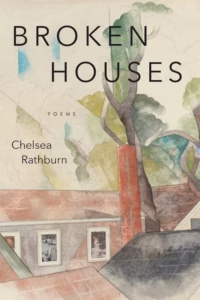
Broken Houses — a poetry collection — is published by Louisiana State University Press.