
The Before
Evie slid onto the slim goose‑feather mattress and prepared to tell her partner that the day had gone well, that the night had been gentle, but Atlas spoke first.
“A man from Monroe wants to buy the chair for his wife. A Christmas gift,” he said.
And the way he leaned in, she could tell he was trying not to wake the baby girl between them. That softness toward him touched her. Considering his mother, his origins, she’d always hoped for those small demonstrations of care from him. She’d never voiced it aloud, but Evie understood that not everyone is meant to be a parent. Her deepest fear was that some part of that truth would reveal itself in the man she loved.
In another life, a life that treated Black people with mercy, Atlas would’ve been a scientist or a king or a master craftsman. He carved all sorts of creatures as gifts for their children. They owned dollhouses and carved bears and little wooden figures. He’d even carved a wooden bust of Evie before the little ones arrived. It was the only portrait he’d ever made, and Evie never allowed any of his works to be sold. She regarded it as the most precious thing she possessed, kept hidden even from him.
Atlas had spent months shaping the chair he now sought to part with. He’d coaxed the thick chestnut oak into a smooth surface and transformed the back into something like a throne. Evie’s favorite detail was the jackal‑headed Egyptian figures carved on the chair’s back. The whole piece was wooden through and through, which would likely be uncomfortable for long sits, but she hoped he would keep it for himself. Or for her. It was meant to be a legacy for their children, a bright thing to counterbalance so much hardship.
He’d finished it on a Saturday several months earlier. When he called her out to the barn and she laid eyes on it, she fell in love with him all over again, right there on the ground. They forgot the children, the horse, the mule, and every other responsibility that could interrupt them; he had pulled her into him with a hunger she hadn’t felt in a long time.
After they’d worn themselves out, she rested her head on his chest. “I’ve been thinking of Beulah lately. I wish I could’ve given her something like this chair,” he said. A murky taste rose in Evie’s throat, and a chill went through her as his touch stiffened.
Atlas’s mother had been a presence in their life, even if they seldom spoke of her. Evie found it odd that he’d chosen that moment to bring her name up, when their bodies still trembled from their closeness. The mood was raw, and there he was, half‑naked, while she felt the weight of Beulah’s memory pressing down on them. Beulah Gardner—an open book, a woman with no secrets, a woman who seemed to have no shame or sense enough to shelter her own recklessness. Evie recalled the lovemaking when he mentioned selling the chair and thought of Beulah Gardner, and she whispered over their child’s head, “The man knows the worth of that chair, the kind of thing that’s hard to come by. I hope he’ll part with at least three dollars for it.”
Atlas sighed. “More than likely, the man will give me whatever he wants me to take.”
She pressed her lips together, placed a hand on the baby’s back, and watched as the child stirred. The little hand brushed her father’s cheek. Then the child whimpered, waking from sleep. “No,” she croaked in a rasping voice. “Pa, no go. Him burn.”
Evie sensed Atlas’s side of the bed go still, as if a chill had swept through the room, freezing his breath and every other feeling. She could hear nothing except the beating of her own heart. A warmth then heat spread through her as if words themselves had lit a flame. She touched her neck in instinct, almost ready to claw at herself, until the night’s sounds—the crickets, cicadas, and crows—filled her ears. The baby’s words lingered for what felt like hours before Evie could take a breath, and she stifled her daughter’s voice too late and too softly.
“What did that baby say?” Atlas asked, inching away from the infant. “What did she say?” Evie could hear how unsettled the tremor in his voice sounded.
And there it was. She recognized the change in him—the thing that lived inside him. A baby that young shouldn’t be uttering words at all. Yes, that was disquieting. She watched the distance grow between him and the child. That baby is your daughter. Our little girl, she wanted to tell him.
Evie knew what they said about his mother. She’d seen how he interacted with the other children; she’d kept a careful watch to see if he could ever hurt them. With Nannie, she had lowered her guard. He’d been a good father to the others—attentive, educated in a way Beulah had never been. He was almost a genius, reading aloud to them every night. He dreamt of schools far beyond the cotton fields for his children. He wasn’t the type for superstition or tall tales. Atlas was a good man, nothing like the man who had forged him.
Yet as the silence stretched over them, Evie sensed a strange strain in him for the first time.
Eventually, the tension dissolved a fraction, and he settled in, allowing Nannie to climb onto his chest as he hummed a lullaby until her soft whimpers faded into sleep. Evie lay awake the rest of the night, replaying the child’s words in her head: Pa, no go. Him burn. She watched over her baby, praying Beulah’s presence wouldn’t intrude on their home. As morning neared, it became clear that this was not a typical trouble. Beulah had killed her child for a different reason. Her child hadn’t witnessed Beulah’s death. Beulah had touched him and seen his fate.
To Evie, the timing seemed almost fitting—an echo of the life Atlas’s mother had faced in the Louisiana State Penitentiary. Beulah had drowned her own baby not long after giving birth to him. It wasn’t right that Beulah had ever been released. She’d served only a few years before being freed for saving two white children from drowning in a pond on prison grounds. Afterward, she was ostracized by her own community and spent the rest of her life hidden in a shack in the woods. Everyone knew the story. They knew Beulah’s mind had come loose. Her surviving children were raised by relatives and others in the community. People visited, but Beulah’s life never truly belonged to any of them again.
The After
Three days had passed since Evie had last laid eyes on Atlas. She had slept little, eaten even less, and hardly done anything beyond tending to the children. His absence was unlike him. Atlas was a husband who came home every day. He didn’t drink and rarely laid a hand on her beyond what was proper.
He’d told Evie he was headed to Monroe, not far away on foot. Perhaps he intended to speak with a sibling or another relative. She didn’t want to admit the thought, but the only place he’d gone could be something she didn’t want to face—the place where the image of that other woman and their child lived. She would never be free of them—the two of them would always haunt her.
On the third day, she sat on the porch shelling peas, numb. She’d been slow to begin that morning. Two’s foot had needed bandaging after he stepped on a rusty nail that pierced from sole to top. The boy was the eldest, the strongest, and the de facto leader of all the children when Atlas wasn’t around. He guided them down the steps and toward the cotton, like a mother duck leading her little ones to the pond. She walked the house with sage and pulled the bust from beneath the floorboards, placing her hands on it and praying for Atlas’s return. When Atlas’s brother Exie Gray arrived—his face pale and strained—Evie had only filled a small portion of the bucket. “You’ve got to come with me, Evie,” Exie said, “Celestine says they’ve got Atlas.” And for a moment, she stood there with a pea pod pressed between her fingers. “Huh?” she finally managed. “Who’ve you got? What do you mean?” The words tasted familiar, as if she’d heard them before. They had. They’d been spoken in the past about others in their family. Surely this couldn’t be about Atlas, not now, not in 1936.
She tilted her head and let her gaze travel toward the cotton fields that stretched to the horizon. Sometimes the children played a game where one child was blindfolded and spun; once the blinds came off, he would try to identify the grand house in the distance. It always looked out of reach, towering above their single‑room shack. The land offered no end to the space between them. She exhaled, then glanced behind her. Nannie had risen from the pea shells and was standing right behind her. The shells kept the little one busy as her mother worked. Evie often listened as the child counted and spoke in phrases far beyond her years, never having been taught to count, never speaking full sentences until just before their third birthdays.
Her eyes widened when she finally saw the child and pulled her close, strapping her to Evie’s back before they began the trek toward Monroe. They walked for a little over an hour before reaching the edge of a crowd. Exie Gray turned to Evie and whispered, “Let’s steer clear of the commotion, Evie. We don’t want to…” His sentence trailed off.
They stood just outside a throng of about a hundred whites—men, women, a few children. Nearby Black people stood with Exie Gray and Evie, a cautious distance from the men who had triggered the uproar. The hanged man occupied the center, bloodied and motionless, smeared with heat and ash. It finally hit Evie that he was already dead, a detail she hadn’t allowed herself to see before. She stood there, not crying, reserving her tears for later as she memorized the scene before turning away and scanning for Exie Gray, who was keeping Nannie’s hand a few steps away. Nannie’s gaze followed her mother’s turning away, her lips moving but no tears forming. Evie faced the hanging man again, resting a hand on her undeniable baby bump and thinking of Atlas—her Atlas—as if he were delivering a sermon or fashioning furniture in the barn. She stood as if watching him burn were a daily ritual. A familiar, sickly habit she had learned to endure.
At the corners of her mouth, a smile quivered—what she would do to keep from laughing at a joke Atlas might have told. Such a fragrance of desire and decay filled her nostrils: the charcoal of his hair, the metallic stench of his blood, the rottenness of his organs that would haunt her every time the scent of roasting meat crossed her nose. She would remember the way his flesh flaked away in charred pieces while white folks cheered and a few Black bystanders swayed in sorrow.
“Atlas. Atlas,” she whispered, inhaling every inch of him still within reach.
Eventually her eyes closed, and she recalled the life they’d built together—the shack they crowded into, the way Mr. Bolden smiled on Atlas and vouched for him in front of white people, calling him a “good boy.” She remembered how sharp his mind was, how often Mr. Bolden asked for his help with his books, how the former asked aloud how Atlas had learned so much. She thought of the book he read to them at night—The Three Musketeers. It was his favorite, so much so that he gave their second child the name D’Artagnan.
They had laughed about it, because Evie believed D’Artagnan was a fool. She preferred Aramis, who she believed would make the best choice in the end. Yet Atlas explained D’Artagnan’s passion and compared it to the world he hoped to build for her and their children, and she embraced the name he chose.
And she had almost forgotten that Nannie was there when the child slipped her tiny hand into Evie’s free one and whispered, “Pa. Him burn.” The little girl began to cry, reminding Evie in a way no mother wants to be reminded of her child’s words—the words that had haunted them three nights earlier. She knelt before the child, still holding her hand, and asked in a constricted voice, “Did you do this, child? What did you say?”
She could feel tears gathering, a desire to shake the life from her child, to do what Beulah had done.
“How did you know?” she managed to ask. “What curse ran from your lips?”
“Pa. Him burn,” the little girl whined again. Evie stood up, still staring at the child, who seemed no longer wholly a child but something else—an entity not of her world, something cruel and unsympathetic. She released the girl’s hand and never touched her again.
__________________________________
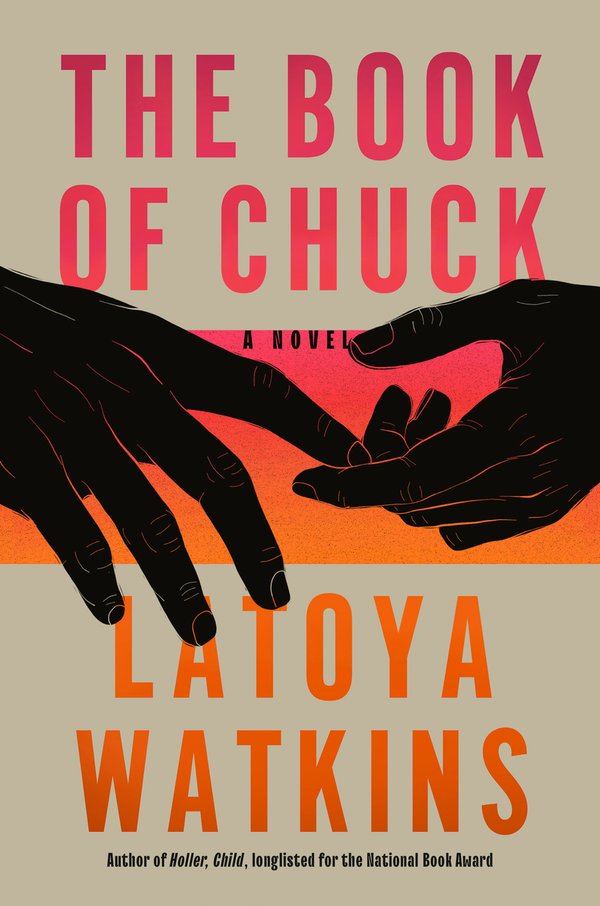
From The Book of Chuck by LaToya Watkins, published on August 18, 2026 by Tiny Reparations Books, an imprint of Penguin Publishing Group, a division of Penguin Random House LLC. Copyright © 2026 by LaToya Watkins