
In Edgar Allan Poe’s 1840 short story “The Man of the Crowd,” an unnamed narrator sits in a café and watches a busy street. He notes small details about the people passing by, and he categorizes them. The men are clerks and other professionals, but also beggars, gamblers, swindlers. Next come the women: hard-working shopgirls, prostitutes, beauties, “paint-begrimed beldames.”
Rereading the story recently through a modern lens, I realized someone was missing from this parade.
Poe’s story is a pioneering text on the nature of urban life, and it features an early version of the flâneur, the modern city’s wanderer. By definition, a flâneur is someone who strolls semi-aimlessly through the streets, observing and cataloguing human life. He (it was usually he, at least at first) feels a thrill at blending anonymously into the crowd, both part of it and detached from it.
“To see the world, to be at the centre of the world, and yet to remain hidden from the world…a prince who everywhere rejoices in his incognito,” was how Baudelaire put it. For Walter Benjamin: “the street becomes a dwelling for the flâneur; he is as much at home among the facades of houses as a citizen is in his four walls.”
Motherhood is fragmentation of the mind, and everything looks impressionistic on three hours sleep.
There have been female flâneurs too. George Sand in nineteenth-century Paris, Virginia Woolf in twentieth-century London, Vivian Gornick in twenty-first-century New York. The appropriately named Janet Flanner fits the mould. So does Martha Gellhorn, street-reporting the Spanish Civil War from Madrid. Valeria Luiselli flâneurs and also cycles in modern Mexico City.
But still, I thought, someone is missing from this lineup.
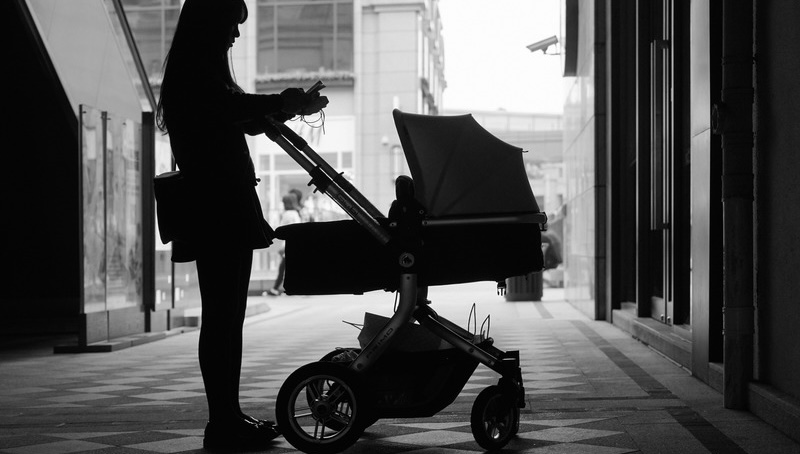
There is another woman who is often found moving through the city, semi-anonymous, strolling. Indeed, stroll she must, for she is pushing a stroller. She is the mother of a young child.
There aren’t a lot of mother-flâneurs in literature, but there are a great many in real life. A mother, especially in urban environments, can pound the pavement for many hours a day. She’s at home on the streets, as Benjamin suggests, if only because sometimes she can’t go home: perhaps she lives in a fourth-floor walk-up and the baby is finally sleeping; or anyway, if she goes home, she might end up stuck there all day.
She observes the world around her, but she participates much less than before. Like the original flâneurs, she is a little bit invisible, or she has bouts of invisibility. While a woman walking alone often feels men watching her, this is less true of a new mother. After the hyper-visibility of pregnancy comes the invisibility of being a woman with a stroller. But she observes those around her. The cafés, the crowd…she knows them all, at least until darkness falls.
Virginia Woolf presented city walking as an adventure. In contrast with the solitude and silence of the home, to walk the streets is to be “part of that vast republican army of anonymous trampers.” George Sand clearly felt this too: she bought hobnail boots and wore men’s clothes so as to possess the streets with the anonymity and speed of a male flâneur.
For the mother-flâneur, the city as adventure might be less obvious. Depending how long she has been a mother, her room and solitude might sound like the real adventure. Walking the streets is instead a necessity; the ever-changing noise and stimulation will bludgeon the baby to sleep. And that will buy her a moment of calm and freedom, a brief return to her pre-baby state.
Meanwhile, she is aimless. What to do, with all these hours? Walk, and see how the city has changed with her new perspective. She may know this city well, but it is being remapped. She is a new person, with restrictions and special mobility requirements and a whole new appreciation of acoustics. She has strange new rituals, strange new humiliations. Going to the bathroom is now a predicament: if she is wearing the baby in a sling, there are wardrobe considerations, if pushing a stroller, it may not fit in the bathroom at all. Does she bring the baby and lie it on the floor, or leave it outside and sprint about her business? There are mobility issues. Does the subway station have an elevator? Is it working? Can she bring her stroller on the bus, or must she fold it, one-handed with the infant gripped clumsily under her other elbow?
The nature of the crowd has changed too. The mother is now semi-invisible, but the baby is not. The crowd goes about its business as always, but sometimes people detach, come to greet the baby, to touch its cheeks, to tell the mother she hasn’t put enough clothes on it, or has put too many. Some people may ask to hold the baby. Some people may just try to pick it up without asking. The crowd can feel a little dangerous but then sometimes it will give moments of sweetness, or connection. Someone will entertain the baby on the bus by making funny faces, buying the mother flâneur a few moments of calm.
The baby is the purest flâneur, with its endless leisure and stroller-eye view. It witnesses and catalogues the street, and all it sees is new.
When that happens, she might lean her forehead against the window and watch the city flicker by in impressionistic bursts. Motherhood is fragmentation of the mind, and everything looks impressionistic on three hours sleep. People go by; much of the world is at work, but there are students, the unemployed, someone drunk in a park.
The mother is an imperfect flâneur, pushing her stroller to nowhere-in-particular. She watches and categorizes, but with divided attention. Is that curb too high to bump the stroller off? Bang. “Upsa daisy,” she says, as the baby scowls blackly. “On we go.” In the distraction, her observation is lost. The flâneur is lost. The pair continue wandering. She wonders when the baby will just go to sleep already, so she can sit down somewhere. But now the baby is interested in its surroundings, and it is watching too.
There is another flâneur in all of this, even more neglected by literature than the mother-flâneur. There is the baby.
We don’t remember what the world looked like when we were babies and still constructing reality with every new outing. Few writers try to imagine it either. In her novel The Long Form, Kate Briggs does speculate: a baby startles awake in a supermarket, bundled in a sling. Her eyes take in “the stark white lights…appearing, disappearing, overhead,” and later the street, a pub, gardens, rain—all while sucking a corner of the sling.
The baby is the purest flâneur, with its endless leisure and stroller-eye view. It witnesses and catalogues the street, and all it sees is new. The pattern of leaves against the sky, the candy wrapper blowing down the road, the woman running for the bus, the crowd jostling, the older child having a meltdown. And umbrellas opening, and doors smacking closed, and the wind picking up, and working people pouring out of subway entrances, and the quick glance of its own mother in a café, taking a mouthful of hot coffee and watching the city.
______________________________
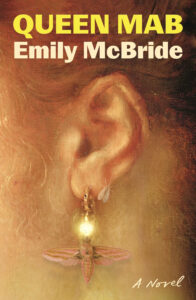
Queen Mab by Emily McBride is available from Farrar, Straus and Giroux, an imprint of Macmillan.