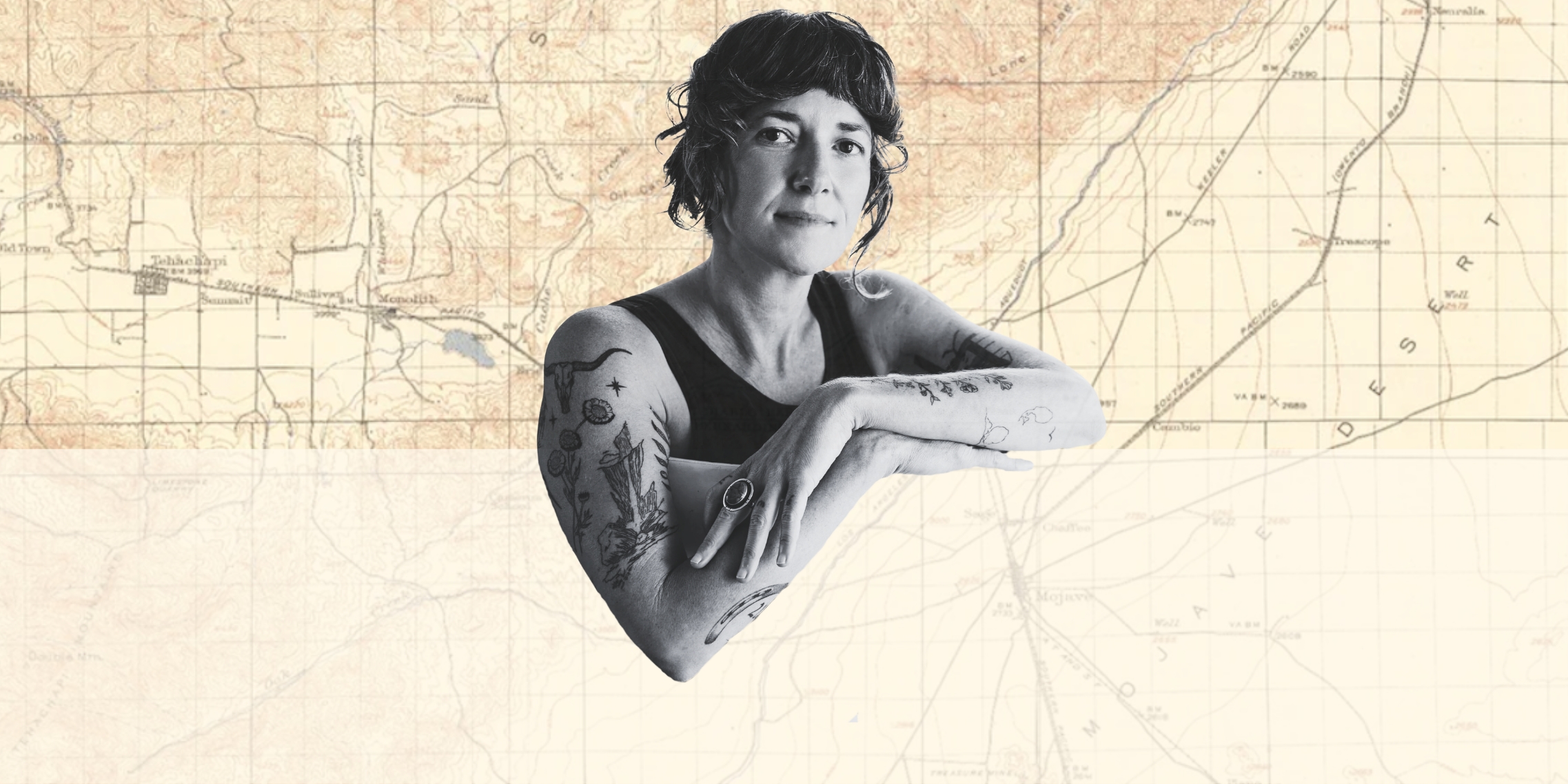
The Mojave Desert runs in Claire Vaye Watkins’s blood. She was born in Bishop, a four-hour journey from Tecopa—the Death Valley town where her parents lived, a place without a hospital—raised in Tecopa and just across the border in Pahrump, Nevada. While discussing her Mojave upbringing, she told John Freeman for Alta’s California book club that the landscape’s reality is “your reality is ‘draining lakes and bombing places…making them toxic for effectively ever.’”
The Mojave casts a long shadow over the stories gathered in Battleborn, her debut collection. Its launch in May 2012 took place in New York City, at the home of her agent Nicole Aragi and Granta editor John Freeman, during a desert-themed soirée co-sponsored by Riverhead Books, Granta, the Paris Review, and One Story. The fête featured cacti, geodes, and cocktails named after the opening story, “Ghosts, Cowboys”—The Ghost, a smoky absinthe-infused revenant made with dry ice, and The Cowboy, a tequila–grapefruit concoction.
The volume quickly established Watkins on the literary map, earning the Story Prize (I was one of the judges), the New York Public Library Young Lions Fiction Award, the Rosenthal Family Foundation Award from the American Academy of Arts and Letters, along with a Guggenheim fellowship and a place on the National Book Foundation’s “5 Under 35” list for 2012. I selected Battleborn as one of NPR’s top five story collections of the year.
Her first novel, Gold Fame Citrus, also unfolds within her desert homeland (though in that book much of the Mojave is buried beneath a colossal dune), and so does her other novel, I Love You but I’ve Chosen Darkness, in which a new mother grapples with postpartum depression and seeks solace in the desert.
“The place is my muse,” Watkins concedes. “I’ve returned since moving away at eighteen, and I now have a little trailer in my hometown. I’m fortunate to work nearby at UC Irvine and to drop by the desert when I’m not teaching. I used to feel more romantic about it, more nostalgic, driven by grief and longing. Returning as an adult, I’m gaining a sharper, more nuanced sense of the place as it is today. I feel closer to seeing it as it truly is. I’m mellowing out, letting the land reveal itself to me.”
The Mojave seeps into the marrow of her new novel Yellow Pine, whose protagonist Rose returns to the desert she knows intimately, rekindles a former affection, and aligns with a group of activists resisting the encroachment of a corporate data center. “Yellow Pine is home to about 90,000 old-growth yuccas and, until recently, 139 adult desert tortoises,” Watkins notes in an essay for The Believer. “It’s an undulating creosote sea that I credit for making the air I breathed throughout my girlhood… from Yellow Pine one looks up to Mount Charleston, the highest peak in the Spring Mountains and a key site in the Salt Songs, the ceremonial creation myth song cycle of the Nuwu.”
*
Jane Ciabattari: The opening lines to Yellow Pine—“Miles came back to Rose transformed. I mean transformed! Not a cell of him was where she left it”—set up an intimate love story with beginnings and endings not only in the past but in the weeks to come. (I do wonder who the first-person I is?) What inspires you to write about returning to love, trying again—such a vulnerable pursuit?
Claire Vaye Watkins: That first-person I voice is a mystery, isn’t it? Maybe that is the mystery. It shows up again in one or two other places, depending on how you count. I’m reminded of Flannery O’Connor’s remark: “Fiction is the concrete expression of mystery—mystery that is lived.”
In my fiction I try to say (as beautifully as I can) what I see. I try to see the land as it sees me. Maybe I write to show myself what I believe in.
The vulnerability involved in a reunion drew me to that plotline for sure, especially the courage it takes to attempt anything again. Partly this came from my relationship with the form, from facing the daunting prospect of writing a novel again after the years-long Herculean task of completing the last one. And because I’d moved back to the desert and spent a lot of time watching the sky, I became obsessed with return, circularity, and the recursive. I kept noticing loops everywhere, pondering to what extent we ever truly do anything “again.” And I observed that reuniting lovers unsettled people, which drew me in. Because retreat and return is a natural pattern. Relationships ebb and flow—if they’re alive (and the good ones are) they undulate. Not just between lovers but among parents and children, friends, neighbors, one’s relationship with herself and beyond. This isn’t to claim I’ve mastered riding these waves! Mostly I was riffing on a moment in a Joy Williams essay from her collection Ill Nature, which my main character Rose carries like a talisman: “Time is repetition, a circle. This is obvious. Day and night, the seasons tell us this. Even so, we don’t believe it.”
JC: Rose, a fundraiser for the Sierra Club, is turning forty. She takes leave and relocates to Nothingness Flats, “a cinder-block cabin on five acres of treeless desert in Tecopa, a defiantly unproductive jackrabbit homestead.” “Thoreau in the Mojave,” as Miles puts it. She returns to her desert home, only forty miles from where she grew up, as well as to Miles. How essential are these returns, these rediscoveries, to her midlife awakening?
CVW: This book is about disillusionment and re-enchantment. Re-enchantment demands a fresh way of seeing. Rose is a helper, an idealist desperate for a better world, which for her means decarbonizing the economy by building a fairer society in the process. Of course, that’s not happening. She’s deeply frustrated by decades of denial and delay, increasingly weary of our damaged social order, and driven to push for a different future. The stupidity and greed of the status quo threatens to push her over the edge. What keeps her together is her rootedness—what Wallace Stegner described as being “a placed and not a displaced person.” She remains in her home, surrounded by neighbors and friends she loves, aware of the place’s history and culture, open to the various thinkers and seers there, including people from her past, including the dead. The returns deepen. They provide ballast for facing the present moment here and now.
JC: What prompted you to center this new novel, indeed name it after Yellow Pine, a site you describe as “a construct,” “an invented place, invented to be owned,” a “new name given by NextEra Energy—a Florida energy conglomerate valued at $175 billion—to a five-thousand-acres trapezoid of formerly public land”? Does this development exist in reality?
CVW: Yes, Yellow Pine is an actual for-profit industrial solar installation near my home. I began visiting the site during the pandemic, before construction began. Watching Yellow Pine rise struck me as the perfect setting for a cautionary parable about how ridiculous it is to entrust capitalism with the energy transition. The aim of an investor-owned utility (like NextEra, the company behind Yellow Pine) is profit. The aim of transitioning to renewable energy should be preserving life on Earth. Returning to Flannery’s idea of fiction as the concrete expression of mystery, Yellow Pine offered a concrete stage from which we could watch these incompatible aims pull apart, and observe how people live with the mystery of what that does to their psyches and spirits when they’re asked to make profound sacrifices for a seemingly foolish reason. How does one persevere in the face of that? I also simply wanted to witness the place before it disappeared, and for me, writing is how I see most clearly.
JC: What were the local names for this place in earlier eras?
CVW: Yellow Pine sits in the South Pahrump Valley, within Newe Segobia, the unceded territory of the Western Shoshone Nation, which holds rights to the land under the Ruby Valley Treaty. “Pahrump” in Southern Paiute means water from the rock, a nod to its location along the Amargosa River, which runs underground for much of its length and emerges via springs here and there. (Alas, the spring near Yellow Pine has dried up due to groundwater depletion, along with other springs along the Amargosa.) The area matters to many tribes, including the Timbisha Shoshone and the Pahrump band of the Southern Paiute. It lies on the Salt Songs Trail, a mythic ceremonial song cycle and oral map of the region performed by the Chemehuevi. It sits along the Old Spanish Trail, a 1600s route used by Spanish colonizers from New Mexico to the California coast. There was a period when it was the southern frontier of Deseret (the Mormon nation). Eventually the land became Clark County, Nevada. Most of the time it was an unnamed expanse of yucca and creosote, home to desert tortoises, kit foxes, and countless other creatures since at least the last Ice Age.
JC: The construction of data centers in relatively remote locales has become a global trend in the twenty-first century. How widespread is this development in the Mojave?
CVW: Leading ecologists and watchdogs—figures like Patrick Donnelly, the Great Basin Director at the Center for Biological Diversity, and Basin and Range Watch—describe the ongoing industrialization in the inner Great Basin as a literal bloodbath. The whole region is being transformed from a landscape that was once wild, healthy, biodiverse, and relatively intact into a sacrifice zone for the energy sector. Yellow Pine, vast as it is, represents just a single cell in a sprawling mosaic of planned or underway industrial arrays on public land across the area. Proponents of these mega-projects, such as Nevada’s Green Link, are often evasive about where the electricity will flow. It’s unlikely to benefit the nearby communities most affected by changes; the implication is that much of the power will feed data centers instead.
So the project isn’t meeting ordinary people’s need for renewable power, but rather fueling AI and other tech pursuits that many see as unnecessary or harmful. Taken as a whole, the social and environmental toll is, in my view, even more damaging than many who oppose data centers realize—an indictment, really. In the Mojave and the Great Basin, it’s not only solar power that is at stake: geothermal energy, mining, and unsustainable farming are also harming this region. Some of the continent’s last intact habitats, home to endangered and endemic species, are being sacrificed, and all under the influence of Silicon Valley money and Wall Street.
JC: How long have you tracked the green-energy rush across the Mojave? What has changed, and how successful have residents been in resisting it?
CVW: I’ve followed waves of exploitation my entire life, but I began paying particular attention to the “green energy gold rush” around 2016. Observing Yellow Pine up close throughout the process drew me deeper into the issue. Partly this is personal—the array lies in the valley where I grew up—but more it’s because the demonstrations there were among the most surprising I’ve attended. The assembly included people from across the political spectrum, including many who otherwise avoided politics. The rhetoric was direct, clear, and persuasive. When I spoke with ordinary people about the issue, they showed a striking willingness to distinguish between privately owned industrial solar in wilderness versus distributed solar in already-impaired built environments. The idea is common sense—people want rooftop panels, shade in parking lots, a more resilient local grid. They see free renewable energy as a basic human right. Those I spoke with about Yellow Pine weren’t as entrenched or defensive as many of us on other issues, and our views probably diverged on many points.
At the risk of sounding sentimental, I believe one reason I’m here is to help people transform that fear of the desert into a more loving approach.
There have been meaningful wins: a solar moratorium in Nye County and a temporary withdrawal of minerals to block lithium mining within the Amargosa River watershed. There’s rising support for a proposed Amargosa Basin National Monument. A notable Harper’s piece on Green Link in Beatty highlighted the issue. Over time I’ve noticed environmental writers becoming sharper and more selective about solar. Most immediately, activists succeeded in scaling back Yellow Pine’s footprint and demanded vegetation management in certain zones instead of total removal. This saved a substantial amount of clean air and water, and a Joshua Tree forest within the array’s original footprint, among other living things. Wins exist, but they’re temporary, and the adversary’s gains tend to be long-lasting. Realistically, without substantial systemic reform, these corporations will continue to press forward with relatively little restraint.
JC: Is Fran, the fictional ecofeminist Whitmanic poetess of equine bearing on hiatus from her UNLV PhD, who has been living at Yellow Pine since the array’s initial approval, based on a real person?
CVW: Fran draws partly on Shannon Salter, a poet who spent considerable time living at Yellow Pine, observing, hosting gatherings, and recording what she witnessed. There’s also a touch of Laura Cunningham (from Basin and Range Watch), plus Amy Noel, and of course the Dann Sisters.
JC: You write with affectionate detail about the natural world—the ancient, tenacious yucca colonies gleaming with an almost supernatural endurance, the creosote rings that glow, the Joshua trees, and the hundreds of endangered tortoises inhabiting Yellow Pine. Nature in the Mojave is as rich as anywhere, yet many label it as barren or wasteland. How does your portrayal of this landscape function—perhaps as a preservation of memory or a safeguard for it?
CVW: I’m grateful you call it loving. I aim for that quality. It’s my way of saying thank you. I see this land being eroded away for no good reason, and most people haven’t bothered to notice. It reminds me of Flannery O’Connor’s remark that “there is a fine grain of stupidity required in the fiction writer.” Fiction, properly done, is not passive. “It is popular to believe that in order to see clearly one must believe nothing,” Flannery writes. “This may work well enough if you are observing cells under a microscope. It will not work if you are writing fiction. For the fiction writer, to believe nothing is to see nothing.” In my fiction I strive to articulate what I perceive. I aim to see the land as it sees me. Perhaps I write to illuminate what I believe in.
JC: You describe the Mojave as no novice’s wilderness, noting it was “the sage’s country, rewarding study and slowness, humility and mystery. The Mojave favored a mystic bent…” How did you craft the stages of desert wisdom that Rose begins to explore, and that Miles starts to sense? (From fear to the Hills Have Eyes phase, to a broadening—Rose learning to hear an inner voice, the horizon’s calm, clear signal.)
CVW: I’ve developed this framework more as a running joke over many years, having hosted visitors in the desert and watched its effects. I likely started it in the rock shop and museum my mother ran, where part of her job was to translate Death Valley for visitors so they could experience grandeur without, you know, dying. Fear is a prudent impulse in the desert. It’s also the impulse the capitalist uses to frame the desert as barren, dead, and therefore exploitable. That mindset underpins extraction and warfare—the Mojave’s landscape is pocked with military installations—the desecration at Yellow Pine continues the legacy of Nevada Test Site, Creech, and more.
Most people arrive in fear, and as Dune urged, let that fear ride over them and through them. That is when transformation begins. Minds shift, life returns to the sense that a place once feared still holds vitality. Observing that evolution has tempered my own misanthropy. And, to borrow a sentiment that might sound corny, I believe part of my purpose here is to help people turn fear of the desert into something gentler and more loving.
JC: A recurring thread in your recent novels is ambivalence toward motherhood. What sparked your interest in portraying a woman who longs for a second child and undertakes a determined quest to become pregnant—first with Miles, her former partner, then through a “Swirl,” with several men she knows?
CVW: In short, I thought it would be arousing. Writing a novel demands a surge of intense emotion, and few states are as forceful as the desire to have a child. Rose isn’t ambiguous about motherhood; she’s utterly consumed by it. Yet it isn’t something she can will into existence. Bill McKibben has described decarbonization as a “timed test.” The same goes for trying to conceive in midlife. The pressure, the ticking clock, the reminder month after month that Miles and Rose must figure out how to be—and how to be together—within time constraints—these elements fuel the drama. Against the death-drive logic of perpetual growth they oppose, Rose and Miles know they face real limits. They are alive, under the influence of the unknown. Living with that is hard, perhaps, but also a joy to write about.
JC: Your prose continually engages with writers who have shaped this West—Didion, Abbey, Mary Austin (the “Whitman of the West”), Lydia Davis, Melville. Which other authors influence this project?
CVW: While composing this book I became intrigued by the Buddhist/Taoist notion of interdependence, echoed in Corbin Harney’s speeches, the late Western Shoshone spiritual leader who helped catalyze a global peace movement that halted nuclear testing not only at the Nevada Test Site but around the world. It’s tempting to embrace a simple harmony of connection, yet the truth is knotty—especially in a society as troubled as ours. Rose’s temptation is to retreat, to become a hermit who believes herself an independent force, a notion I find misguided. I wanted her to confront interdependence and to wrestle with its complexities.
So she travels through books, attempting, with varying luck, to use them to connect others. I especially enjoyed crafting a long, playful scene where she pedals around town with a backpack full of preferred nature volumes, preaching to everyone she meets. She is right in her judgments, but also earnest to a fault and occasionally pretentious. Yet without books and art, a character like Rose might well go mad. She is a loner, yet can be drawn into community through figures such as Kim Stringfellow, Sallies Zanjani and Denton, eco-socialists like Ben Ehrenreich and Ashley Dawson, musicians like John Craigie and Lucinda Williams, a constellation of religious and nature-writing voices, and the anonymous twelve-step literature that has helped countless lives.
JC: What projects are you pursuing now or next?
CVW: I’m juggling a couple of new book projects while also working on a documentary. It’s something of a travelogue through the same lifeways along the Amargosa River—intended as a kind of portrait of the land and its people, a tour of the remarkable and strange ways of living here. The film—titled Lorehole—is being shot entirely on film to emphasize our Luddite sympathies. It’s another return, another re-encounter with the same terrain, aiming to reveal what’s at stake and to invite people to look longer at where profiteers would rather we avert our gaze.
____________________________
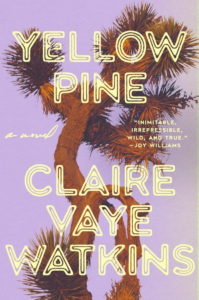
Yellow Pine by Claire Vaye Watkins is available from Riverhead Books, an imprint of Penguin Publishing Group, a division of Penguin Random House, LLC.