
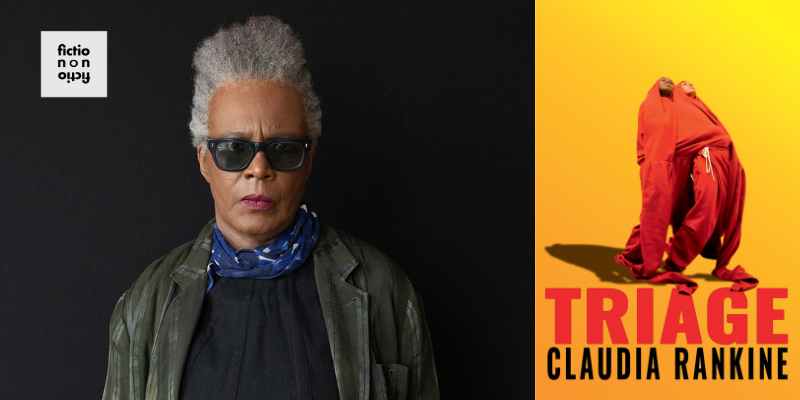
Poet, essayist, and playwright Claudia Rankine joins co-hosts Christian Barter, Jennifer Maritza McCauley and Whitney Terrell to talk about her new book Triage. Rankine outlines the decades-long relationship between the book’s narrator and a character she names “the theorist,” who, as college students, develop the habit of collapsing whenever they greet each other. She talks about how each character interprets collapse differently, the theorist prescribing action while the narrator fights for her “silences, routines, and quietude.” Rankine discusses how their “conversation” echoes Antigone and is rooted in our current reactions to the war in Gaza and the second Trump Administration. She reflects on the role that visual imagery has in her work and reads from Triage.
To hear the full episode, subscribe through iTunes, Google Play, Stitcher, Spotify, or your favorite podcast app (include the forward slashes when searching). You can also listen by streaming from the player below. Check out video versions of our interviews on the Fiction/Non/Fiction Instagram account, the Fiction/Non/Fiction YouTube Channel, and our show website: https://www.fnfpodcast.net/This podcast is produced by Christian Barter, Jennifer Maritza McCauley, and Whitney Terrell.
Claudia Rankine
Triage • Don’t Let Me Be Lonely: An American Lyric • Citizen: An American Lyric • Just Us: An American Conversation
Others
Antigone | Sophocles • Fiction/Non/Fiction Season 8, Episode 51: Omar El Akkad on Gaza and Western Empire • Julia (1977) dir. Fred Zinnemann
EXCERPT FROM A DISCUSSION WITH CLAUDIA RANKINE
Whitney Terrell: Speaking of Antigone, there’s a moment later in the book when the narrator goes to the bathroom, pulls Antigone from her book basket beside the toilet, and reads it. That reading motivates her to write a letter to the theorist, and that letter references several policies of the second Trump term.
She’s echoing what they imagine the government is doing, right? Opposing trans people. Opposing choice. Opposing refugees. Opposing work. Opposing FEMA. Opposing U.S. and USAID. Opposing free speech. And in response to these policies, the narrator returns to Antigone, which she had just reread, and says, “Shouldn’t our response at least echo what’s already been said? Be whatever you want, and I will bury you. It seems fair to me to die doing it.” Could you unpack that passage for us and discuss how it ties to the dialectic between the narrator and the theorist that you described?
Claudia Rankine: I teach at NYU, and I’m struck by the students’ willingness to take every risk in service of Gaza and related causes. Then there’s Minnesota, where people have shown up, risking their lives and sometimes losing them. I truly feel that this moment is asking of us: are you ready to risk everything for anyone?
I felt that the rise referenced in that passage signals the necessity of showing up, of demonstration, of making one’s presence felt, which is a bit ironic because the narrator is the one who doesn’t actually do it but expects it of the theorist. And to see the theorist reach a point where the overwhelm of the present makes them want to collapse rather than rise up ends up frustrating the narrator and triggering anger.
Christian Barter: In the trilogy, which covers your earlier books, it seems the reader is always conscious of how powerfully language works. I think of how in Don’t Let Me Be Lonely, there are constant references to the language used by drug companies and to the language on television, in the speech on the news after 9/11, and by politicians. Much of this is wielded by shadowy forces—corporations, politicians, and rigid normative pressures—but it is also used by writers, artists, and a figure in Citizen, such as Serena Williams, who challenges the umpires. Or, in Just Us, the narrator prompts people to engage in difficult conversations about race.
And in Triage, the theorist argues that language alone isn’t enough. Do you see this book as an extension of the language-work you explored in those earlier titles, or as a dialogue with them? Does it mark a reversal or a rethinking of what you pursued there?
CR: I don’t view it as a reversal because the process of Triage is the conversation. The American trilogy really asked whether people can actually perceive the person before them, speak to them, talk with them, and explain their feelings with a bit of empathy or history guiding their actions.
Here, it’s almost as if Triage takes the counsel of those books and puts it into practice as conversation. The work is structured as four conversations: the lecture, and then three meetings by the end in which they present their positions and attempt to reconnect as friends. I wanted the book not to be a manual but a performance.
The other dynamic at play now is that within families and circles of friends, people have reached a stalemate. They refuse to converse with others who hold different views, perceiving that unwillingness to engage as a kind of action. They can’t enact an action that directly addresses the dead, yet they can choose not to engage those who grasp the severity of the moment. So I wanted to propose examining what it means to simply keep the conversation going.
WT: That’s exactly what I was thinking. As a novelist, I remind myself I don’t need to agree with my characters, nor do I need to resolve their rifts. I just need to allow them to debate, which is the sense in which your book felt designed. Did your own thinking shift as you let these figures argue?
CR: Yes, it did. I even drafted an alternative ending and sent it to my editor as if the book were finished; they loved it, and we were ready. Then I told them, “That ending isn’t right,” and they asked, “Why not? It seems perfect.” So I rewrote the ending and sent it again. At first they resisted, then they accepted, saying, “Okay, we see what you’re doing.”
WT: Could you share what the ending you abandoned looked like or what changes you made?
CR: The original ending aligned more with Antigone, culminating in the theorist’s death as if choosing sacrifice for a cause. I’m reminded of the film Julia, where Vanessa Redgrave plays the Antigone figure and Jane Fonda the Ismene; that film ends with a decisive act. Watching it again, I felt that outcome was too neat for our moment. We live in a time when global currents press in on everyone, as nations shift to the right, as border regimes tighten, as deportations continue. There’s nowhere untouched—whether in Morocco, South Africa, or Europe—and climate change across Asia, with the United States moving at full speed, permeates every layer of life.
Jennifer Maritza McCauley: Talking about your trilogy, we’re all huge admirers. Let’s shift to craft a bit and examine how you craft a sequence of brilliant, compact pieces—like those in Citizen and Don’t Let Me Be Lonely—that feel linked yet maintain a deeply emotional, complex arc, as you do in Triage.
CR: I don’t think I could have written Triage in my forties or even early fifties. There’s something about turning sixty—multiple forces at play. Having faced cancer, I don’t sense imminent death, but you realize that every action might be the one you have, so you treat it with intention; that awareness allowed me to pursue exactly what I wanted in terms of craft for Triage.
I think all those years working on a text like Citizen, which focused on tightening language until there was no extra, where every word carried weight in a way that longer forms can’t replicate. Just Us likewise functioned as an archival, citational journey that aimed to educate about particular issues. Lonely leaned more toward lyrical expression, and throughout them, imagery played a significant role.
Here in Triage, I thought, Look, you’ve written nonfiction, journalistic essays, and poetry. Why not draw on what you know from each genre to shape this book? So I decided to let lyric serve as an internal stethoscope, letting the language of poetry intrude at moments, forcing the reader to adjust to those shifts. Then the more narrative voice would surface when it needed to. The essayistic segment would discuss these art pieces, and all of it would be housed under a single umbrella. Let’s see if you can pull it off.
Transcribed by Otter.ai. Condensed and edited by Vianna O’Hara. Photograph of Claudia Rankine by Dirk Skiba.