
I envy painters the freedom to convey thoughts without words. So much so that at one difficult stretch in my life I resolved to give up writing and pick up a paint brush.
It wasn’t that I supposed that by learning to paint I might master shape and form and apply it to my work. I simply wanted to lose myself in color. To paint a perfect shade of blue, dive into it, swim a lap or two.
By embracing a completely new art form, I thought I might escape the crises large and small that were making it difficult to write: the emptying nest, the crumbling marriage, the challenges of managing an aging parent. I had set aside the novel I was working on, which in the great scheme of life disruptions is known as a pause, but at that moment walking away from my novel in progress—my fifth if I could see it through—felt cataclysmic.
You are no doubt familiar with the little book, the style guide first written and privately printed in 1918 by William Strunk Jr.
Part of my desire to paint had to do with becoming enamored with an illustration of a baby named Chloë. Chloë is cherubic, with teal blue eyes, carrot-colored hair, and a perfect cherry bow of a mouth. “Chloë smells good, as a baby should,” reads the caption beneath her portrait, meant to illustrate a rule of grammar having to do with usage of the words like and as.
I had stumbled upon Chloë while preparing for the writing class I was teaching at the time. I liked to press on my students The Elements of Style, aka “the little book.”
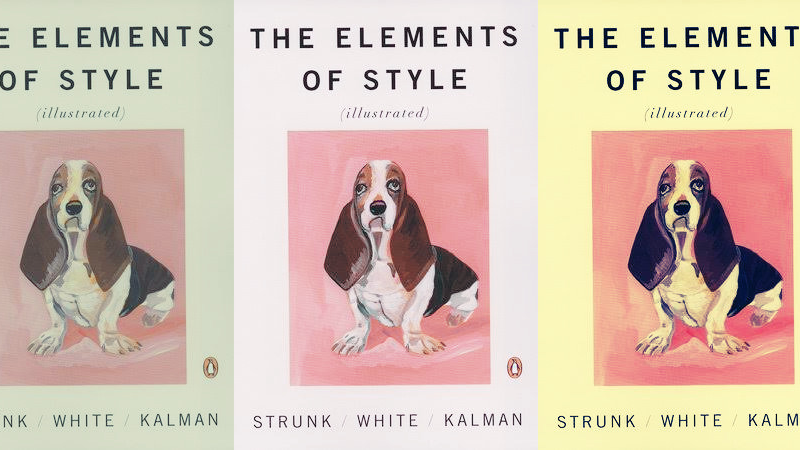
You are no doubt familiar with the little book, the style guide first written and privately printed in 1918 by William Strunk Jr. This book was later updated and expanded by Strunk’s former student, E.B. White, and it has continued to evolve with multiple editions, including the one that contains the depiction of Chloë. The edition I have is illustrated by Maira Kalman, who manages to make painting look as simple as the clean, clear writing Strunk and White espouse.
Use the active voice. Omit needless words. Do not overstate. These are just a few of their admonishments.
Dorothy Parker famously said of this book, “If you have any young friends who aspire to become writers, the second-greatest favor you can do is present them with copies of The ‘Elements of Style.’ The first-greatest, of course, is to shoot them now, while they’re happy.”
I was deep in that unhappy place Dorothy was referring to. I wasn’t going to shoot myself, but I did want to stop writing and immerse myself in shapes and colors. I wanted to paint this sweet baby. It wasn’t just about Chloë. I wanted to learn to paint each of the dozens of impossibly colorful, whimsical, brilliant illustrations in this book, including the droopy eared, sad-eyed Basset Hound who even addressed me directly: “Well, Susan, this is a fine mess you are in,” the caption reads, in reference to a particular use of commas that I could not have cared less about.
I did not talk about my fine mess: my empty nest, my flailing, i.e. failing, novel, my what-to-do-with-the-rest-of-my-life middle-aged crisis.
I signed up for a painting class at a community center, where I spent a few months trying to paint a bowl of pears. My attempts were a shonda—Yiddish for a disgrace. My pears were bulbous, disfigured, likely mutant. A kindergartener could have done a better job. The instructor tried to guide me, to no avail. After a few weeks, sensing my frustration, he politely suggested that before I learn to paint, I should learn to draw.
This bit of guidance led me to the studio of a private instructor. Upon my arrival, she looked at the book in my hand, bookmarked to Chloë-the-good-smelling-baby, and said, “Oh! So you want to paint like Maira Kalman!” And then she began to laugh.
I didn’t see what was so funny. Sure, the pears had not gone especially well, but how hard could it be to draw, then paint, a baby? A big round face, two eyes, a nose, a mouth. For the love of God, the angle captured in the book only required the rendering of one ear!
But more to the point: Maira Kalman? How was it possible that I had been staring, awestruck, at these illustrations without asking myself who Maira Kalman was— an acclaimed writer and artist who has published over 30 books and illustrated many New Yorker covers, a few of which I loved so much I had set them aside to savor. Her work is exhibited around the world. It was akin to wanting to write Mrs. Dalloway without realizing the iconic status of Virginia Woolf.
To use the sort of overstatement that would make Strunk and White break out in hives, the discovery of Maira Kalman would change my life.
Let’s begin by drawing a pencil, the instructor politely suggested.
Touché.
I spent a few weeks working hard on the pencil. I enjoyed the time in the quiet, sunny studio, aspiring to be a person who could first draw, then paint a pencil. The instructor and I spoke only about drawing-the-pencil-related things. There was no friendly chit-chat. I did not talk about my fine mess: my empty nest, my flailing, i.e. failing, novel, my what-to-do-with-the-rest-of-my-life middle-aged crisis.
The pencil was not going well. I had clearly rendered an object that was at least pencil-adjacent, although it could have been mistaken for an AAA battery, a missile, or worse. Even if correctly identified, there was no denying my underlying lack of talent. Replicating this baby, never mind the even more artistically complex Bassett Hound, was an ever-receding fantasy.
One day, the instructor said something that I interpreted as a breakup line, an it’s-not-you-it’s-me kind of thing. She said she had read something of mine, and that she could see why I was drawn to these illustrations. Perhaps someone with more confidence might have heard this as encouragement to keep trying, but I interpreted her comment as a polite way of saying that I could sit here for another ten years and never acquire the ability to draw that pencil well.
Epiphanies do not drop from the sky—they are the product of random and subjective inputs filtered through what we want or need to hear. At that moment, I thought I heard the instructor telling me to return to my novel, to infuse it with all of the focus and energy I had been pouring into my sad pencil.
The point is clear, elegant writing, of course, but equally important is to think and write visually.
Which is precisely what I did. I went back to my manuscript and began again. This time I tried to render each scene as a vivid illustration. Schmaltzy and reductive as it sounds, if I couldn’t paint with a brush, I would paint with words. For the first time in my writing life, I could actually see my characters—the color of a dress, the precise shade of lipstick, the floorplan of a house, an animal’s coat. I felt that spark return, my pilot light reignite.
My adoration for Maira Kalman’s work has continued to deepen to a somewhat embarrassing degree. Her illustrations are screensavers on my computers, inspiring me as I write. This summer, two of my daughters gave birth just a few weeks apart, and when I realized that the image on my computer—the one that had belonged to my mother before she passed away—was a Maira Kalman illustration depicting a cherry pie celebration of a summer birth—I burst into tears. A full circle of life right there on my desk.
A character in my newest novel is similarly obsessed; among the too many things she is always carrying around is Maira Kalman’s remarkable Women Holding Things book which, true to its name, features paintings, as well as self-described ruminations and digressions about women captured in the act of holding things: an irritated woman holding a giant cabbage, for example, or a woman holding a pink ukulele under a giant cherry tree, or a woman holding red balloons walking through the park.
It is also about women holding things metaphorically. A cluster of women perched in Bertoia chairs outside of what is presumably a museum, holding opinions about modern art. Or, as Kalman writes in the opening pages, they are holding “the home and the family. And the children and the food. The friendships. The work.”
I recently began to teach writing again, and I continue to assign The Elements of Style. I read passages aloud with such reverence that you might think I was quoting a sacred text or reciting from a cherished volume of poetry, although given the proliferation of AI editing tools that not only volunteer to correct grammar, but to rewrite entire chunks of prose, I’m not sure that my students—or anyone for that matter—cares much about The Elements of Style these days.
Nevertheless, I insist that they acquire a copy of the edition illustrated by Maira Kalman. The point is clear, elegant writing, of course, but equally important is to think and write visually. To let one’s mind wander outside the box.
__________________________________
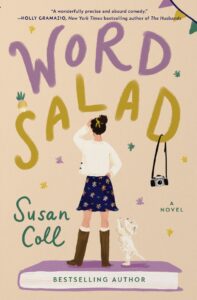
Word Salad by Susan Coll is available from Harper Focus.